
Mitsubishi to build 1,000 humanoids per month
PLUS: AI² Robotics raises $735M, ForSight completes first fully robotic cataract surgery, and UV robots that work at night

Welcome back to your Robot Briefing
Mitsubishi Motors just announced it will mass-produce humanoid robots at 1,000 units per month starting in 2027, turning its Kyoto engine plant into a factory for factory workers. The Japanese automaker signed an MOU with Tokyo startup Highlanders to co-develop bots for its own assembly lines, and potentially sell them to others.
This isn't just another pilot program or proof-of-concept. When a legacy automaker commits manufacturing capacity to building humanoids at scale, the question shifts from whether these machines can work to whether the unit economics actually pencil out at volume.
In today's Robot update:
Mitsubishi Motors to mass-produce humanoid robots at 1,000 units per month
Snapshot: Mitsubishi Motors signed an MOU with Tokyo startup Highlanders to co-develop humanoid robots for its own factories and potentially mass-produce them at 1,000 units monthly starting in 2027 at its Kyoto engine plant. This marks the first announced partnership between a carmaker and robotics startup explicitly targeting high-volume humanoid manufacturing, not just deployment.
Breakdown:
Takeaway: A tier-two automaker committing to mass production infrastructure shifts the conversation from "testing humanoids" to "building an industry." If Mitsubishi hits its 2027 timeline, operations leaders will face procurement decisions about humanoid suppliers in the near future, within 18-24 months.
AI² Robotics raises $735M at $2.8B valuation for wheeled humanoid robots
Snapshot: Shenzhen-based AI² Robotics secured $735 million at a $2.8 billion valuation from a mix of Chinese government funds, industrial corporations, and financial firms to scale production of its AlphaBot wheeled humanoid equipped with a proprietary vision-language-action model. The company deliberately chose wheels over legs to reduce costs, improve durability, and avoid regulatory barriers in logistics, manufacturing, biotech, and retail environments.
Breakdown:
Takeaway: The wheeled design choice and $2.8 billion valuation suggest the market is splitting between technically impressive legged robots and commercially pragmatic wheeled systems for structured environments. Operations leaders should evaluate whether their facilities actually need legs or if wheels with lifting mechanisms deliver 80 percent of the value at a fraction of the complexity.
ForSight Robotics completes first fully robotic cataract surgery from start to finish
Snapshot: ForSight Robotics' JASPER Platform completed a robot-assisted cataract surgery in a human patient in Manila, handling every step from initial incision to closure rather than partial tasks. The procedure was controlled by a skilled surgeon with AI-assisted mistake prevention, not autonomous operation, addressing the global shortage of trained ophthalmic surgeons.
Breakdown:
Takeaway: Full-procedure robotic surgery in a high-volume specialty like cataracts signals that surgical robotics is moving from niche applications to scalable solutions for workforce shortages, with clinics in surgeon-scarce regions the most likely early adopters.
TRIC Robotics raises $5.5M to deploy UV-light pest control robots that work while farmers sleep
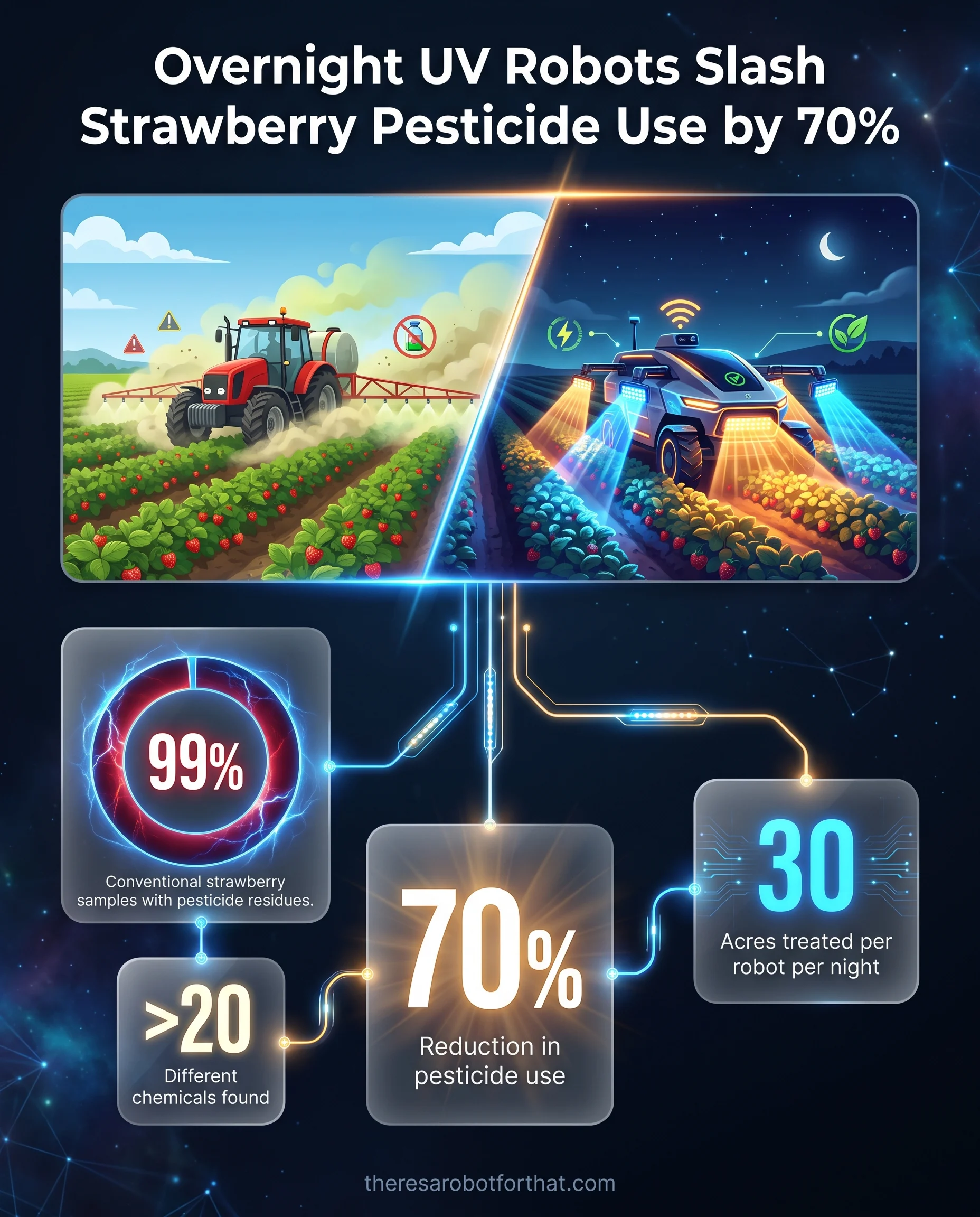
Image Source: There's A Robot For That
Snapshot: San Luis Obispo-based TRIC Robotics closed a $5.5 million seed round led by Version One Ventures to expand autonomous robots that treat strawberry fields with UV-C light at night, reducing pesticide use up to 70 percent. The company operates nine robots across hundreds of acres in California's Central Coast with a service model where farmers pay per treatment rather than buying equipment.
Breakdown:
Takeaway: The product-market fit is nearly perfect: robots work off-hours, eliminate labor scheduling conflicts, and deliver chemical reduction without requiring behavior change from farmers. Operations leaders in agriculture or other 24-hour facilities should examine whether their overnight downtime represents untapped opportunity for robotic systems that complement rather than compete with existing workflows.
Other Top Robot Stories
Brave1 launched a grant competition to develop bipedal robots built exclusively for military use, making Ukraine's state defense-tech cluster the first government to fund combat humanoids as a distinct procurement category, with breakthrough projects eligible for over 100 million hryvnias as factory-proven platforms get tested against GPS-denied, jamming-heavy trench terrain.
1X unveiled advanced hands for its Neo humanoid featuring 25 actuated degrees of freedom and tendon-driven motion with high-resolution tactile sensors, plus IP68 sealing that allows the robot to perform tasks like cooking and self-cleaning in household environments.
Medicaroid received the CE mark for its Hinotori surgical robot system, authorizing the Kawasaki-Sysmex joint venture to compete with Intuitive Surgical across urology, general surgery, gynecology and thoracic procedures in Europe, the Middle East and Africa.
Stereotaxis completed its acquisition of French surgical robotics company Robocath in a deal valued at up to $45 million, combining expertise in robotic magnetic navigation and endovascular interventions to accelerate development for electrophysiology and interventional cardiology procedures.
Deploying humanoids this year? Our free Facility Readiness Checklist walks your site before the robot arrives, 77+ items, one complete toolkit module.
🤖 Your robotics thought for today:
Mitsubishi is converting an engine plant to build 1,000 humanoids monthly. AI² just raised $735M for wheeled bots that can't climb stairs. One chose manufacturing scale over perfection, the other chose practicality over capability. The companies betting biggest aren't chasing the most impressive demos—they're solving for unit economics and deployment speed.
Which strategy actually scales?
Until Wednesday,
Uli


