
1X launches World Model Lab for humanoid autonomy
PLUS: BYD enters humanoid robotics with dealer sales, Figure 03 lands first major retail commercial deal, and US Army backs stealthy robotic logistics trucks

Welcome back to your Robot Briefing
1X Technologies just spun up a dedicated lab to build AI world models that let humanoid robots learn new tasks on the fly — no retraining required. The Norwegian startup hired a founding researcher from Luma AI after its NEO bot proved it could tackle completely unfamiliar work autonomously.
If they crack it, we're looking at robots that adapt like humans instead of needing months of fine-tuning for every new job. The real question: can world models scale fast enough to make general-purpose humanoids commercially viable, or will they hit the same wall that's kept AI robotics stuck in the lab?
In today's Robot update:
1X launches World Model Lab to scale humanoid autonomy
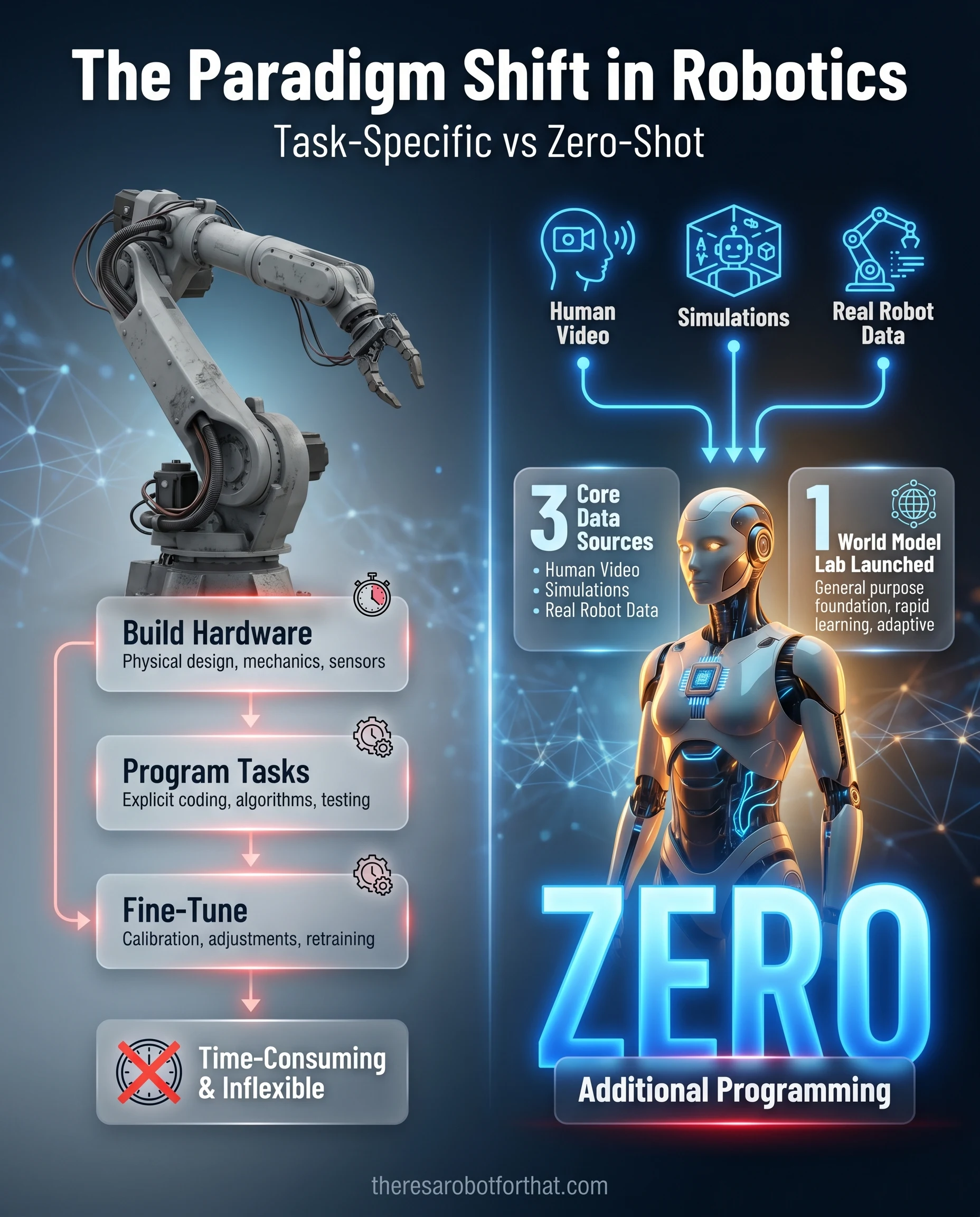
Image Source: There's A Robot For That
Snapshot: 1X Technologies launched a dedicated lab to develop large-scale AI models for autonomous humanoids, hiring a founding researcher from Luma AI after internal breakthroughs enabled their NEO robot to execute completely new tasks without additional training.
Breakdown:
Takeaway: A major robotics company is betting its roadmap on pretraining foundation models rather than programming specific tasks — the same architectural shift that unlocked ChatGPT's capabilities. If 1X is right about zero-shot execution, the timeline for general-purpose humanoids just compressed significantly, because each robot learns tasks without custom engineering.
BYD enters humanoid robotics, plans dealer network sales
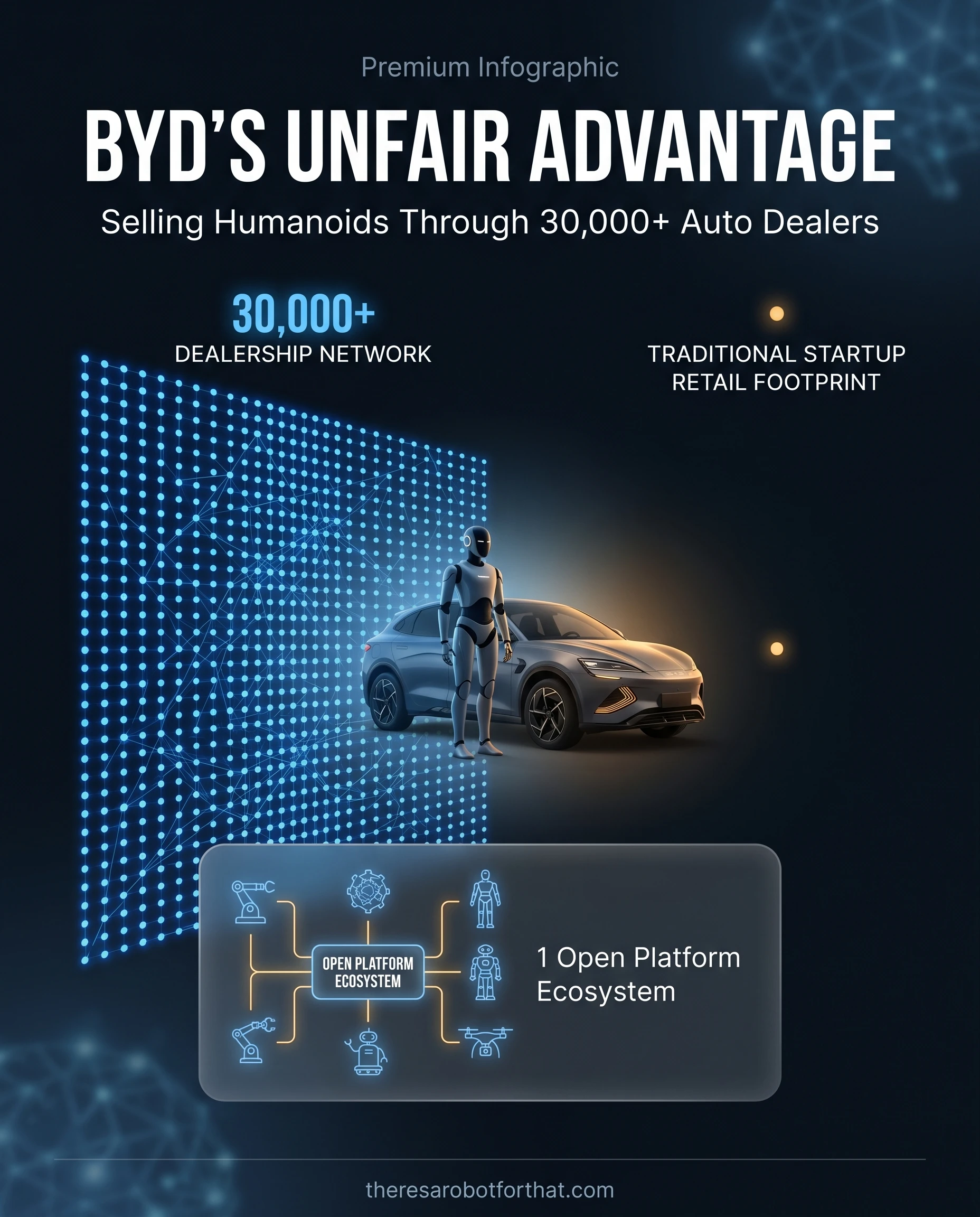
Image Source: There's A Robot For That
Snapshot: Chinese EV giant BYD confirmed it's developing humanoid robots for household use and plans to sell them through its automotive dealer network, while building an open platform that works with both BYD-developed and third-party robots.
Breakdown:
Takeaway: An automaker with proven manufacturing scale and a 30,000+ dealer network entering humanoids signals the market is moving beyond tech startups to industrial players with distribution advantages. BYD's open platform approach suggests they're positioning robots as consumer products sold alongside cars, not niche industrial equipment.
Figure AI lands first commercial humanoid deal with JCPenney parent Catalyst Brands
Snapshot: Figure AI signed a commercial agreement with Catalyst Brands, parent of JCPenney, Brooks Brothers, Aéropostale, Lucky Brand, and Nautica, to deploy Figure 03 humanoid robots at a 1.7 million square foot Reno distribution center, marking one of the first real commercial humanoid contracts with a major U.S. retailer.
Breakdown:
Takeaway: A first signed commercial agreement with a major retail conglomerate moves humanoid robots from "interesting demo" to "line item in a logistics budget." Operations leaders evaluating warehouse automation should note that the retail use case Figure picked, high-volume sorting and packing, is exactly where labor costs and turnover hurt the most, and where humanoid economics start working before they make sense in skilled assembly.
US Army backs stealthy robotic logistics trucks to solve battlefield supply gap
Snapshot: The US Department of Defense contracted American Rheinmetall and Harbinger to develop autonomous, hybrid-electric military cargo trucks designed to be affordable, expendable, and stealthy enough to operate in combat zones, reducing soldiers' manual supply hauling.
Breakdown:
Takeaway: Military logistics faces the same last-mile problem as commercial operations — eventually humans must manually carry supplies the final distance — but with higher stakes and willingness to pay for solutions. The Pentagon's emphasis on mass-producible and affordable autonomous vehicles suggests defense applications will drive down costs and prove reliability faster than waiting for consumer robotics to mature.
Other Top Robot Stories
Medtronic requested FDA clearance for its Hugo robotic surgery system in general and gynecological procedures, positioning the medical device giant to challenge Intuitive Surgical's dominance in hernia repair and other key surgical applications beyond the urologic procedures already approved in December.
JAKA unveiled Pi, a compact 1.22-meter humanoid weighing 42 kilograms with 27 degrees of freedom, marking the Shanghai-based collaborative robot maker's expansion into intelligent robotics with an open SDK platform targeting labs, schools, and office environments.
GlobalFoundries completed its acquisition of Synopsys' ARC Processor IP Solutions business, combining it with MIPS to deliver a software-to-silicon capability for Physical AI spanning RISC-V processor IP, custom design, and advanced manufacturing for automotive and industrial robotics applications.
Niqo announced its AI-powered agricultural weeding robotics business is on track to achieve profitability in its first full year of commercial operations, a rare milestone in agri-robotics driven by a one-time purchase model with no subscription fees and deployment across farms in India and the United States.
🤖 Your robotics thought for today:
1X just hired a Luma AI researcher and spun up a whole lab because their NEO bot handled brand-new tasks without any training. That's the zero-shot execution bet — same architecture shift that made ChatGPT work. If they're right, we just skipped years of task-specific programming. I'm watching whether other humanoid makers follow this playbook or double down on fine-tuning.
Enjoy your weekend,
Uli


