SoftBank Puts $200 Million Into Autonomous Excavators
A robot-safety startup goes public, humanoid skin gets acquired, and a $30-an-hour robot maid that turns out to be human-driven.
The Big Number
$200 million, all from a single backer, is the largest Series A ever raised by a construction-robotics company.
Welcome back to your Robot Briefing
This week the money in physical AI moved toward the unglamorous parts of the stack: the machines that already exist, the safety layer that keeps them from hurting anyone, and the sensors that let a robot feel what it is holding.
Four deals, one theme. The humanoid story is quietly turning into an industrial-supply-chain story, and the operators who come out ahead will be the ones asking harder questions about safety and about data.
The 60-Second Read
SoftBank put $200 million into Gravis Robotics, the largest Series A ever in construction robotics, to turn ordinary excavators autonomous.
FORT Robotics is going public through a SPAC at a $556.6 million enterprise value, betting that robot safety is its own market.
Uni-Chem bought e-skin maker Loomia as tactile sensing becomes a distinct layer in the humanoid supply chain.
Tau Robotics' $30-an-hour home-cleaning humanoid is teleoperated, and the real product is the data it collects.
News
SoftBank hands a Swiss startup $200 million to automate excavators
Snapshot: Gravis Robotics raised $200 million from SoftBank at a $1 billion valuation, the largest Series A ever in construction robotics, with SoftBank as the sole investor.
Breakdown:
The Zurich company, spun out of ETH Zurich in 2022 and led by CEO Ryan Luke Johns, sells autonomy kits that bolt onto excavators and heavy equipment already on site, rather than building new machines.
Its software is pitched as manufacturer-agnostic, running across kit from Caterpillar, John Deere, JCB and Hitachi, so buyers are not locked into one brand.
The roughly 75-person team has deployed across four continents and recently won an $8 million contract to retrofit excavator fleets in the UK.
Gravis frames the raise around a construction sector short on labor and racing to build the roads, grids and housing that the AI infrastructure boom demands.
Takeaway: The interesting part is the business model, not the check. Retrofitting autonomy onto equipment a contractor already owns turns a seven-figure machine purchase into a software upgrade, which is a far easier sell to a cautious operator than a brand-new robot. If the retrofit approach holds up across real sites, it is a template every heavy-industry vendor will want to study.
News
A robot-safety company bets the public market wants a Trust layer
Snapshot: FORT Robotics agreed to merge with Newbury Street II Acquisition Corp, a SPAC, in a deal that values the combined company at a $556.6 million enterprise value and takes it public on Nasdaq.
Breakdown:
The combined business will be named FORT Robotics Holdings and trade under the ticker FROB, pending approvals, on a pre-money equity value of $500 million.
Founded in 2018, FORT builds what it calls the Trust layer for physical AI: safety controllers, wireless emergency stops and access controls that sit between a robot and the people around it.
It claims more than 600 customers, including Agility Robotics, Google DeepMind, Zoox, Ocado and DoorDash, and counts Tiger Global, Mark Cuban Companies and Prologis Ventures among its backers.
The pitch is that as humanoids and mobile robots move onto shared floors, someone has to certify that the stop button actually stops the machine.
Takeaway: Safety is becoming a product line, not a checkbox. A robot vendor can promise autonomy, but the liability question of who guarantees the machine halts when a person steps in front of it is now valuable enough to list on Nasdaq. For operators, that is a signal to treat the safety stack as a named line item in any humanoid contract, not an afterthought bundled in with the robot.
⏱️ The Compliance Clock
When a humanoid or mobile robot shares a floor with people, the standards that matter most are the functional-safety ones: ISO 13849 and IEC 62061 define how reliably a machine's safety functions, its emergency stop, its speed and force limits, actually have to perform. They are rated in Performance Levels or Safety Integrity Levels, and a buyer is expected to have that rating documented before the robot ever moves. FORT Robotics is now floating on Nasdaq on the bet that certifying exactly this layer is a business in itself.
News
The race to give humanoids a sense of touch just consolidated
Image Source: There's A Robot For That
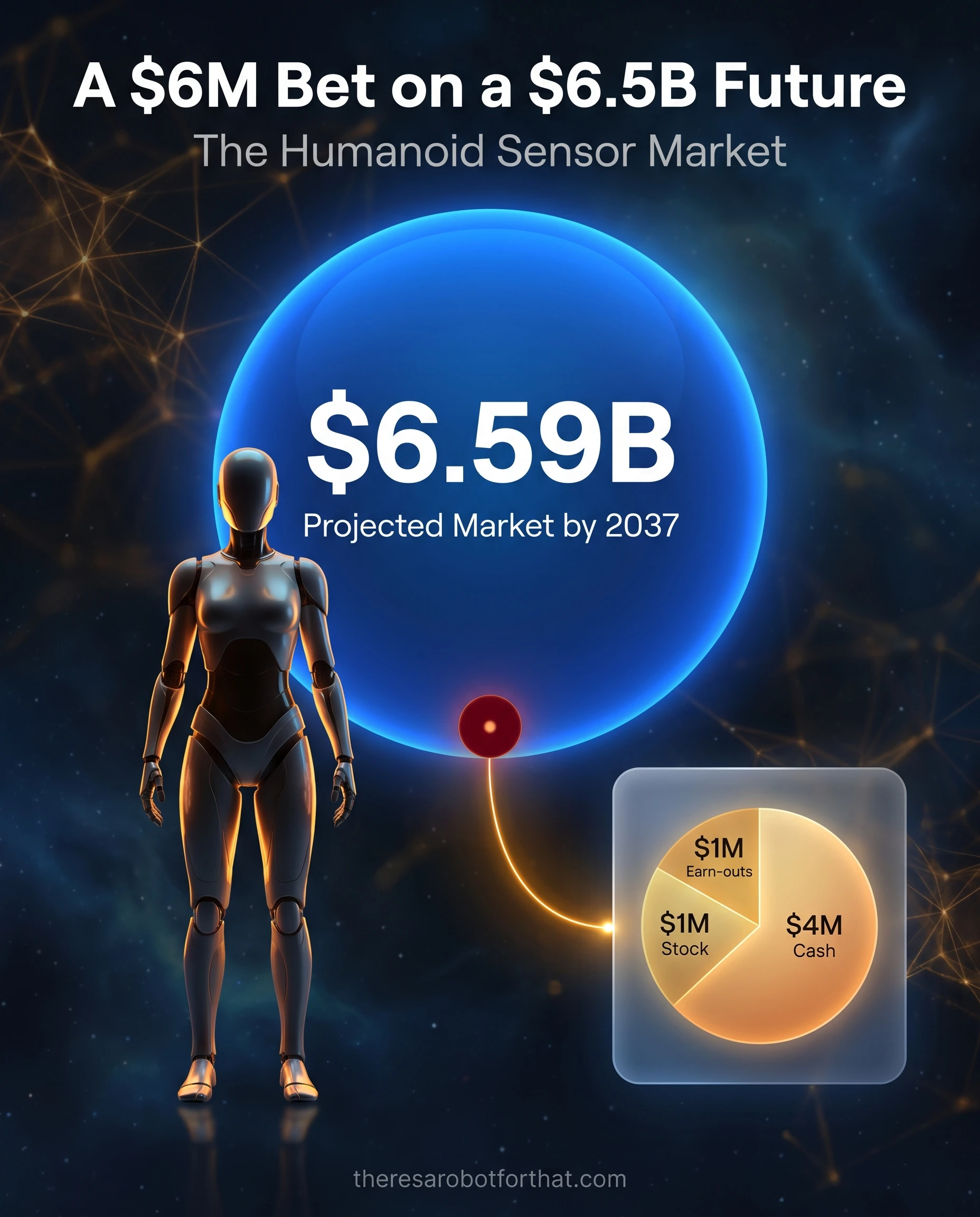
Snapshot: Materials maker Uni-Chem acquired Brooklyn e-skin startup Loomia for about 8.6 billion Korean won, roughly US$6 million, to move into tactile sensing for humanoid robots.
Breakdown:
The deal is structured as $4 million in cash, $1 million in Unichem stock and $1 million in earn-outs, with closing expected in mid-October.
Loomia, founded in 2014 by Stanford graduate Madison Maxey, bonds circuits to flexible materials so a robot's surface can register pressure and force the way skin does.
Loomia's foundry partner R&Y is co-developing sensors that read both vertical pressure and shear force, with engineering samples due in early 2027.
IDTechEx projects the sensor market for humanoid robots, spanning cameras, lidar, force-torque and tactile, will reach US$6.59 billion by 2037, and touch is the layer still missing at scale.
Takeaway: Vision got humanoids to the demo stage, but manipulation, the ability to pick up something soft or fragile without crushing it, depends on touch. When a materials company buys a sensor startup to become a component supplier to the robot makers, it tells you where the durable value is settling: not only in the finished robot, but in the parts every robot maker will have to buy.
News
The $30 robot maid is real, and a human is driving it
Image source: CHOSUNBIZ
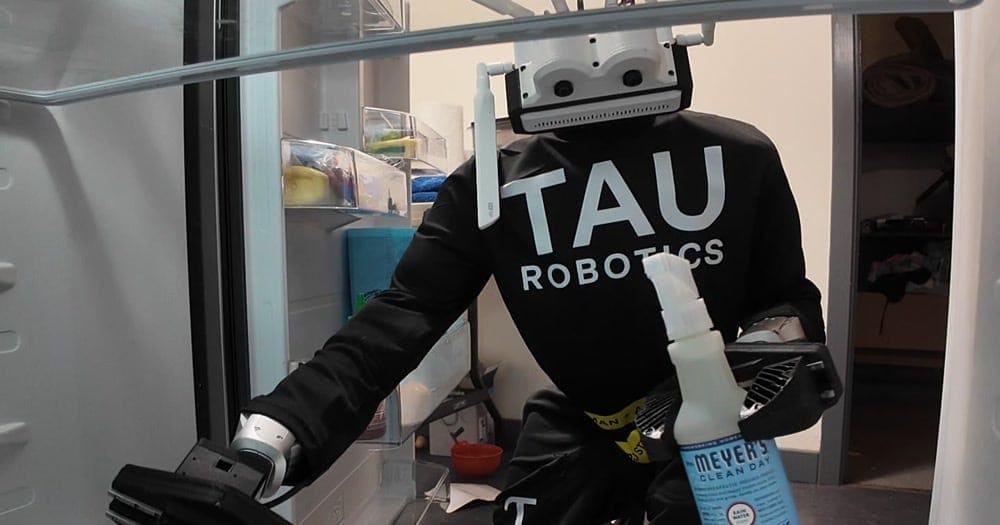
Snapshot: US startup Tau Robotics began charging $30 an hour, about 42,000 won, for an in-home humanoid cleaning service in San Francisco, where a trained operator steers the robot in real time.
Breakdown:
The humanoid vacuums, wipes counters, picks up dropped items and empties bins, while an employee watches its camera feed and controls it and an AI system assists with the motion.
Tau's real product is the mess: hours of unscripted home footage that are hard to capture any other way and valuable for training motion-learning models.
Tesla and Figure are chasing the same real-world data, and Chinese firms are running large data factories that pair human operators with machines to capture motion at scale.
In Korea, LG Electronics and Samsung are building dedicated training facilities to feed their own humanoid programs.
Takeaway: The near-term humanoid economy runs on people. Teleoperators generate the demonstrations that the models learn from, which means today's autonomous home robot is often a remote-controlled one with a data meter running. For anyone weighing a humanoid pilot, the useful question is not whether it works in the demo, but how many humans are in the loop and who ends up owning the data it records.
▶ Operator's Playbook
Before signing any humanoid or mobile-robot pilot this quarter, ask the vendor two things in writing: the Performance Level or SIL rating of the machine's safety-stop function, and how many teleoperators sit behind an autonomous demo, plus who owns the data those operators generate. Then model one number: the fully loaded cost of a human in the loop per robot-hour against the vendor's quoted autonomous rate. If the gap is wide, the robot is a data-collection tool wearing an autonomy label, and you should price the contract accordingly.
Other Top Robot Stories
Ambi Robotics and Pickle Robotconnected their robots to fully automate package flow from trailer unloading through pallet stacking and warehouse receiving, using existing dock infrastructure.
Seeing Machineslaunched a platform that extends its driver-monitoring computer vision into spatial awareness for collaborative robots and humanoids.
University of Essex spin-out Versatile RobotXraised £1 million to commercialise agricultural robots that pick crops in the field.
HDT Robotics' Hunter Wolfheads to evaluation with the US Army's 82nd Airborne Division, an uncrewed ground vehicle rated to carry a 2,800-pound payload.
JD.comopened a stack , from its EgoLive human-demonstration data to shared robot bases, pitching an open ecosystem for China's robot industrialization.
Trossen Robotics and Stereolabspartnered , the Ouster subsidiary supplying calibrated stereo-vision rigs to speed high-fidelity data collection for training physical AI.
Seoul National Universitylaunched an institute to concentrate its physical AI research as Korea scales up its national humanoid push.
Compliance tool
Where does your robot documentation stand?
The ISO 10218:2025 Gap Analysis Checklist finds every gap in 62 audit questions.
The flashiest robot this week was a $30 house cleaner in San Francisco, and the quiet truth is that a person was driving it from another room. Most of what looks like autonomy right now is a rehearsal, with humans feeding the machines the experience they do not yet have. That is not a knock on the robots. It is worth remembering that the future is arriving with a lot of people still holding the controller.