
Bezos's Prometheus raises $12B for artificial general engineer
PLUS: Barcelona's Theker lands Europe's largest robotics Series A, wheeled vs legged humanoids debate intensifies, and Rivian CEO's separate $1B robotics company

Welcome back to your Robot Briefing
Jeff Bezos just placed a $12 billion bet on software that replaces engineers — not factory workers, but the people designing jet engines and pharmaceutical processes. Prometheus closed a $12 billion funding round at a $41 billion valuation, making it one of the most richly valued AI startups ever funded and one of the largest single bets on the physical AI sector., and it's targeting the brains behind manufacturing, not just the hands.
The question isn't whether AI can automate blue-collar tasks anymore. It's whether entire engineering departments become optional when software can handle complex design and production workflows end-to-end.
In today's Robot update:
Jeff Bezos's Prometheus raises $12B to build 'artificial general engineer' for physical world
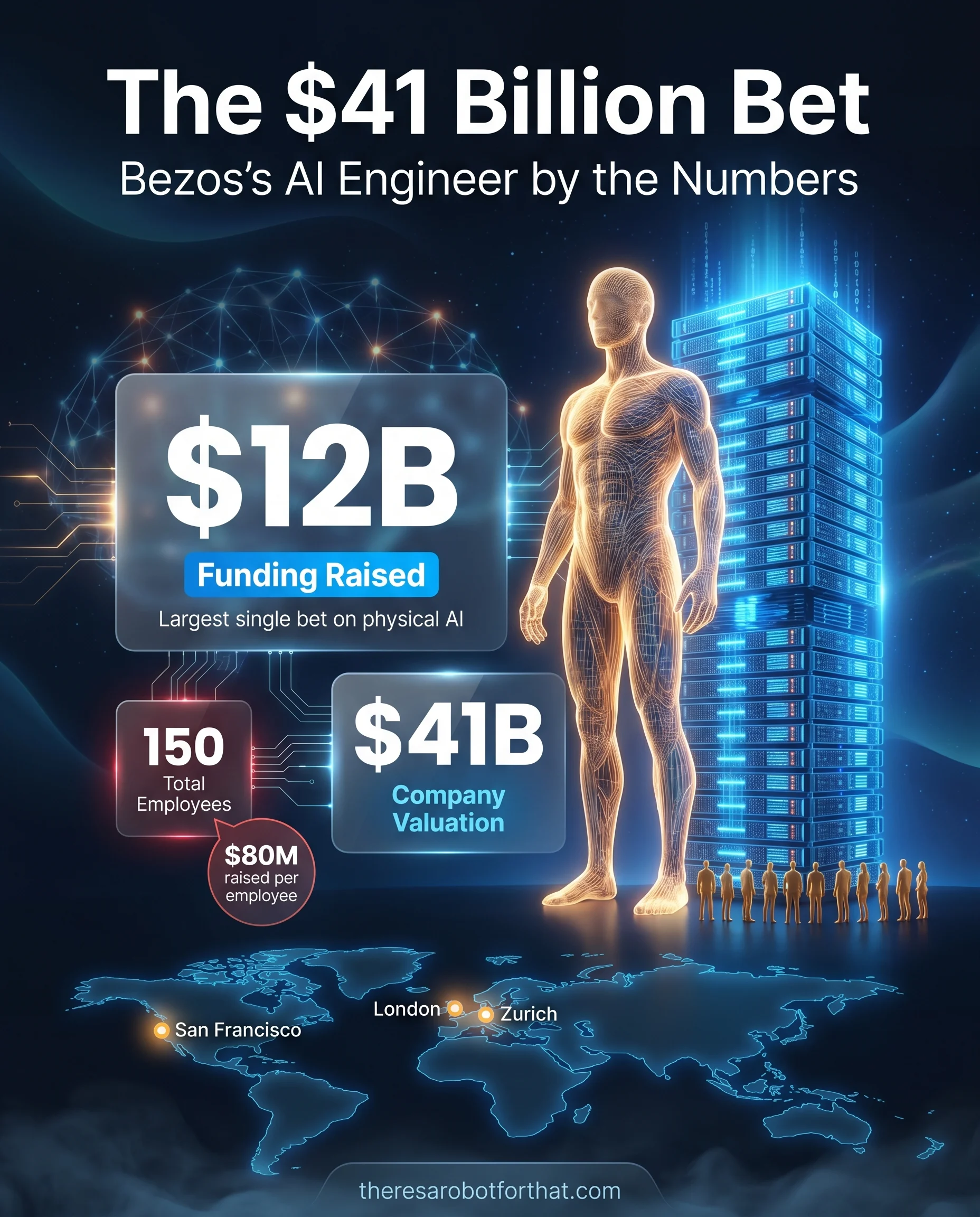
Image Source: There's A Robot For That
Snapshot: Prometheus, Jeff Bezos's physical AI startup, just closed $12 billion at a $41 billion valuation to build software that automates complex engineering and manufacturing tasks — from jet engines to pharmaceuticals. This is the largest bet on physical AI to date, and it's not about robots on factory floors; it's about replacing engineering work itself.
Breakdown:
Takeaway: The $41 billion valuation signals investor belief that automating engineering work — not just manufacturing tasks — is the next frontier, with implications far beyond robotics. Companies evaluating automation strategies should watch whether Prometheus delivers actual products or becomes a cautionary tale about capital chasing ambition without proof points.
Barcelona's Theker raises Europe's largest robotics Series A at $85M
Snapshot: Spanish startup Theker just closed an $85 million Series A — Europe's largest robotics Series A on record — to build factory robots that reconfigure themselves for different tasks rather than specializing in one job. Backers include CRV, Samsung, and Bernard Arnault's investment vehicle, signaling serious interest from both manufacturing and luxury retail.
Breakdown:
Takeaway: The generalist approach matters because it addresses automation's biggest operational hurdle: most manufacturing processes require flexibility, not just speed. Operations leaders facing labor constraints should note that reconfigurable systems may finally offer ROI without the multi-year retooling timelines traditional robotics required.
Humanoid robotics companies debate whether wheels beat legs
Snapshot: Diligent Robotics has deployed wheeled humanoid robots Moxi and Roxi across more than 25 health systems, where they complete dozens of hospital tasks daily — raising a fundamental question about whether bipedal humanoids are even necessary for human-designed environments. The machines deliver lab samples, medications, and supplies while navigating elevators and hallways, all without the complexity of walking.
Breakdown:
Takeaway: This challenges the prevailing narrative that humanoids must walk to succeed in human environments. Companies evaluating robotics investments should focus less on whether robots look human and more on whether they solve specific workflow problems with technology that's deployable now, not in three years.
Rivian CEO launches Mind Robotics with $1B+, taking different path than Musk
Snapshot: Rivian CEO RJ Scaringe started a separate robotics company called Mind Robotics that has raised over $1 billion, keeping it independent from the automaker rather than integrating robotics into the vehicle business like Tesla's approach. Rivian will be a large minority shareholder and the launch customer for Mind's first product, expected in under a year.
Breakdown:
Takeaway: The structural choice matters more than the technology: keeping robotics separate preserves focus while creating optionality to serve broader markets if manufacturing use cases prove viable. Executives watching the auto industry's automation push should note that deployment timeline — under a year to first product — as a benchmark for when factory humanoids might move from prototype to production.
Other Top Robot Stories
FarmDroid featured its FD20 autonomous seeding and weeding robot on Amazon's hit series "Clarkson's Farm," demonstrating GPS-accurate mechanical weeding on Jeremy Clarkson's Diddly Squat Farm as farmers face rising labor costs and sustainability requirements.
Hyperscale confirmed production of its first 30 OPR-R2 humanoid robots through subsidiary Omnipresent Robotics, targeting Q3 2026 deployment at its Michigan AI data center as part of a broader 143-unit rollout for embodied AI development and autonomous workflow testing.
Osaka developed a virtual tomato farm simulation that automatically generates labeled training data for agricultural AI systems, addressing the labor-intensive bottleneck of manually labeling crop images by using real-world farm data to create realistic digital environments for robot training.
Essentia unveiled the ROSA Knee System at its St. Mary's-Detroit Lakes hospital, offering robot-assisted knee surgeries with real-time anatomical data and customized implant fitting to reduce post-surgery pain, recovery times, and infection risk through minimally invasive procedures.
🤖 Your robotics thought for today:
Bezos just wrote a $12 billion check for software that replaces engineers, not assembly line workers. Meanwhile Diligent's wheeled robots are already running hospital logistics at 25+ health systems. One's a $41B valuation with zero disclosed product. The other's solving actual problems today with wheels instead of legs.
Which approach ships first?
Until Wednesday,
Uli


