
Figure's robots sort 50,000 packages in 40-hour livestream
PLUS: Schaeffler's thousands of humanoids by 2032, surgical robots repair 100-micron vessels, and UK military's autonomous microfactories

Welcome back to your Robot Briefing
Figure AI just wrapped a livestream of its humanoid robots sorting packages for up to eight hours continuously, drawing attention from viewers as skeptics questioned the AI's capabilities. CEO Brett Adcock extended what started as an eight-hour demo into a marathon proof-of-concept after early skeptics questioned whether the whole thing was remote-controlled.
The real test wasn't whether the robots could move boxes—it was whether they could do it repeatedly, autonomously, and at scale without breaking down or needing bailouts. If Figure's claims hold up, we're looking at a turning point for warehouse automation: can humanoids finally match the reliability of traditional systems while adding the flexibility that conveyor belts can't?
In today's Robot update:
Figure's humanoid robots sort 50,000 packages in viral 40-hour livestream
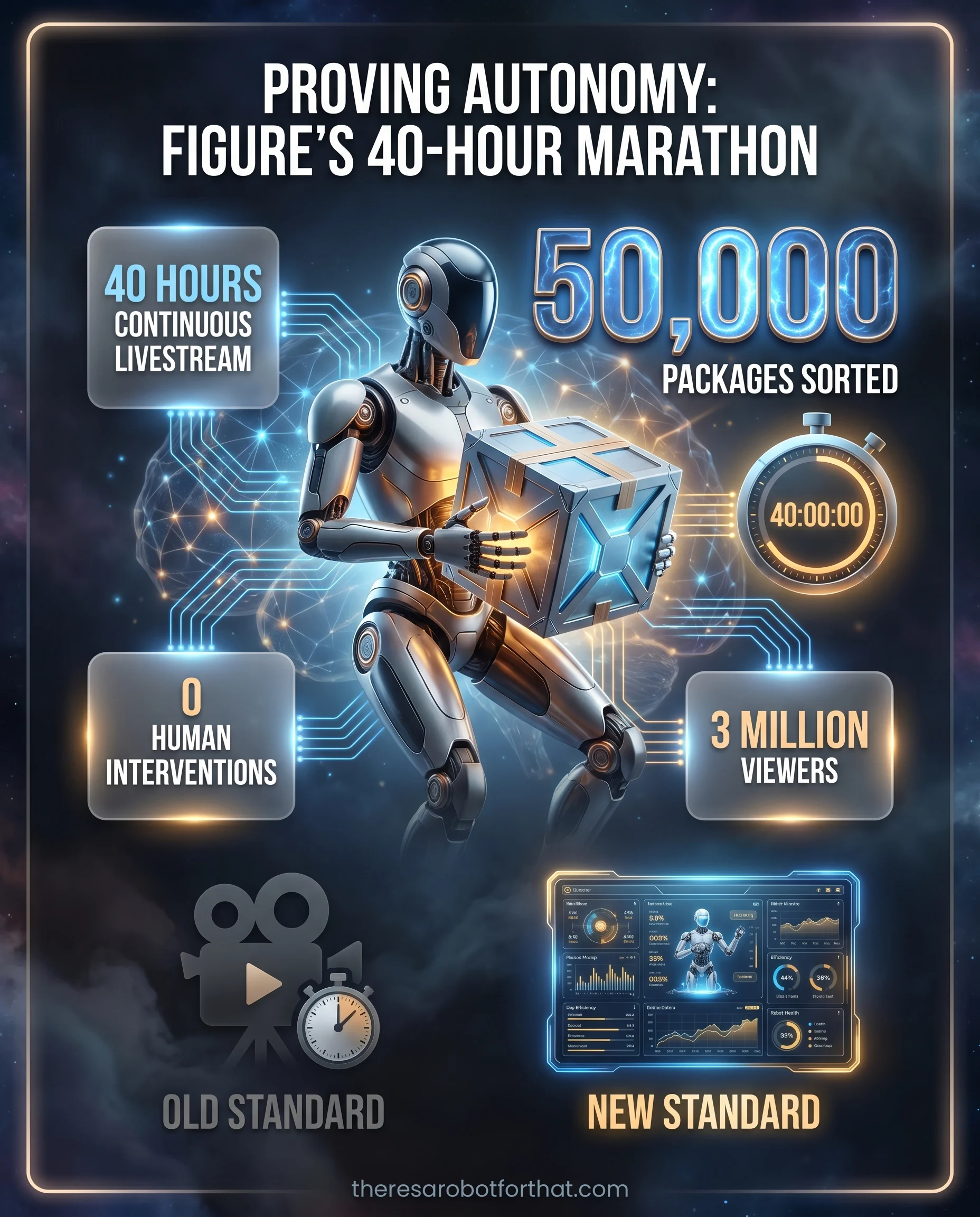
Image Source: There's A Robot For That
Snapshot: Figure AI's humanoid robots sorted packages autonomously for nearly 40 hours in a livestream that drew over 3 million viewers, with CEO Brett Adcock claiming zero failures as skeptics questioned whether humans were remotely controlling the robots. The company extended what started as an eight-hour demo into a marathon session to prove the technology works without human intervention.
Breakdown:
Takeaway: When a robotics CEO needs to livestream for 40 hours to prove the technology works, it signals the market still doesn't trust deployment claims — but also that companies now recognize credibility requires transparent, unedited demonstrations rather than controlled videos. Operations leaders evaluating humanoid pilots should demand similar proof: not what the robot can do in a demo, but whether it can run a full shift without human intervention.
Schaeffler to deploy thousands of humanoid robots across German factories by 2032
Snapshot: UK robotics firm Humanoid signed a binding agreement with German automotive supplier Schaeffler to deploy thousands of humanoid robots globally by 2032, starting with live production environments in Germany by late 2026. The deal includes both a Robot-as-a-Service model and a five-year actuator supply agreement, positioning it as one of the largest disclosed humanoid deployments.
Breakdown:
Takeaway: The RaaS structure matters more than the robot count — it means a major automotive supplier sees humanoids as operational tooling rather than capital equipment, betting on subscription economics over ownership. Mid-sized manufacturers should watch the Herzogenaurach deployment closely: if Schaeffler achieves stable production performance by mid-2027 on live factory floors, the business case shifts from experimental to replicable.
Surgical robots achieve submicron precision in 100-micron blood vessel repair
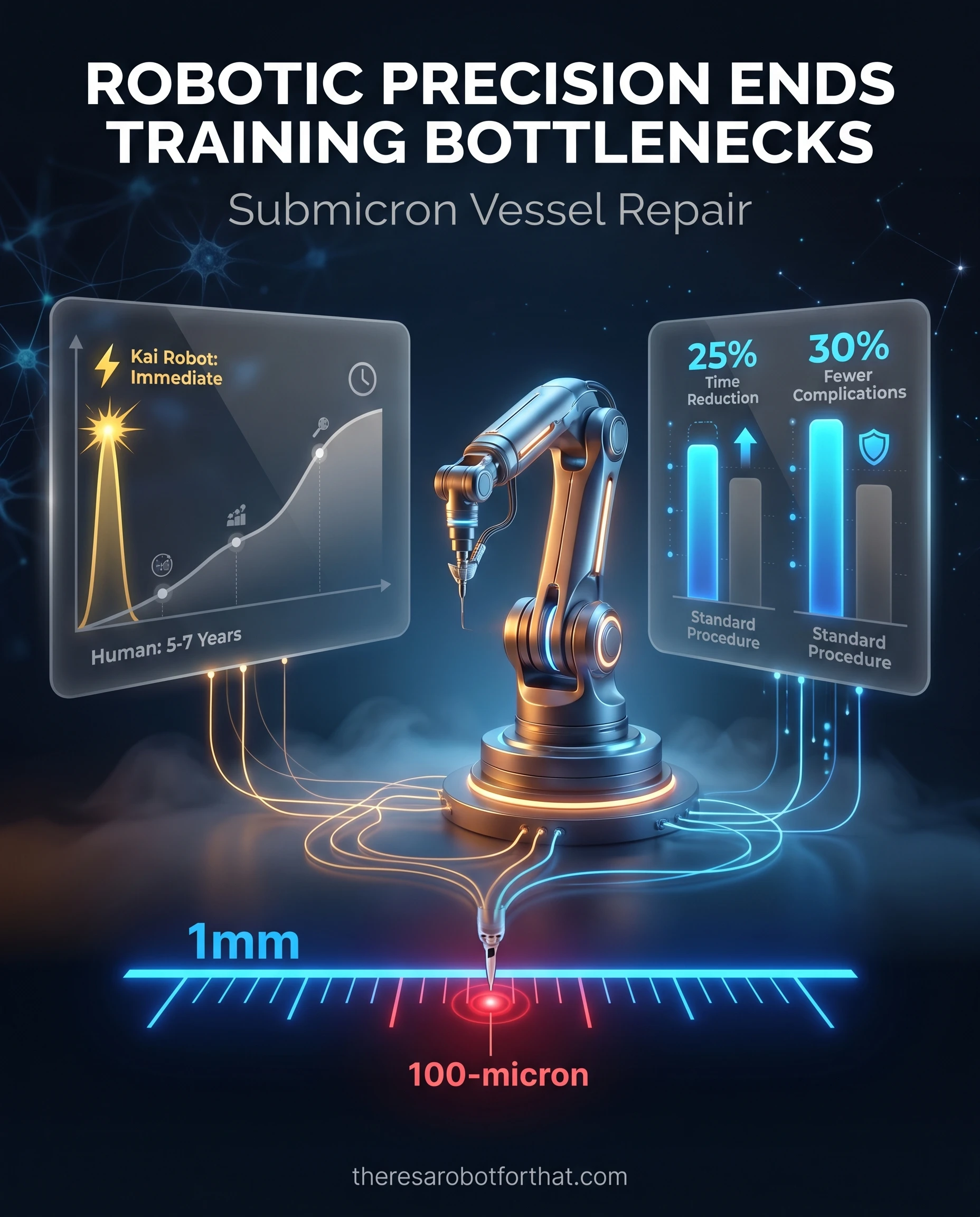
Image Source: There's A Robot For That
Snapshot: KouTech Medical Robotics' Kai system enables surgeons to perform supermicrosurgery on blood vessels one-tenth of a millimeter wide by filtering tremors and scaling movements to submicron precision. The technology addresses a critical bottleneck in reconstructive procedures that previously required five to seven years for surgeons to master, with clinical trials now underway at Chinese hospitals.
Breakdown:
Takeaway: This represents industrial automation logic applied to surgery: find the highest-skill bottleneck with the longest training time, then deploy robots that compress years of learning into programmable precision. Healthcare operations leaders should monitor whether clinical outcomes justify adoption costs, particularly as the technology moves from elite reconstructive centers to broader surgical applications where precision and consistency drive volume economics.
UK military backs microfactory robots that finish 3D-printed parts autonomously
Snapshot: Rivelin Robotics, supported by the UK Defence Science and Technology Laboratory, developed microfactory systems with human-like dexterity that automate the manual finishing of 3D-printed defense components. The technology enables on-demand manufacturing for naval operations while expanding into five commercial customers across aerospace, medical, and energy sectors in Europe and the US.
Breakdown:
Takeaway: The defense use case reveals the business logic: when supply chain delays cost more than automation, robots become procurement strategy rather than manufacturing efficiency. Companies managing high-value, low-volume parts with long lead times should evaluate whether microfactory economics work for their constraint points — particularly where manual finishing creates bottlenecks that delay production or reduce part consistency across batches.
Other Top Robot Stories
X-Humanoid unveiled a bionic face prototype with artificial skin and hair at its Beijing facility, as China accelerates humanoid development to address its aging population — with over 100 robots completing this year's Beijing half-marathon compared to just six finishers in 2025.
GEAIR deployed intelligent breeding robots that cut tomato development cycles from five years to one year and reduced soybean pollination time by 76.2%, as China's agricultural mechanization rate reaches 76.7% and technology contributes over 64% to output growth.
Jogyesa ordained a 51-inch humanoid named Gabi as an honorary Buddhist monk at Seoul's main temple on May 6, marking the first robot to take Buddhist vows and serve as a high-tech mascot during celebrations leading to Buddha's Birthday on May 24.
🤖 Your robotics thought for today:
Figure livestreamed for 40 hours because the default assumption is still that humanoid demos are fake. Schaeffler just committed to thousands of robots anyway. Either industrial buyers see something in closed-door pilots that the public doesn't, or we're watching the biggest procurement bet in manufacturing automation history get placed on unproven tech.
I'm watching what Schaeffler reports in mid-2027.
Until Wednesday,
Uli


