
Hyundai commits to 25,000 Atlas humanoids by 2028
PLUS: South Korea's 50.4 billion won hospital humanoid project, Zamenix surgical robot approved, and Rivian-backed Mind Robotics hits $3B valuation
Welcome back to your Robot Briefing
Hyundai Motor Group just committed to deploying more than 25,000 Atlas humanoid robots across its factories by 2028 — and is scaling actuator production to 300,000 units per year in U.S. facilities to match.
This is the first concrete deployment timeline and volume commitment from a major automaker, with the first wave landing at the Georgia Metaplant in 2028 and Kia's Georgia plant in 2029. The question now isn't whether humanoids work on a factory floor — it's whether the rest of the industry will move at the same speed.
In today's Robot update:
Hyundai commits to deploying 25,000 Atlas humanoid robots across factories by 2028
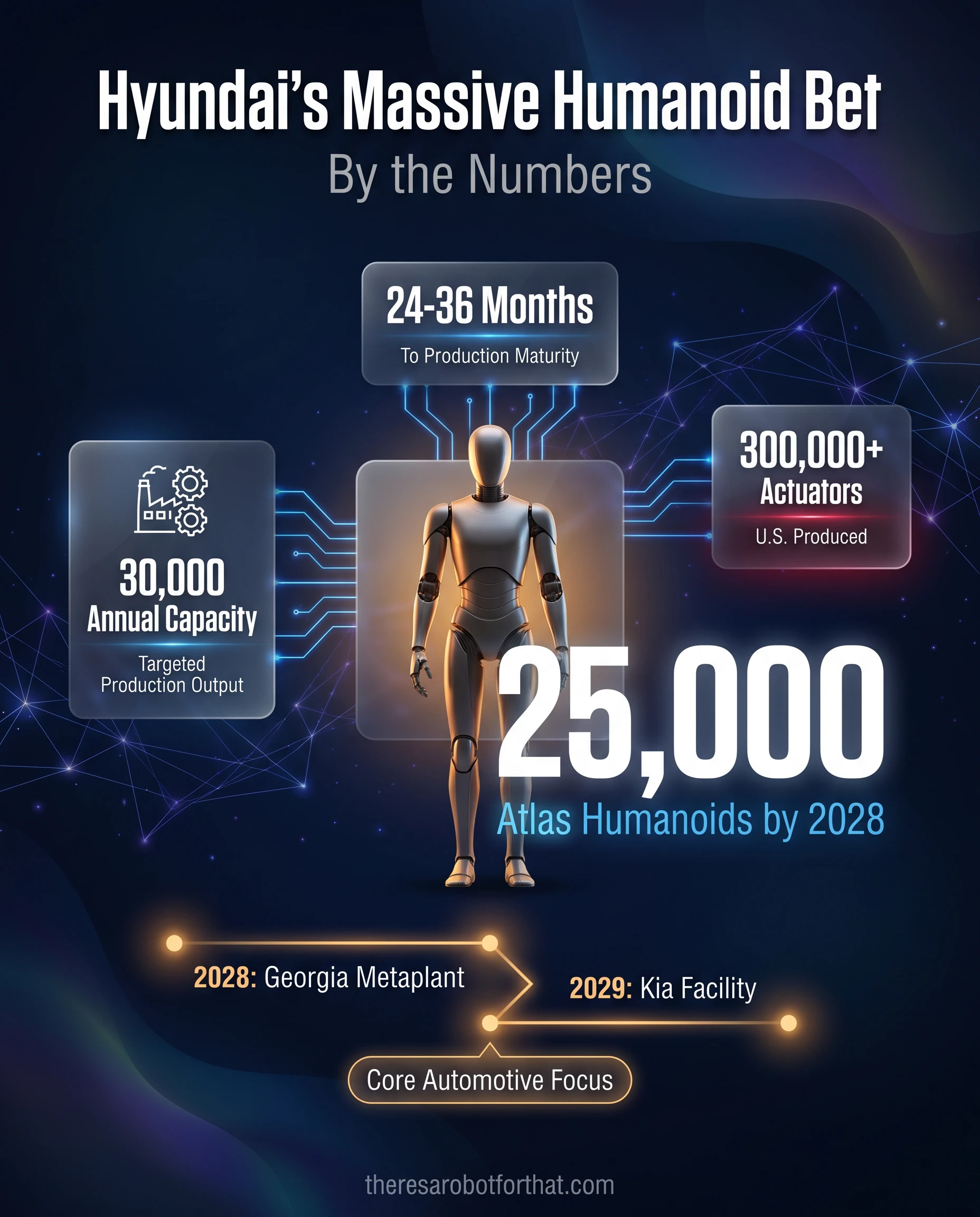
Image Source: There's A Robot For That
Snapshot: Hyundai Motor Group plans to deploy over 25,000 Atlas humanoids across its manufacturing facilities by 2028, while building capacity to produce 30,000 units annually and manufacturing 300,000+ actuator units per year in U.S. facilities. This represents the first concrete deployment timeline and volume commitment from a major manufacturer for humanoid robots.
Breakdown:
Takeaway: When the world's third-largest automaker commits capital to deploy 25,000 humanoids and build domestic component manufacturing, it's placing a calculated bet that human-shaped robots will solve labor constraints more cost-effectively than redesigning factories around fixed automation. Operations leaders at manufacturers facing similar workforce challenges should benchmark their labor costs per task against Hyundai's implied unit economics over the next 18 months.
South Korea launches 50.4 billion won project to build 24-hour hospital humanoid by 2030
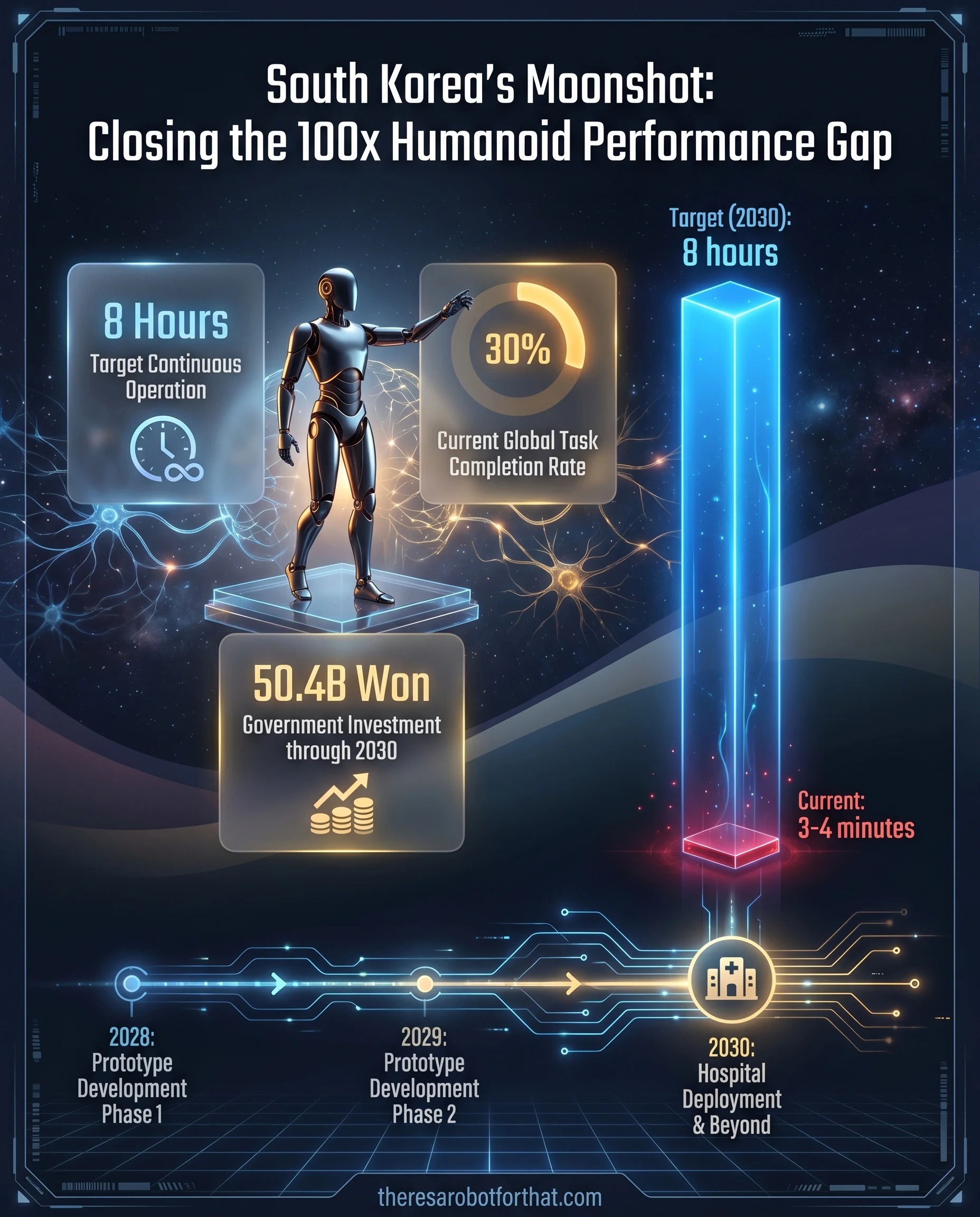
Image Source: There's A Robot For That
Snapshot: South Korea's government is investing 50.4 billion won through 2030 to develop humanoid robots capable of 8-hour hospital shifts, targeting full deployment at Hallym University hospital starting in 2029 for cleaning, organizing, waste sorting, and intra-ward deliveries. The project explicitly aims to exceed current global humanoid performance benchmarks of 30% task completion and 3-4 minutes of continuous operation.
Breakdown:
Takeaway: Government-funded moonshot programs reveal where capabilities stand today versus marketing claims — if South Korea needs until 2030 to achieve 8-hour hospital shifts, businesses evaluating humanoids for similar service tasks should plan on 4-5 year horizons, not 12-18 months. The explicit acknowledgement of current 30% task completion rates provides a useful reality check for ROI modeling against vendor promises.
Korea approves first invasive surgical robot for clinical use, enabling hospital revenue generation
Snapshot: Roen Surgical's Zamenix becomes Korea's first invasive surgical robot approved for revenue-generating clinical practice after a 232-patient trial demonstrated 93.5% stone removal rates in kidney procedures. Hospitals can now bill patients for robot-assisted procedures, marking the transition from research prototype to commercial medical service.
Breakdown:
Takeaway: Medical robotics crossed a critical threshold — regulatory approval for invasive procedures with reimbursable billing creates sustainable business models beyond equipment sales, which accelerates development cycles and hospital adoption. Healthcare operations leaders should note that AI-enhanced surgical robots are establishing clinical evidence and payment infrastructure faster than many anticipated, compressing the timeline for evaluating capital investments in robotic surgical suites.
Rivian-founder spinoff Mind Robotics raises $400M, hits $3B valuation
Snapshot: Mind Robotics — the industrial humanoid startup spun out of Rivian in late 2025 with Rivian CEO RJ Scaringe as chairman — closed a $400 million round led by Kleiner Perkins, pushing total funding above $1 billion and the company's valuation past $3 billion just two months after its $500M Series A. The round mirrors Hyundai's same-week deployment commitment — the auto industry is now backing humanoids on both the buy side and the build side.
Breakdown:
Takeaway: Pairing Hyundai's 25,000-unit deployment commitment with a Rivian-backed $1B+ startup raise in the same week tells a clean story: the auto industry is treating humanoids as the next factory automation platform, on both the buy and build sides. Operations leaders evaluating humanoid pilots should track which startups have committed manufacturing partners — funding without a deployment customer is now a weaker signal than the reverse.
Other Top Robot Stories
CUHK established Hong Kong's first full-stack embodied AI lab with 24 tech partners—mainly from mainland China including AGIBOT and Deep Robotics—to develop humanoid and quadruped robots over five years, leveraging the city's access to international talent and low-cost mainland supply chains.
Southwest Airlines banned humanoid and animal-like robots from all flights—both cabin and checked baggage—just two days after a Dallas business owner flew his 3.5-foot robot "Stewie" from Las Vegas to Dallas in a purchased passenger seat, marking the first major airline policy restricting robot passengers.
LG CNS signed an MOU with Korean e-commerce firm Kurly to pilot humanoid robots at Kurly's logistics centers and develop logistics intelligence solutions, aiming to ease workloads and boost safety in smart logistics operations while validating on-site suitability of humanoids in live fulfillment environments.
WVU Medicine grew its robotic surgery fleet from 3 da Vinci systems at one academic center in 2018 to 28 robots across its 25-hospital health system while expanding from 47 to 119 trained robotic surgeons, with executives citing better patient outcomes, improved care team experience, and long-term cost savings.
🤖 Your robotics thought for today:
Hyundai just put a number on humanoid deployment: 25,000 Atlas units by 2028, starting with the Georgia Metaplant. South Korea's government, meanwhile, admits today's humanoids work 3–4 minutes daily at 30% task completion — and is spending 50.4 billion won to push that to an 8-hour shift.
The same week tells you exactly where we are: real commitments at the top of the curve, real gaps at the bottom.
Until Friday,
Uli


