
China's SeeLight S1 humanoid cooks and cleans
PLUS: Kawasaki partners with Nvidia on physical AI, Bosch to manufacture UK humanoid, and China eyes 24M robots by 2035

Welcome back to your Robot Briefing
China just unveiled its first household humanoid designed to tackle everyday chores — cooking meals, doing laundry, and making beds. GigaAI's SeeLight S1 will launch free trials in Wuhan in the first half of 2027 with a target price under $14,700, putting domestic robots within reach of middle-class households.
The real question: can a sub-$15K humanoid actually handle the messy complexity of real homes, or will early adopters end up with expensive coat racks? If China cracks affordable autonomy at scale, the labor economics of eldercare and domestic work could shift faster than anyone expected.
In today's Robot update:
China's household humanoid targets families by 2027
Snapshot: GigaAI unveiled the SeeLight S1, China's first general-purpose household humanoid robot that autonomously performs chores from cooking to laundry, with free trials starting in Wuhan by H1 2027 and a target price under $14,700.
Breakdown:
Takeaway: This shifts the household robotics timeline from vague "future promise" to concrete trial deployment within 18 months, with pricing approaching consumer appliance territory rather than luxury goods. The focus on eldercare and real-world testing in employee housing signals companies are betting on practical viability, not just demo videos — something worth monitoring if labor availability or elder care costs are pressure points in your operations.
Kawasaki partners with Nvidia on physical AI robots
Snapshot: Japan's Kawasaki Heavy Industries is partnering with Nvidia to integrate physical AI into robotics for medical and mobility applications, establishing a joint development center in Silicon Valley with participation from Microsoft and Fujitsu.
Breakdown:
Takeaway: When a century-old industrial conglomerate opens a Silicon Valley center with the leading AI chip maker, it signals physical AI is moving from research concept to engineering priority. The focus on medical and mobility sectors — not factories — suggests major players see near-term commercial opportunities in environments where robots must handle unpredictability, not just repetitive tasks.
Humanoid secures Bosch as manufacturer
Snapshot: UK-based Humanoid is partnering with Bosch for European manufacturing of its HMND 01 robots following successful proof-of-concept trials at Bosch facilities, taking a distributed approach opposite to competitors like 1X that prioritize vertical integration.
Breakdown:
Takeaway: Bosch's commitment to manufacturing humanoids — not just supplying components — validates that industrial demand exists beyond pilot programs and venture capital demos. The distributed manufacturing strategy could accelerate European deployment by leveraging existing quality systems and supply chains, potentially giving logistics operators a credible vendor option within 12-18 months rather than waiting for startups to build factories.
China could deploy 24 million humanoid robots by 2035
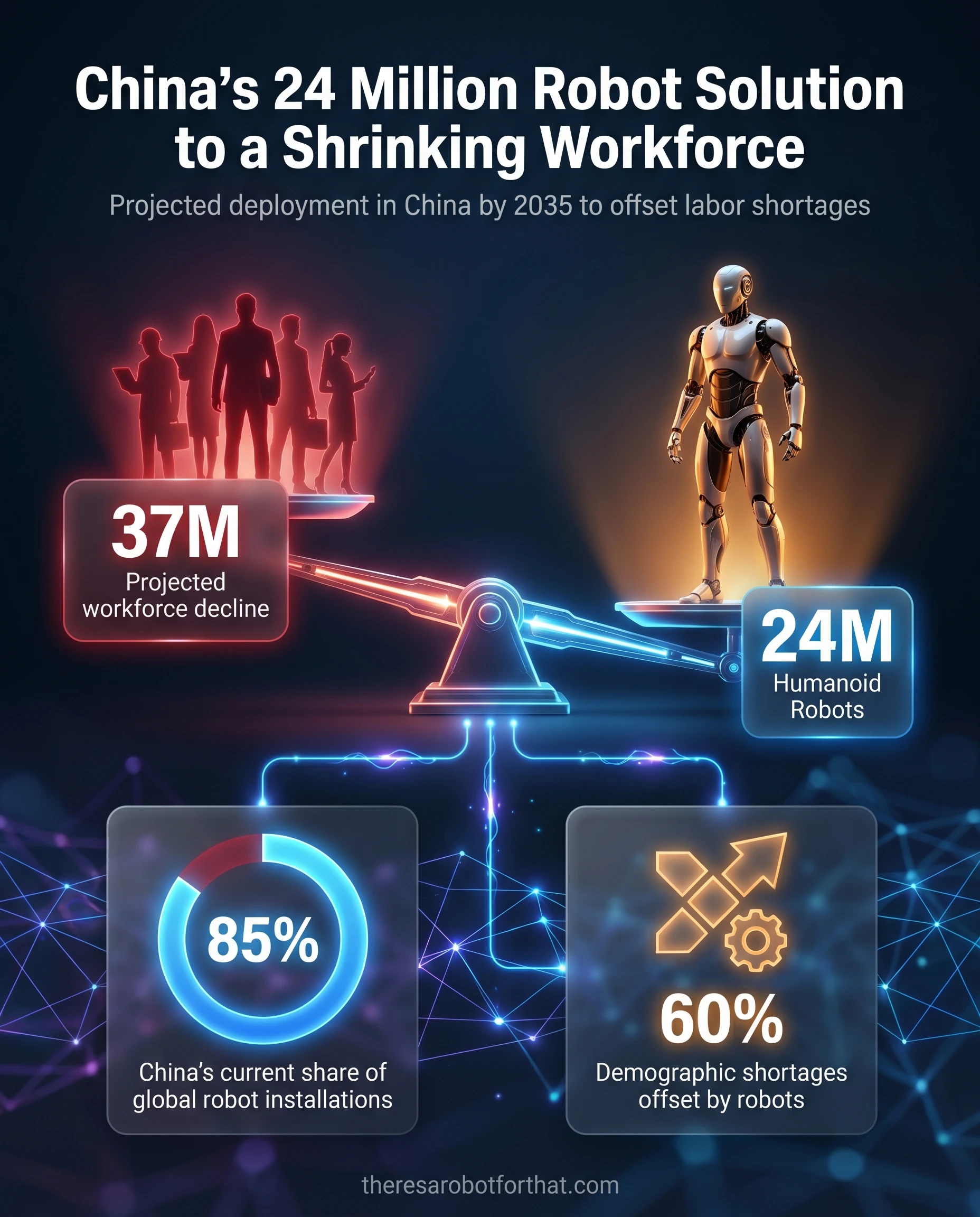
Image Source: There's A Robot For That
Snapshot: Barclays estimates China could deploy up to 24 million humanoid robots by 2035 to address a projected 37 million-person workforce decline, representing 4% of the labor force and offsetting 60% of demographic shortages, with applications spanning manufacturing, agriculture, and healthcare.
Breakdown:
Takeaway: When a major investment bank models 24 million units deployed within a decade, robotics moves from "innovation to watch" to macro-economic force that will reshape global manufacturing costs and capacity. If China achieves even half this projection, companies with Asian supply chains or competing against Chinese manufacturers should expect significant labor cost arbitrage shifts by the early 2030s — enough runway to plan, not enough to ignore.
Other Top Robot Stories
Menlo introduced a $15,000 DIY humanoid robot kit called "Here Be Dragons Edition," offering developers and research teams an open-source 1.20-meter platform with 25+ degrees of freedom and Discord-based assembly support to democratize access to bipedal robotics.
Mistral acquired Vienna-based Emmi AI to strengthen its industrial AI offering across European aerospace, automotive, and semiconductor clients, adding physics simulation capabilities for airflow, heat transfer, and material stress analysis following Emmi's 15 million euro funding round in 2025.
Sentante received CE mark approval for its haptic endovascular robotic platform that enables remote stroke surgery with real-time force feedback, following FDA breakthrough device designation in 2025 and acceptance into the Total Product Life Cycle Advisory Program earlier this year.
LivesMed secured its 1,000th intellectual property right ahead of launching next-generation surgical robot STARK, with 756 patents added in the past five years and 132 STARK-specific patents averaging 17.9 years of remaining protection to build competitive moats in robotic surgery.
🤖 Your robotics thought for today:
Bosch doesn't manufacture products it thinks will sit in warehouses. When a Tier 1 industrial supplier commits to humanoid production — not just components, but full manufacturing — that's a demand signal worth more than any forecast. The question isn't whether humanoids scale. It's whether your competitors are already planning deployment timelines.
Enjoy your weekend,
Uli


