
DHL's Warehouse Robots Pass 1.5 Billion Picks

OpenAI folds its robotics team, ASUS builds a factory humanoid, Neura puts robots in the power grid, and a Trump-backed startup misses payroll.
DHL's Warehouse Robots Pass 1.5 Billion Picks

The Big Number

DHL's warehouse robots have now completed more than 1.5 billion picks, and the company is handing them adaptive AI to decide what to grab next.

Welcome back to your Robot Briefing

DHL Supply Chain's warehouses have now passed 1.5 billion robotic picks across more than 9,000 machines, and the company is handing those robots to adaptive AI that reads the floor and changes plan on its own instead of running fixed scripts. That fleet is already one of the largest in logistics, and the new work is the software deciding what each machine does.

OpenAI folded its standalone robotics team into its main research org, ASUS detailed its first factory humanoid, and Neura Robotics signed Germany's grid operators to put humanoids in electricity substations. There is also a US humanoid startup that missed payroll, a $135 million robotics fund, a Chinese robot-chip venture, and human brain cells wired into a robot named Iris.

The 60-Second Read

DHL's warehouse robots have made more than 1.5 billion picks, and adaptive AI now decides their next move.
OpenAI disbanded its standalone robotics team, betting its general models can run robots directly.
ASUS set a 99.5% target for its first factory humanoid, packing 15 parts in 20 seconds a board.
Neura Robotics will put humanoids into E.ON substations, with live grid trials set for 2027.
News

DHL Hands Its Warehouse Robots to Adaptive AI

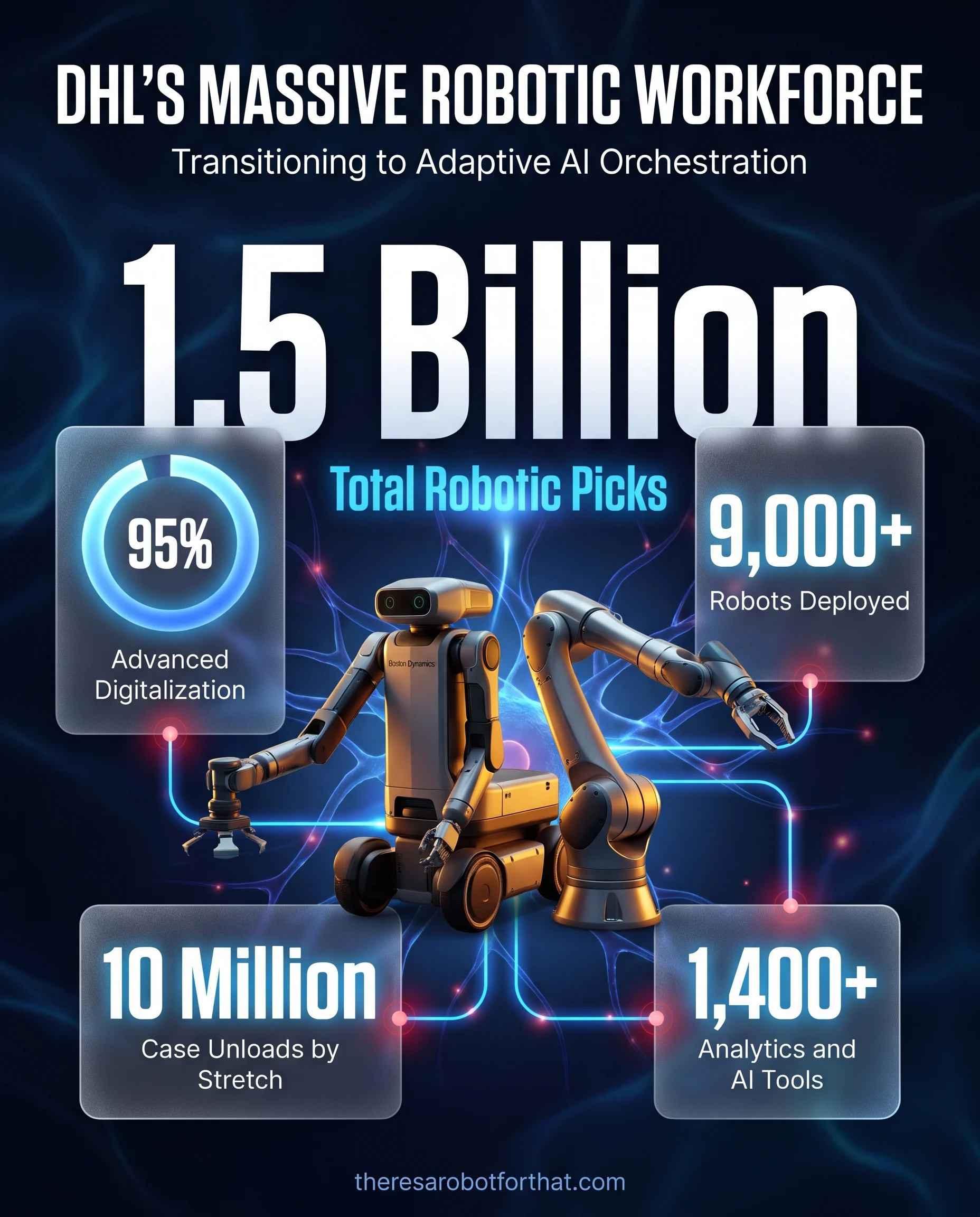
Statistical infographic detailing DHL's warehouse robotics scale, highlighting a hero stat of 1.5 billion total picks alongside supporting metrics of over 9,000 deployed robots, 10 million case unloads, and a 95 percent adoption rate for advanced warehouse digitalization.

Image Source: There's A Robot For That

Snapshot: DHL Supply Chain is rolling out adaptive AI-powered robots and AI orchestration software across live warehouses, letting its fleet adjust to changing order volume rather than follow fixed instructions.

Breakdown:

The division now runs more than 9,000 robots that have completed over 1.5 billion picks, with 10 million case unloads handled by Boston Dynamics' Stretch.
The new layer is AI orchestration, software that links workers, automated equipment and warehouse data to allocate resources by order volume, which DHL has started rolling out in operational sites after a proof of concept.
More than 95% of its warehouses already use advanced digitalization, and it has deployed analytics and AI tools over 1,400 times, including more than 500 in 2026.
Tim Tetzlaff, global head of digital transformation at DHL Supply Chain, says digital and physical AI are complementary forces and that the immediate priority is scaling proven robotics across more sites.

Takeaway: DHL has installed these robots over several years, and the 9,000 it runs today mostly sit on fixed paths. Adaptive control and orchestration are what let it add the next batch without the floor seizing up, because a larger fleet on fixed scripts eventually spends more time waiting on itself than picking.

News

OpenAI Folds Its Robotics Team Into Its Main Research

Snapshot: OpenAI disbanded its standalone robotics team and moved the researchers into its main research and applied groups, saying its general-purpose models can now be pointed straight at robots.

Breakdown:

Robotics research now reports to Chief Research Officer Mark Chen, and the applied and hardware teams move under President Greg Brockman, in what a spokesperson called an effort to accelerate robotics, not abandon it.
The trigger is model performance: in an Nvidia study, an agent built on OpenAI's general GPT-6 Astra hit a 74.8% success rate on a simulated manipulation benchmark, against 51.0% for the best specialized robot models.
Researchers still flag limits, since the large models are cloud-hosted and slow, so smaller onboard models are needed for real-time control.
This is OpenAI's second robotics shutdown, after it disbanded an earlier team around 2020 over a lack of training data.

Takeaway: The 2020 version was forced by missing data. This time OpenAI is folding the team because its general models cleared the specialized ones on Nvidia's benchmark, so the company no longer treats robot control as a separate research problem.

⏱️ The Compliance Clock

This week's stories put humanoids inside shared human workspaces, from an ASUS packing station to a DHL warehouse floor, where a robot and a person can reach into the same bin. The standard that governs that contact is ISO/TS 15066, which sets concrete force and pressure limits for what a collaborative robot may exert on a human body, broken down by body region. It is the technical specification an integrator uses to prove a humanoid can work next to people without a fence, and it sits beneath the broader robot safety standards as the document that turns "safe enough" into measured newtons.
Read the full guide →

News

ASUS Builds Its First Humanoid to Pack Motherboards

ASUS Builds Its First Humanoid to Pack Motherboards

Image source: ASUS

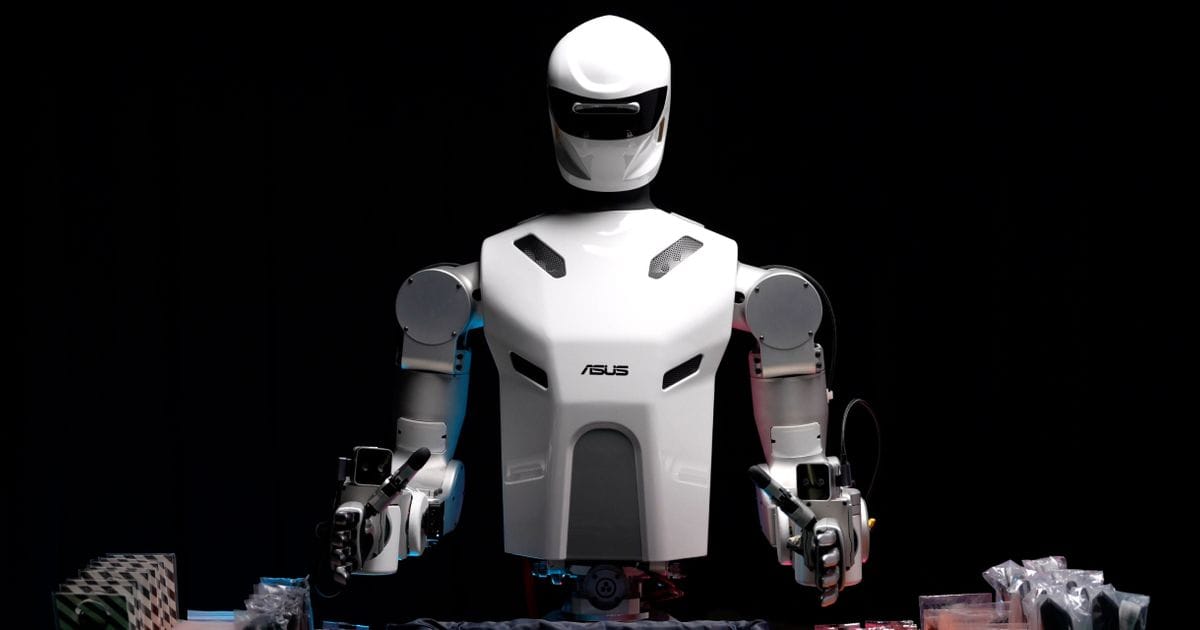
Snapshot: ASUS detailed Gallop, its first humanoid robot, which is learning to pack 15 motherboard accessories at one of the group's own electronics factories with a target of 99.5% success in 20 seconds a board.

Breakdown:

Gallop learns mostly by watching skilled workers wearing a head camera, with an operator refining moves through a VR headset and gloves on the same parts and cameras used at the real station.
It runs on a single Nvidia Jetson AGX Thor onboard, with an in-house dexterous hand that has a sense of touch, on a two-arm fixed base today and a wheeled version planned next.
The software splits into planner, supervisor, skills and control layers with fixed interfaces, so ASUS can swap in better AI models without rebuilding the robot.
Customer pilots are set for 2027 with a Computex 2027 showcase, and market availability is targeted for the second half of 2028.

Takeaway: ASUS set the bar at 99.5% on bagged parts, and clear plastic over soft bags is exactly what trips up a robot's vision and grasp, which is why a packing station is a harder first job than it looks. Running it on a live line inside its own factory makes ASUS both the maker and the first customer, the same way most Taiwanese and Chinese humanoid programs are now de-risking a first deployment.

News

Neura Signs Germany's Grid Operators for Substation Humanoids

Snapshot: Neura Robotics partnered with utility E.ON and regional operator enviaM to put humanoid robots into electricity substations, with the first live grid trials planned for 2027.

Breakdown:

The robots would handle inspection, asset monitoring and site security, taking on demanding or hazardous tasks so skilled grid workers do not have to.
Neura supplies its 4NE1 humanoid and training setup, E.ON and enviaM bring grid expertise, and enviaM's network unit Mitnetz Strom will run the field tests once the skills prove out.
Training runs at the TUM RoboGym in Munich, combining human demonstrations, real robot data and simulation through Neura's Neuraverse platform.
E.ON and enviaM keep control of their operational data and the trained robot skills, including whether to share them.

Takeaway: Grid inspection is a sensible early humanoid job because the work is dangerous and the sites are fixed and mapped, which narrows the problem a general robot has to solve. The data-ownership clause matters commercially, since a utility that keeps its trained skills can reuse them across thousands of near-identical substations instead of paying to retrain at each one. Trials in 2027 also put energy behind the warehouse and factory pilots already running, so the grid is following those deployments rather than leading them.

▶ Operator's Playbook

When you scope a humanoid pilot, put model portability in the contract: ask whether the robot's skills are locked to one AI model or whether the control stack lets you swap models without replacing hardware. ASUS built Gallop in four swappable layers for exactly this reason, and OpenAI's move to general models means the best model for your task in 2027 may not be the one shipping today. If swapping it later means buying new robots, the economics of the whole pilot change.

Other Top Robot Stories

Foundation , the Eric Trump-backed US humanoid startup, missed its October 30 payroll amid a cash crunch, after co-founder and CEO Sankaet Pathak borrowed $4.6 million from the company in 2025 to buy a home; he is now seeking funding at a $3 billion valuation.

Stanford researchers wired lab-grown human neurons into a humanoid robot named Iris, whose cultured brain cells read social cues and drove its responses, decoding signals with up to 94% accuracy in a fraction of a second.

Zacua Ventures closed a $135 million second fund , more than double its first, to back robotics, physical AI and industrial tech, with corporate backers including Volvo Group, Hilti and Trimble Ventures.

Xilect , a robot-chip venture jointly owned by chipmaker MetaX and humanoid maker UBTECH, raised 500 million yuan , about US$75 million, to build an embodied-AI processor it plans to tape out in the second half of 2027.

Gritt and MasTec agreed to deploy bolt-on robots that clamp onto existing construction equipment to build utility-scale solar farms faster across several US states, with financial terms undisclosed.

Fincantieri, Poste Italiane and TIM formed Italy's first national physical AI value chain , aimed at shipbuilding, as the shipbuilder separately develops humanoid welders for its yards.

Free for subscribers

Deploying humanoids this year?

Our Facility Readiness Checklist walks your site before the robot arrives, 77+ items, one complete toolkit module.

Get the free checklist →

🤖 Your robotics thought for today:

ASUS is teaching its Gallop humanoid to pack 15 motherboard parts by letting it watch a factory worker wear a head camera, then practice on the same bagged parts. A year ago that workstation was one person's whole shift, and now it is also a training set.

Until Wednesday,
Uli

DHL's Warehouse Robots Pass 1.5 Billion Picks

Great! Check your inbox and click the link to confirm.
Please enter a valid email address.