Genesis AI Raises $500 Million Before Selling a Robot

Atlas walks into the chip fab, China Post's parcel humanoids, and a fingertip that feels.

Genesis AI Raises $500 Million Before Selling a Robot

The Big Number

Genesis AI raised a $500 million Series A, among the largest first rounds any robot maker has ever closed, before it has sold a single robot to the public.

Welcome back to your Robot Briefing

Genesis AI, a Paris- and San Carlos-based robotics company most people have never heard of, just raised $500 million at a $3.5 billion valuation, with NVIDIA, AMD Ventures, former Google CEO Eric Schmidt and a former Tesla CFO on the cap table. It has built fewer than 40 robots and has not sold one.

Alongside the money, Boston Dynamics is sending Atlas into a chip fab, ROBOTERA's humanoids are now sorting parcels across 11 China Post hubs, and Melexis shipped a fingertip that lets a robot hand feel which way a grip is slipping. Plus Plural's new billion-euro fund and three more robot raises.

The 60-Second Read

Genesis AI closed a $500 million Series A at a $3.5 billion valuation to build general-purpose robots it has not yet sold.
Boston Dynamics will put its Atlas humanoid inside GlobalFoundries chip fabs in early 2027, its first customer outside carmaking.
ROBOTERA's humanoids now sort parcels at 11 China Post hubs across Guangdong, averaging more than 1,500 an hour.
Melexis launched its first fingertip module, letting a robot hand read force in three directions at once.
News

Genesis AI Raises $500 Million to Build a Robot It Has Not Sold

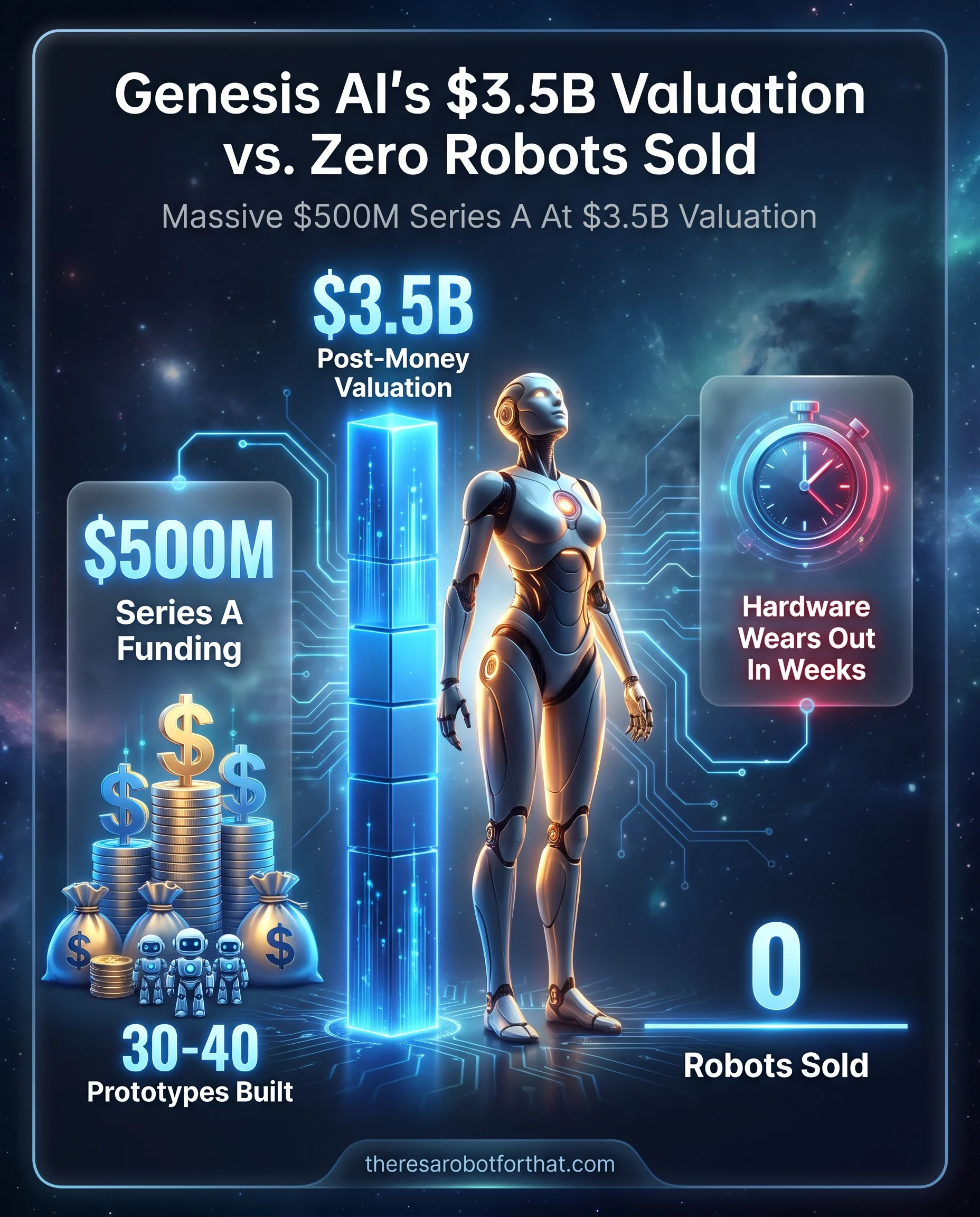
Comparison chart illustrating Genesis AI's 3.5 billion dollar valuation and 500 million dollar Series A funding juxtaposed against zero public sales and only 30 to 40 prototypes built.

Image Source: There's A Robot For That

Snapshot: Genesis AI raised $500 million in a Series A at a $3.5 billion post-money valuation, one of the largest first rounds in robotics, co-led by Premji Invest, Khosla Ventures and Eclipse.

Breakdown:

Backers include NVIDIA, AMD Ventures, Samsung Next, Bpifrance, former Google CEO Eric Schmidt and former Tesla CFO Zach Kirkhorn; the Paris- and San Carlos-based company has built 30 to 40 of its Eno robots and is piloting them with undisclosed customers in manufacturing, logistics and laboratories.
Genesis builds the full stack itself: a foundation model called GENE, a simulator called Genesis World, and a dexterous hand paired with a data-collection glove, with more than 100 workers wearing the gloves to record how human hands move and apply force.
Eno is a wheeled robot with two dexterous hands rather than a walking humanoid, a design the company says favors capability over human appearance.
CEO Zhou Xian told TechCrunch the dexterous hands currently last only a few weeks of regular use before they need replacing, and the company has not disclosed revenue or how many paying customers it has.

Takeaway: Genesis is the largest of at least four robot raises in the same week. Plural closed a billion-euro deep-tech fund, and Promise Robotics and UniX AI pulled in rounds of their own. All of it is landing before any of these companies has shown sustained paid deployment at scale.

News

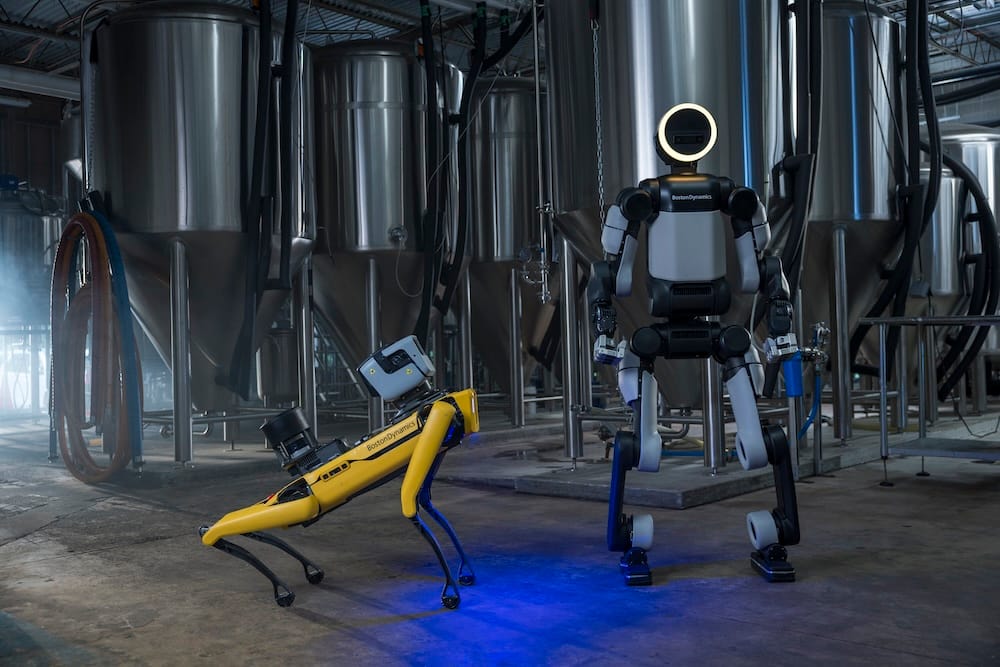
Boston Dynamics Sends Atlas Into a Chip Fab

Boston Dynamics Sends Atlas Into a Chip Fab

Image source: The Robot Report

Snapshot: Boston Dynamics and GlobalFoundries expanded their robotics partnership to put the Atlas humanoid inside semiconductor fabs, making the chipmaker the first customer outside the automotive industry to test Atlas, with on-site trials starting in early 2027.

Breakdown:

The companies did not say how many Atlas units will take part, which sites will host them, or what tasks come first, framing the work as an early-adopter program and skills-development workshop.
The deal also extends Boston Dynamics' Spot quadruped to GlobalFoundries fabs in Malta, New York; Burlington, Vermont; Dresden, Germany; and Singapore, where the inspection fleet has run at a reported 99% mission success rate.
Atlas's committed production is still going mostly to parent Hyundai Motor Group, which plans to deploy 25,000 Atlas robots across Hyundai and Kia plants and is first training them for parts sequencing and material handling near Savannah, Georgia.

Takeaway: A chip fab is a harder first room than a car plant, with cleanroom gowning, contamination limits and tool-level precision a general-purpose humanoid has not had to meet in public. GlobalFoundries already runs Spot for inspection, so the fab has lived with Boston Dynamics robots for years before Atlas ever shows up.

⏱️ The Compliance Clock

This week's humanoids are moving onto semiconductor fab floors and into postal sorting halls, shared spaces where a wrong move has to trigger a dependable stop. ISO 13849 is the functional-safety standard that rates how reliably a robot's safety control system carries out its protective functions, graded as performance levels an integrator must meet for each hazard. It governs the electronics and logic that decide whether a machine actually halts when a sensor says stop, the part a force limit on its own cannot prove.

News

China Post Puts Humanoids on 11 Sorting Lines

Snapshot: ROBOTERA has deployed its humanoid robots across China Post's Guangdong network, reaching 11 sorting hubs in eight cities in what the company calls the logistics sector's largest humanoid rollout to date.

Breakdown:

The robots run in Guangzhou, Shenzhen, Dongguan, Jiangmen, Shantou, Shanwei, Jieyang and Heyuan, and have averaged more than 1,500 parcel inductions an hour since the pilot began at the Guangzhou Postal District Center in March 2026, a rate ROBOTERA says matches an experienced human worker.
Guangdong handles more express parcels than any other Chinese province, so the network doubles as a stress test for sorting humanoids during peak shopping periods.
Some units use ROBOTERA's own five-finger dexterous hand, and the company has deployed the same integrated system across postal operations in East China.

Takeaway: ROBOTERA frames the robots as filling capacity gaps on strenuous frontline tasks so staff can move to maintenance, coordination and quality control. Going from one pilot center in March to eleven hubs by November is one of the faster logistics rollouts on record, at a point when comparable Western humanoid trials are still measured in single warehouses.

News

A Robot Fingertip That Feels Which Way a Grip Slips

Snapshot: Melexis launched the MLX90901, its first tactile fingertip module, giving a robotic hand the ability to sense force in three directions at once.

Breakdown:

The module reads normal force up to 15 newtons and shear force up to 4 newtons across two directions, with 10% full-scale accuracy and a typical resolution of 200 millinewtons, enough to catch small slips as a grip loads up.
It is built on the company's magnetic Tactaxis sensing and packages the sensor, magnet, elastomer, mechanical structure and electronics into one unit that talks to a hand controller over I2C.
Melexis is pitching it as an off-the-shelf part for humanoid hand makers, a step away from the bespoke, research-grade touch sensors that have been too costly and complex to build at volume.

Takeaway: Touch is the limit Genesis is spending glove data to close and ROBOTERA built its own hand to solve, and Melexis is now selling it as an off-the-shelf part.

▶ Operator's Playbook

Genesis's own CEO says its dexterous hands wear out in weeks, and ROBOTERA built its own five-finger hand in-house. Before signing a humanoid pilot, ask the vendor for the mean replacement interval and unit cost of the hands and end-effectors, then add that consumable line to the quoted price. A robot that needs new fingers every month carries a running cost no spec sheet will show you.

Other Top Robot Stories

Figure's Brett Adcock argued that memory, not chips, is now the binding constraint on humanoid robots, saying the industry effectively ran out of compute in September and that fabs take years to catch up.

Plural closed a €1 billion third fund, about US$1.1 billion, to back early-stage European AI, robotics, defense and energy startups.

Promise Robotics raised 40 million Canadian dollars, about US$28 million, in a Series B led by White Star Capital to scale its AI-driven robotic factories for homebuilding across North America.

Rockwell Automation integrated NVIDIA Omniverse, RTX and OpenUSD into its Emulate3D platform, letting manufacturers simulate and virtually commission whole factory floors before any equipment is installed.

Samsung and LG are preparing rival humanoid prototypes for CES 2027, with LG targeting a first-quarter release for its CLOiD robot and Samsung planning to use its own 100-plus factories as proving grounds.

UniX AI raised 500 million yuan, about US$75 million, in a Pre-A round for its wheeled service humanoids aimed at security, hotels and retail, one of several Chinese robotics raises this week.

Compliance tool

Where does your robot documentation stand?

The ISO 10218:2025 Gap Analysis Checklist finds every gap in 62 audit questions.

Get the checklist ($49) →

🤖 Your robotics thought for today:

The same week Genesis AI raised half a billion dollars to build a better robot hand, its own CEO said the hands it has now wear out within weeks of regular use.

Until Friday,
Uli

Genesis AI Raises $500 Million Before Selling a Robot

Great! Check your inbox and click the link to confirm.
Please enter a valid email address.