
Neura lands record $1.4B from Tether and Nvidia
PLUS: Xpeng CEO takes charge of humanoid pivot, Wonder's robots make 500 bowls per hour, and Moon Surgical's multi-AI platform
Welcome back to your Robot Briefing
German humanoid maker Neura Robotics just locked in $1.4 billion from Tether, Qualcomm, Amazon, Nvidia, Bosch, Schaeffler, European Investment Bank, Lingotto Horizon and Giano Capital. — one of the largest robotics funding rounds ever recorded. The funding round values Neura at about $7 billion and comes with a claimed order pipeline already topping $1 billion.
With plans to manufacture millions of units by 2030, Neura is betting big on scale. But can a European startup with massive backing actually compete with Tesla, Figure, and China's humanoid army — or does a billion-dollar backlog mean the enterprise market is finally ready to buy?
In today's Robot update:
Neura Robotics Secures Record $1.4B Funding Round
Snapshot: German humanoid maker Neura Robotics closed a $1.4 billion Series C at a ~$7 billion valuation, backed by Amazon, Nvidia, Tether, and Qualcomm in one of the largest robotics investment rounds on record. The company claims an existing order pipeline exceeding $1 billion and plans to manufacture several million robots by 2030.
Breakdown:
Takeaway: The deal structure — milestone-based rather than lump-sum — reflects how even well-funded robotics companies must prove commercial traction, not just technical capability. If Neura delivers on its $1 billion pipeline, European robotics could finally match the deployment momentum seen in Asia and North America.
Xpeng CEO Takes Direct Control of Robotics Division
Snapshot: Xpeng's chairman He Xiaopeng personally assumed leadership of the electric carmaker's robotics business, positioning the unit for Q4 2026 mass production and household deployment by 2028. The move signals Xpeng's strategic pivot from automotive manufacturer to "physical AI company."
Breakdown:
Takeaway: When a public company CEO takes personal control of a business unit, it's either desperation or strategic conviction — Xpeng's Q4 2026 production timeline suggests the latter. The household deployment target of 2028 puts a concrete stake in the ground for when businesses should expect commercial humanoid availability at scale.
Wonder's Robotic Bowls Outpace Humans 10-to-1
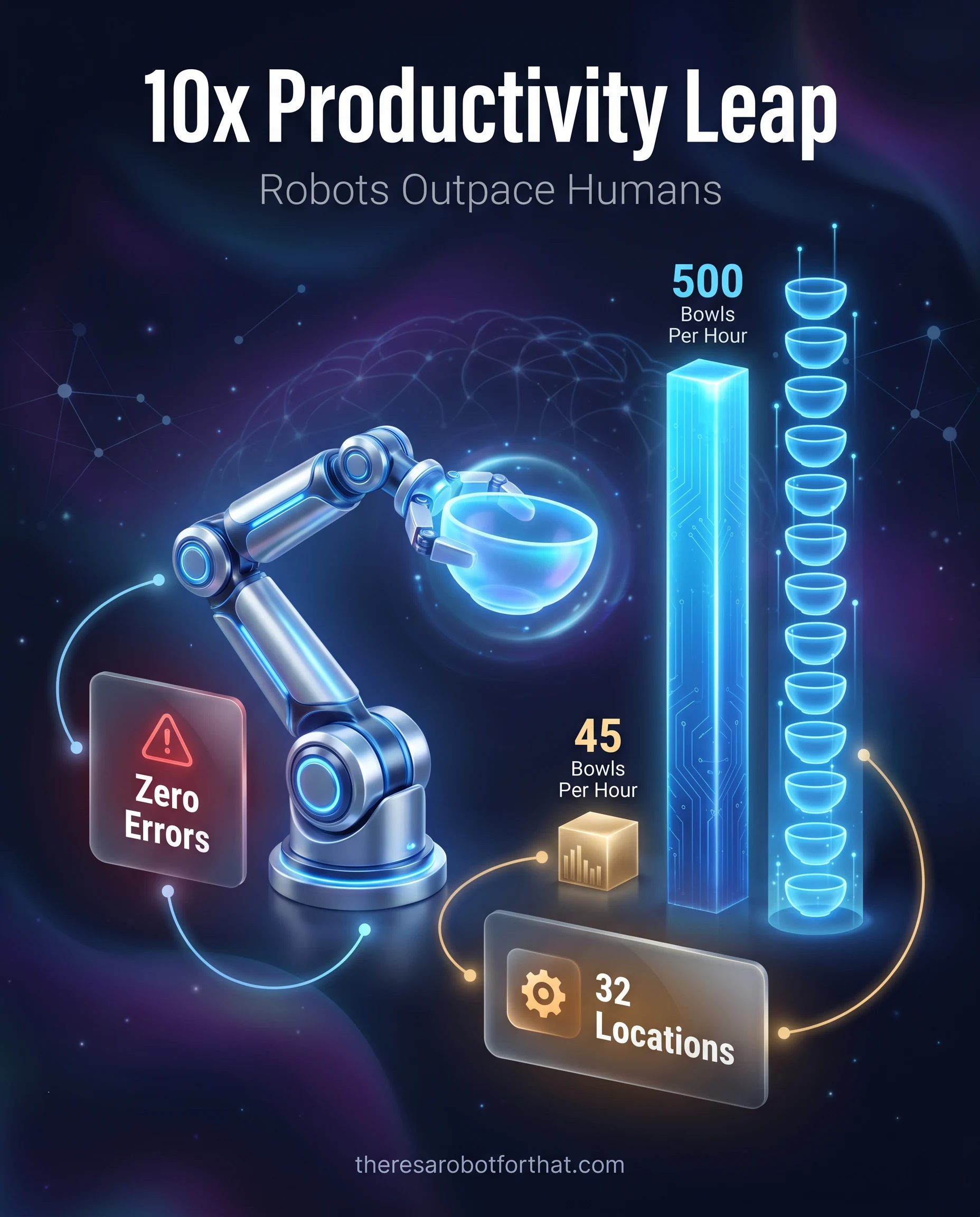
Image Source: There's A Robot For That
Snapshot: Marc Lore's food-tech startup Wonder deployed Sweetgreen's automated bowl system that produces 500 customized meals hourly with zero errors, compared to 30-45 for human workers. The technology already operates across 32 Sweetgreen locations and arrives at Wonder's first kitchen next month.
Breakdown:
Takeaway: The 10x productivity gap isn't theoretical — Sweetgreen already runs this across 32 locations, providing real operational data that proves automated food assembly works at commercial scale. For any business in high-volume, customizable production, this deployment model offers a clear ROI benchmark and implementation timeline.
Moon Surgical Expands Robot Into Multi-AI Platform
Snapshot: Moon Surgical's Version 2.7 software transforms its FDA-cleared Maestro surgical robot from single-AI to multi-model intelligent platform, adding automated setup, enhanced ScoPilot assistance, and AI-driven workflow optimization. The company targets ambulatory surgery centers where efficiency and patient throughput directly impact profitability.
Breakdown:
Takeaway: Moon's focus on ambulatory settings reveals where robotics economics work today — high-volume environments where setup time and throughput matter more than complex capabilities. The platform approach signals that surgical robotics value increasingly comes from software and workflow optimization, not just mechanical precision.
Other Top Robot Stories
FARMAR aims to create robotic systems that learn physical tasks directly from human demonstrations and verbal instructions, converting farmer workflows into machine-readable sequences that coordinate teams of ground robots and drones for autonomous field work.
Infineon signed a memorandum of understanding with Vietnam's VinRobotics to jointly develop humanoid robots through a new Hanoi competency center, with Infineon contributing semiconductor expertise valued at roughly $500 per robot in average bill-of-materials.
MIT developed an ultrasound wristband that captures detailed muscle and tendon movement beneath the skin to create datasets that could train humanoid robots to replicate human hand dexterity for household tasks, addressing limitations in existing camera and sensor-based motion tracking systems.
Atlas demonstrated the 'ghost rabona' football technique at Boston Dynamics while China's Booster Robotics T1 humanoid kicked a ball hard enough to damage a wall, marking significant progress in athletic capabilities as the robots train ahead of a long-term goal to compete against human World Cup champions.
🤖 Your robotics thought for today:
Neura raised $1.4 billion. Wonder's robots make 500 bowls per hour with zero errors across 32 locations. Xpeng's CEO just took personal control of their humanoid division with Q4 2026 production locked in. Everyone's still asking "when will robots actually work?" — but the deployment data says we're past that question.
I'm watching which companies hit their 2026 timelines.
Enjoy your weekend,
Uli


