
Nvidia open-sources Cosmos 3 for physical AI
PLUS: Intel's $130M robotics comeback, Nvidia and Unitree's open humanoid design, and Sam Altman backs stealth robotics startup Alfred

Welcome back to your Robot Briefing
NVIDIA just released Cosmos 3, an open-source foundation model that bundles physical reasoning, world generation, and action generation into a single package. The company isn't just sharing the model—they're handing over weights, training code, deployment tools, and datasets to anyone building robots or autonomous systems.
It's a big bet on open development in a field where most players guard their AI closely. The real question: will giving away the building blocks accelerate the industry faster than keeping them proprietary would?
In today's Robot update:
NVIDIA open-sources Cosmos 3 frontier model for physical AI
Snapshot: NVIDIA released Cosmos 3, combining physical reasoning, world generation, and action generation into one open-source foundation model. The company is releasing model weights, training code, deployment tools, and datasets to help companies build robots and autonomous systems without starting from scratch.
Breakdown:
Takeaway: The open-source release compresses the timeline for companies evaluating physical AI by providing a validated starting point rather than requiring internal AI teams to build foundation models. For operations leaders, this shifts the question from "Can we afford to develop this capability?" to "Which use cases justify adaptation costs?" — No change needed.
Intel stakes $130M+ robotics comeback with Series 3 chips and OpenVINO framework
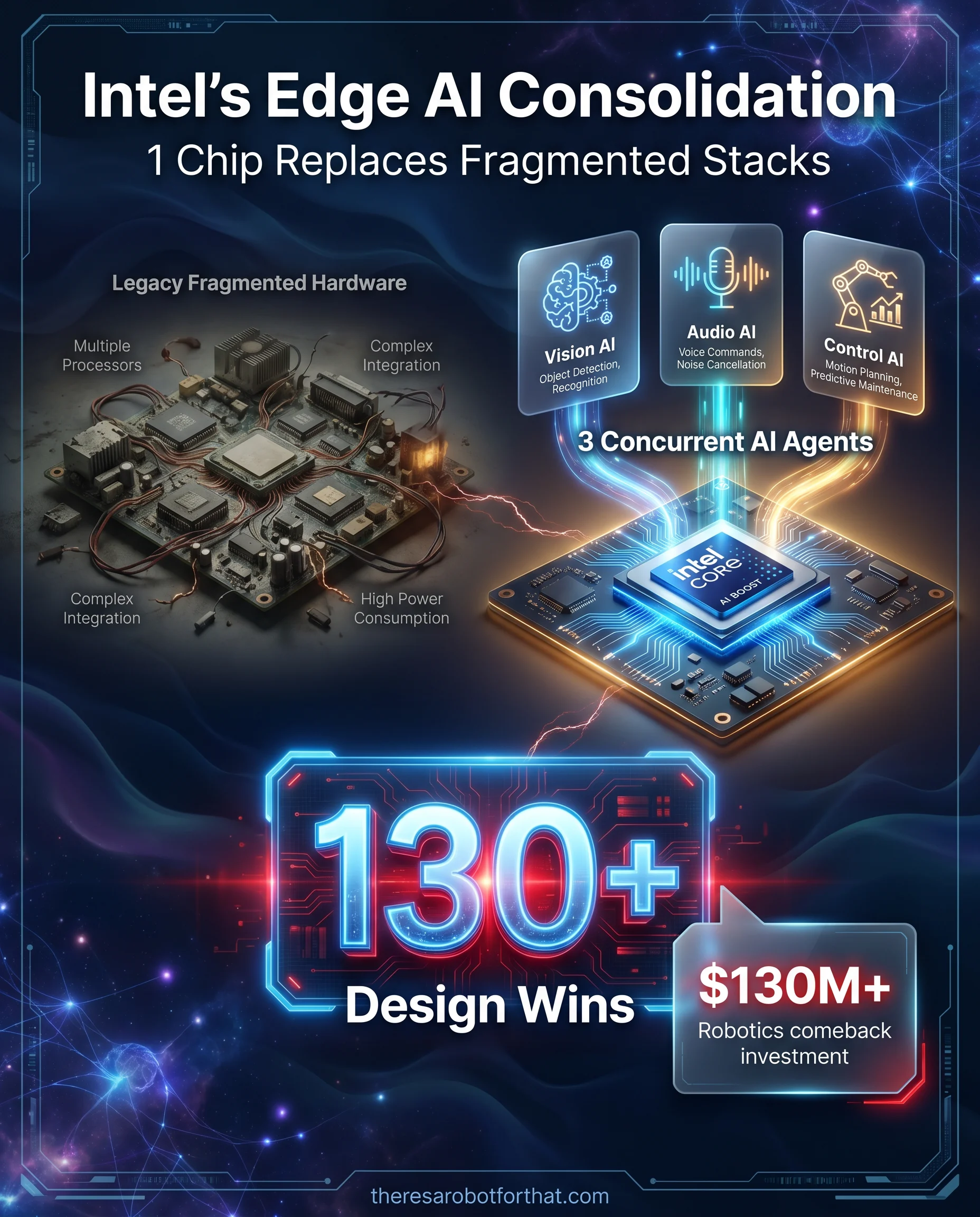
Image Source: There's A Robot For That
Snapshot: Intel announced 130+ design wins for its Series 3 edge AI processors and launched OpenVINO Physical AI, an open-source framework addressing the deployment gap between lab robotics models and production factory floors. The move positions Intel's unified silicon and software stack against the fragmented CPU-plus-accelerator approach that has dominated robot design.
Breakdown:
Takeaway: Intel's 130+ design commitments signal that robot makers are consolidating around fewer, more capable processors rather than assembling custom accelerator stacks — reducing integration risk for companies evaluating robotic systems. Operations leaders should ask vendors whether their platforms use consolidated compute or require managing multiple chip vendors, as the former increasingly indicates a more mature, deployment-ready product.
NVIDIA and Unitree launch open H2 Plus humanoid reference design for researchers
Snapshot: NVIDIA partnered with Unitree to create the H2 Plus, the first open humanoid robot reference design combining Unitree's H2 chassis, Sharpa hands, NVIDIA Jetson Thor compute, and the Isaac GR00T development platform. The integrated reference design targets academic researchers by providing validated hardware and open software without requiring proprietary platforms.
Breakdown:
Takeaway: This reference design targets academic research rather than immediate commercial deployment, signaling that even leading robotics players see general-purpose humanoids as multi-year development efforts requiring open collaboration. For operations leaders fielding board questions about humanoid robots, the timeline indicator is clear: companies positioning humanoid reference designs for researchers in 2026 expect commercial viability in 2028-2030, with 2027 being too soon for widespread commercial deployment.
Sam Altman backs Alfred, a stealth robotics software startup targeting $40M valuation
Snapshot: OpenAI CEO Sam Altman is backing Alfred through Hydrazine Capital, a 9-month-old startup building software to help robotics and automotive engineers reduce R&D timelines by automating routine engineering tasks. The Hawthorne, California company is raising at a $40 million valuation with talks underway with customers in automotive, defense, and robotics sectors.
Breakdown:
Takeaway: Early-stage software tooling for robotics R&D is attracting top-tier capital despite zero disclosed customers or revenue, signaling that investors expect a sustained wave of robotics hardware development that will need better engineering tools. Operations leaders should note that the proliferation of robotics infrastructure plays — not just robot makers — suggests the market is maturing beyond one-off deployments toward repeatable engineering processes, though Alfred's 9-month age and pre-product status confirm this tooling layer remains 18-24 months from production readiness.
Other Top Robot Stories
China assigned digital ID cards to all humanoid robots operating in its territory, tracking each machine from assembly line to scrappage under Beijing's directive to aggressively deploy embodied AI "wherever it is needed" amid a shrinking workforce.
Tokuiten entered full production use of its suction-type cherry tomato harvesting robot at its 2,000 m² organic farm in Chita, Japan, achieving 31 kg automated daily harvests with quality matching hand-picked fruit—marking one of the first commercial deployments worldwide for fruit vegetable harvesting.
Osaka Metropolitan University developed a virtual tomato farm environment using Unreal Engine 5 that automatically generates realistic training images and labels for agricultural AI systems, eliminating the time-consuming manual process of labeling each tomato with bounding boxes and ripeness categories across varying farm conditions.
LG Electronics quadrupled its share price in 2026 as investors backed the Korean appliance maker's robotics pivot, with stock rising by its 30% daily limit for two consecutive sessions ahead of LG Group Chair Koo Kwang-mo's meeting with NVIDIA's Jensen Huang.
🤖 Your robotics thought for today:
Intel just locked in 130+ design wins with a single chip architecture. NVIDIA is handing out complete foundation models and robot reference designs for free. Both bets assume the bottleneck isn't technology access anymore—it's deployment speed. If they're right, the companies still running 18-month hardware evaluation cycles are optimizing for a problem that just disappeared.
I'm watching which operators shorten their timelines.
Until Friday,
Uli


