
Surgeon operates on patient 3,000km away
PLUS: da Vinci 5 gets 100+ upgrades, China's greenhouse robots cut labor 20%, and Under Armour now protects humanoids
Welcome back to your Robot Briefing
An Indian urologist, Dr. Syed Mohammed Ghouse, stationed in Wuhan, China, successfully performed a robot-assisted bladder reconnection surgery on a patient in Hyderabad, India, nearly 3,000 kilometers away. The 90-minute procedure relied on Chinese robotics tech and 5G networks to beam live 3D video feeds across borders.
Cross-border telesurgery is technically impressive, but it raises a bigger question: can hospitals actually build the infrastructure, regulatory frameworks, and fail-safes needed to make remote operations routine rather than experimental?
In today's Robot update:
Surgeon in China remotely operates on patient 3,000km away in India
Snapshot: An Indian urologist successfully performed bladder surgery on a Hyderabad patient while operating from Wuhan, China, 3,000 kilometers away, using Chinese-developed robotics and 5G connectivity. The 90-minute procedure required coordination between medical teams in both countries, with the surgeon controlling robotic arms remotely via a console while monitoring live 3D video feeds.
Breakdown:
Takeaway: The business signal here is infrastructure readiness. This wasn't a lab demonstration but a live patient procedure coordinating teams across borders using commercially available 5G networks. Companies evaluating automation for remote expertise or operations should note that the connectivity and robotic precision previously considered "future state" are now handling high-stakes applications in real time.
Intuitive readies 100+ updates for da Vinci 5 surgical robot
Snapshot: Intuitive Surgical unveiled over 100 planned updates for its da Vinci 5 robotic surgery system, with U.S. rollout beginning in June 2026. The updates leverage the system's computing power, 10,000 times greater than older models, to add remote observation tools, mobile phone login, and enhanced collaboration features.
Breakdown:
Takeaway: This rollout model matters for operations leaders watching capital equipment investments. Intuitive is treating a robotic system like a software platform with continuous improvement cycles rather than a fixed asset. The company's commitment to ongoing feature additions through computing power creates a different depreciation and capability curve than traditional medical equipment.
China deploys AI-powered robots across greenhouse agriculture
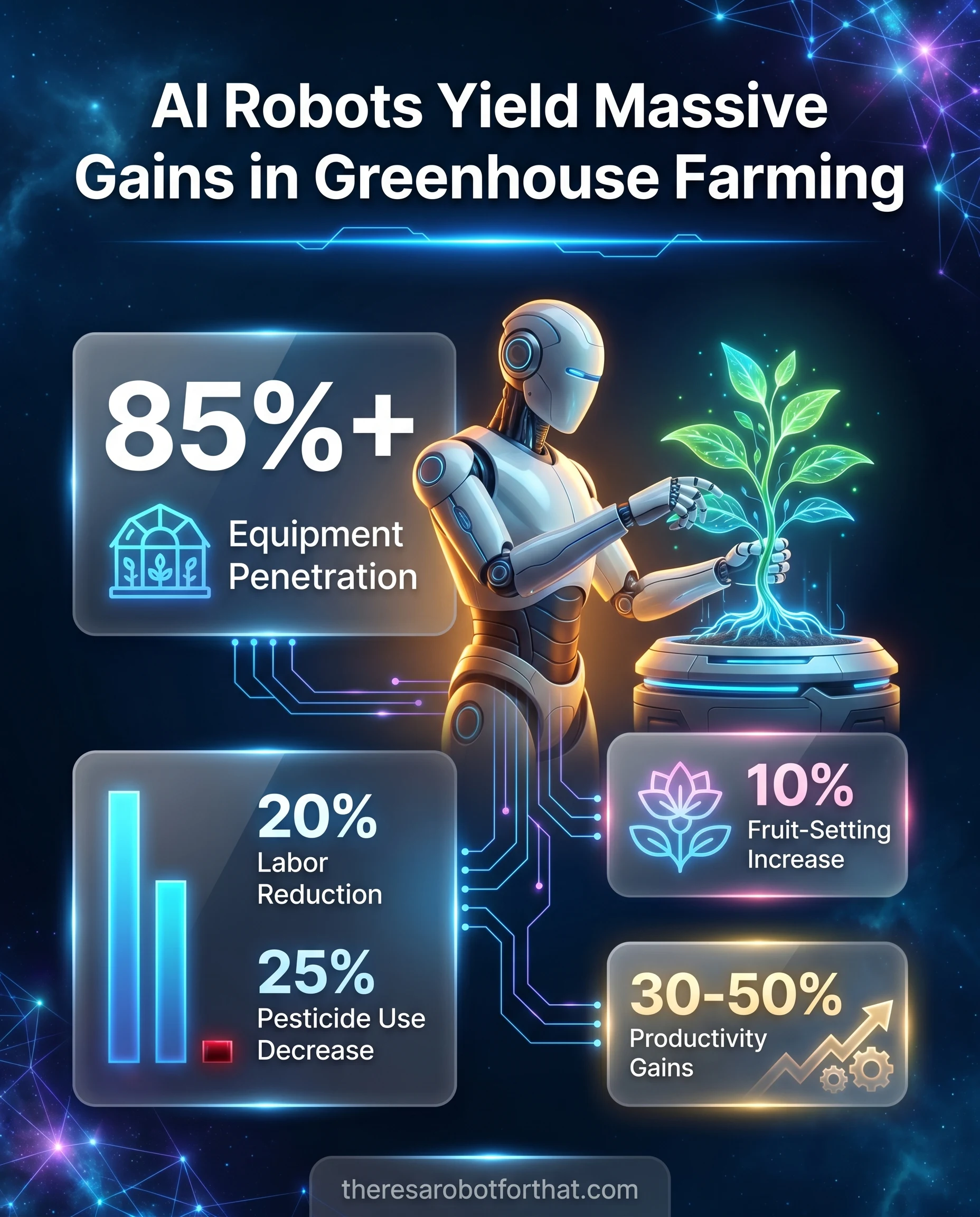
Image Source: There's A Robot For That
Snapshot: China's Shouguang region is showcasing autonomous agricultural robots at the 27th International Vegetable Expo, including spray robots that cut labor by 20% and pesticide use by 25%. The region reports that intelligent equipment penetration in newly built greenhouses has exceeded 85%, with labor productivity gains between 30% and 50%.
Breakdown:
Takeaway: The 85%+ penetration rate in new facilities signals this has moved past pilot programs into standard infrastructure in China's agricultural sector. For operations leaders evaluating automation timelines, the fact that Chinese agtech companies are successfully exporting these systems to Middle Eastern markets suggests the technology has cleared the reliability threshold for production environments beyond home territory.
Houston robotics startup taps Under Armour to protect humanoid robots
Snapshot: Persona AI has partnered with Under Armour to develop performance textiles that protect humanoid robots operating in harsh industrial environments like shipyards. The collaboration applies athletic wear technology like thermal management, abrasion resistance, and flexibility to robotics durability challenges.
Breakdown:
Takeaway: Under Armour's involvement signals that humanoid robots are approaching deployment density where specialized support industries see viable markets. Athletic apparel companies don't launch research initiatives for niche applications. The preseed funding level and existing shipyard partnerships suggest commercial deployments are 12-18 months out, not multi-year horizons.
Other Top Robot Stories
Former NASA Robotics Chief Robert Ambrose argued in Fortune that U.S. humanoid strategy is misaligned, citing models that hit 90% success in controlled simulation but only 12% on real household tasks, and called for tax credit restructuring, NIST interoperability standards, and structured deployment pathways for mid-sized manufacturers to close the adaptability gap with China.
BlackBerry said demand is rising for its QNX software platform in robotics and physical AI applications after transforming from a cash-burning business into a profitable software company, with QNX President John Wall highlighting growth opportunities in industrial automation at the CIBC Technology & Innovation Conference 2026.
Serve Robotics reported Q1 2026 revenue of $3.0 million, up 578% year-over-year, with roughly 2,000 delivery robots now active across 44 cities in 14 states, though a $49 million net loss highlights the gap between physical AI growth headlines and unit economics, with management reaffirming $26 million full-year 2026 guidance.
South Korea's Ministry of National Defense began discussions with Hyundai Motor Group on deploying robots including Boston Dynamics' Spot for reconnaissance and logistics as the country's active-duty military personnel could shrink from 450,000 to 350,000 by 2040 due to record-low birth rates.
🤖 Your robotics thought for today:
A surgeon just operated across 3,000km using commercial 5G networks. Not in a controlled demo. On a live patient. Meanwhile Intuitive is pushing 100+ software updates to surgical robots like they're iPhones. The infrastructure gap between "technically possible" and "operationally routine" is closing faster than most hospital systems are prepared for.
I'm watching which health systems move first on remote capabilities.
Until Wednesday,
Uli


