
Surgical drone operates mid-flight in combat zones
PLUS: Robots learn surgery from YouTube videos, magnetically-steered micro-bots navigate your brain, and Cognizant's trillion-dollar AI factory play

Welcome back to your Robot Briefing
An Indian medical device maker is mounting surgical robots onto drones to operate on wounded soldiers in combat zones where evacuation isn't an option. SS Innovations' Vimana Aero concept was born from a simple reality: hemorrhage kills faster than a medevac can fly.
If it works, we're looking at a new category of autonomous emergency medicine — one that redefines where "point of care" can be. The bigger question: can a drone-mounted platform deliver the precision surgery demands, or will physics and battlefield conditions keep this grounded?
In today's Robot update:
Surgical robots take flight: SS Innovations developing drone-based operating platform
Snapshot: Indian medical device maker SS Innovations is developing the Vimana Aero, a drone-mounted surgical robot designed to perform emergency procedures in combat zones and remote areas where evacuation is impossible. The concept emerged from a request by the Indian Army to address hemorrhage deaths when wounded soldiers can't reach care fast enough.
Breakdown:
Takeaway: This signals how specialized robotics platforms are evolving from fixed installations toward mobile deployment in high-stakes environments. The timeline matters less for most businesses than the underlying validation: remote surgical procedures work reliably enough that a company is betting on drone delivery to austere locations.
Cognizant launches sovereign Physical AI platform targeting trillion-dollar industrial automation market
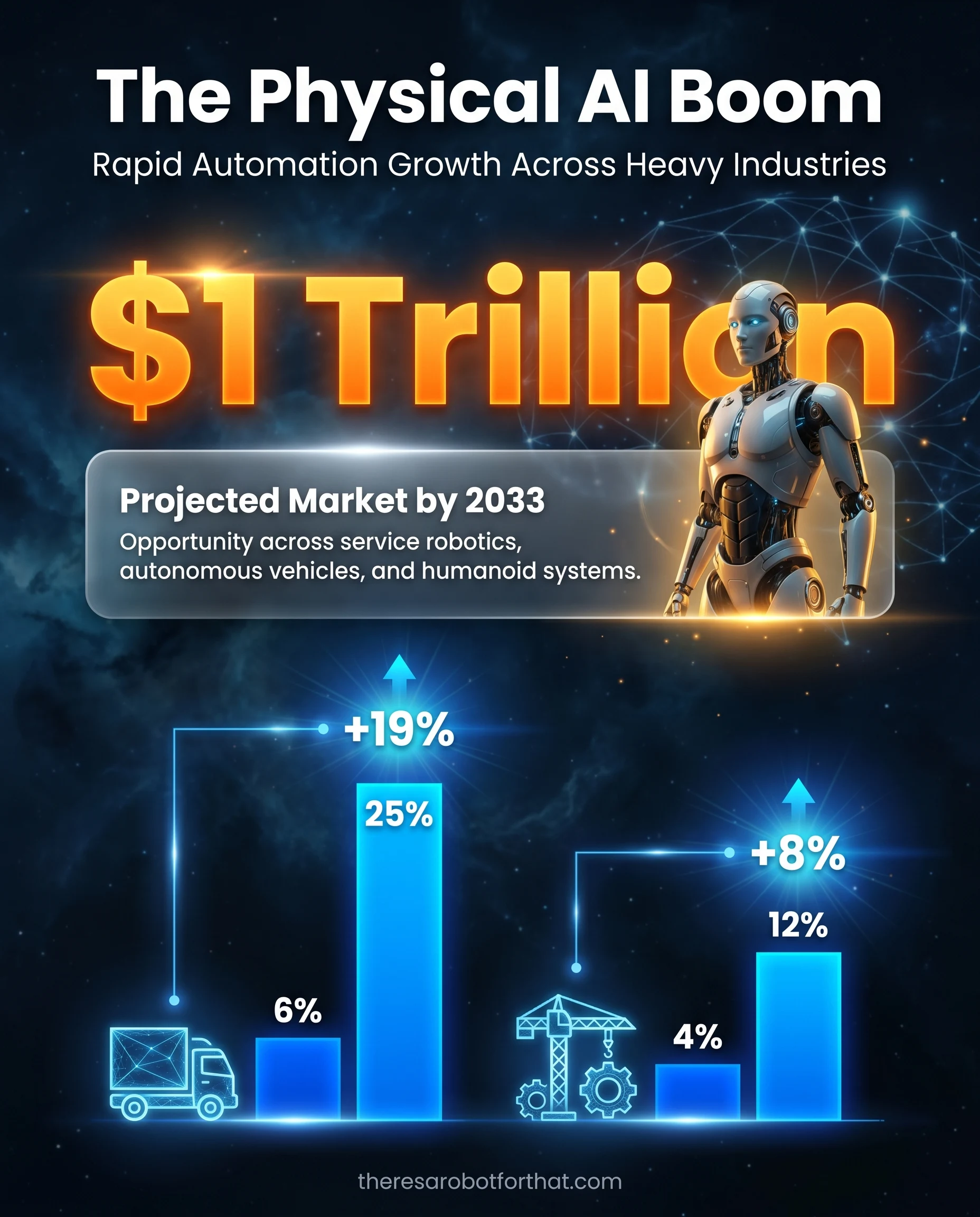
Image Source: There's A Robot For That
Snapshot: IT services giant Cognizant released an enterprise Physical AI Platform-as-a-Service that integrates industrial sensors, IoT devices, and factory automation into a unified intelligence fabric. The move positions autonomous systems as core infrastructure rather than pilot projects.
Breakdown:
Takeaway: When a major IT services provider builds platform infrastructure for physical automation, it's a clear market signal that enterprise deployment has moved past experimentation. CEO Ravi Kumar's "iPhone moment" framing may be marketing, but the underlying bet is substantive: Cognizant is positioning to integrate robots the way it once integrated ERP systems.
Korean researchers crack AI learning from videos, robots now train from YouTube-like demos
Snapshot: KAIST developed VOTP (Video Optimal TransPort), a physical AI learning technology that enables robots to learn human evaluation criteria by analyzing just a few example videos. The breakthrough eliminates the need for direct human feedback or extensive training datasets.
Breakdown:
Takeaway: The practical constraint holding back robot deployment has been training cost and complexity, not hardware capability. If robots can learn from video demonstrations rather than requiring engineers to hand-code every evaluation criterion, the economics of customizing automation for specific workflows changes substantially.
Magnetically-steered micro-robots could replace risky brain surgery catheters
Snapshot: Concordia University researchers developed AI-assisted soft robots guided by external magnets that can navigate delicate neurovascular pathways to treat blood clots, published in the journal Smart Materials and Structures. The system achieved 77% better tracking accuracy than conventional catheter-based interventions.
Breakdown:
Takeaway: Medical robotics advancement increasingly comes from combining materials science with AI control systems rather than mechanical innovation alone. The 77% accuracy improvement matters because it represents the difference between research prototype and clinical viability, though translation to actual procedures typically takes 5-7 years beyond published research.
Other Top Robot Stories
Deep showcased its DR02 humanoid navigating outdoor terrain while carrying firefighting equipment, demonstrating IP66-rated industrial capabilities designed for hazardous environments rather than laboratory settings as competition intensifies in China's robotics sector.
Intel announced a collaboration with Hitachi to advance physical AI and next-generation digital infrastructure across manufacturing, energy, and mobility industries, targeting real-world deployment of AI-powered automation systems.
Unitree performed on America's Got Talent with eight G1 humanoid robots dancing alongside a Chinese performer, earning a standing ovation and over 1 million YouTube views within 24 hours while Congress debates restrictions on Chinese robotics.
Xiangtan published breakthrough research in the Journal of Manufacturing Processes on precision machining of large-pitch Gothic-arch ball screws—the core transmission components in humanoid robot joints—offering greener, more efficient production methods for high-end actuators.
🤖 Your robotics thought for today:
SS Innovations has done 11,000 real surgeries with their robot. Now they're mounting it on a drone. Everyone's focused on whether it'll fly — but the real story is that remote surgery already works well enough to try this. The hard part was already solved.
I'm watching the 2026 prototype date.
Until Wednesday,
Uli


