
US robot curbs could erase 58% of humanoid revenue

Audi puts humanoids on the line, Chinese robots job-hunt in Korea, and Formic banks $50M for factory-floor RaaS.
US robot curbs could erase 58% of humanoid revenue

The Big Number

IDC's trade-policy model puts US humanoid robot revenue 58% below its pre-restriction baseline by 2030, close to three of every five projected dollars gone.

Welcome back to your Robot Briefing

Trade policy, not torque curves, set the agenda this week. A single US import rule is already bending the humanoid market's growth curve, and the volume it blocks is landing in Europe and Asia instead.

On the floor, the deployments kept coming: Audi started picking parts with mobile humanoids, Chinese makers pushed from Korean showrooms into Korean factories, and a Chicago company raised fresh capital to rent robots by the month.

The 60-Second Read

IDC says a July FCC rule will leave US humanoid revenue 58% below where it would have been by 2030.
Audi is testing Agile Robots humanoids for parts sequencing at Ingolstadt, a plant that runs about a million picks a day.
Chinese makers UBTech, Unitree and AgiBot are moving from demos into Korean factory trials as Seoul triples its physical-AI budget.
Formic raised $50 million to scale its robots-as-a-service fleet past 750,000 live production hours.
News

A US import rule is quietly shrinking the American humanoid market

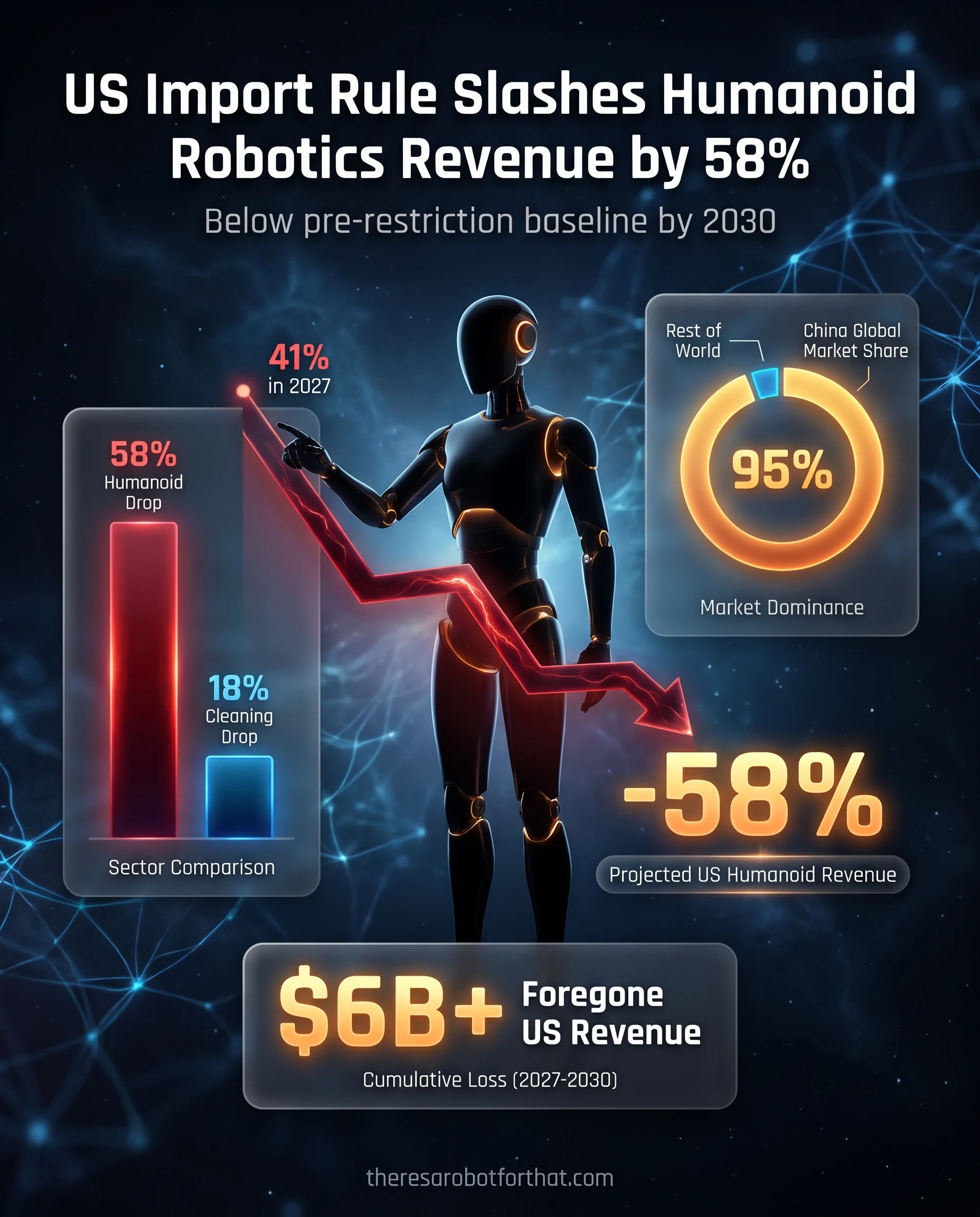
Bar and donut charts illustrating the impact of the FCC import rule, showing a 58 percent drop in US humanoid revenue by 2030 compared to an 18 percent drop for cleaning robots, alongside China's 95 percent global market share.

Image Source: There's A Robot For That

Snapshot: The FCC's decision to add foreign-made advanced robots to its Covered List could shrink US humanoid revenue 58% below its pre-restriction path by 2030, the deepest hit of any robot category.

Breakdown:

On July 28, 2026, the FCC added foreign-made advanced robotic devices that sense, move and connect wirelessly and weigh more than 4.4 pounds to its Covered List, so new foreign models can no longer get the equipment authorization needed to be sold in the US.
Humanoids turn over models faster than any other category, so there is almost no certified-model cushion: the gap reaches 41% in 2027 before widening to 58% in 2030, against 18% for household cleaning robots.
Chinese vendors shipped about 95% of the world's humanoids in the first half of 2026, and US builders such as Figure and Apptronik still depend on China for motors, actuators, batteries and rare-earth materials.
IDC counts more than $6 billion in foregone US robotics revenue between 2026 and 2030, with over $2 billion of it in 2030 alone, and already-certified models keep shipping with firmware support waived through at least January 1, 2029.

Takeaway: The rule protects the badge on the finished robot and does nothing for what is inside it, so a buyer's real exposure is the product cycle and the bill of materials, not the flag on the box. Model continuity now: which units already hold authorization, where the parts come from, and whether a vendor can still support the fleet once the 2029 firmware waiver runs out.

News

Audi puts mobile humanoids on its parts-sequencing line

Audi puts mobile humanoids on its parts-sequencing line

Image source: Audi

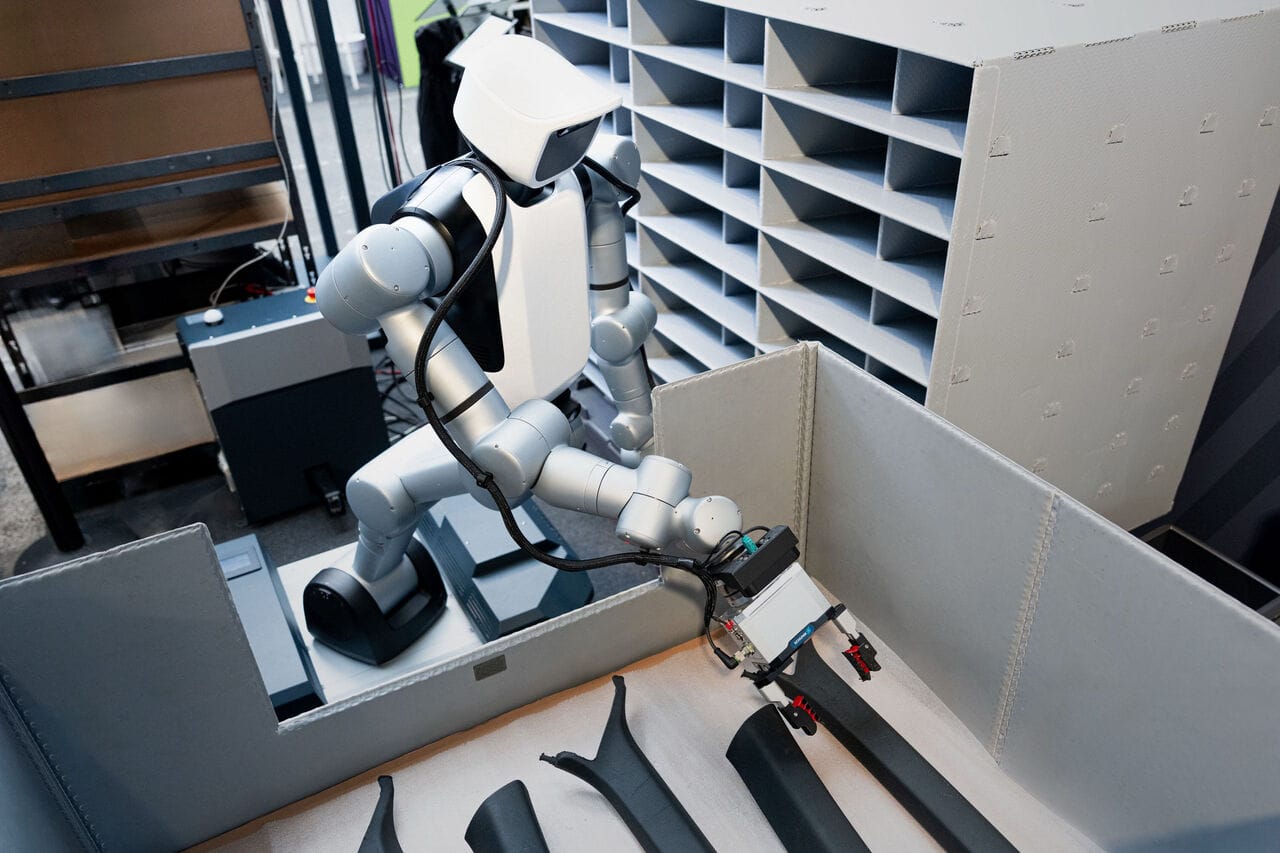
Snapshot: Audi began testing mobile humanoids from Agile Robots to pick and sequence parts for final assembly at its Ingolstadt plant, in a proof of concept with NVIDIA and Dassault Systèmes shown at GTC Berlin.

Breakdown:

Audi's sequencing runs on roughly one million picks a day, delivering parts to each station in assembly order, a workflow that varied and semi-rigid parts in unsorted bins have long kept out of reach of automation.
The dual-arm robots work at human height on a mobile base and use AI perception to grasp mixed components, so Audi can automate the task without rebuilding its logistics floor around new machines.
Before any robot runs live, a digital twin of the area built in Dassault Systèmes' DELMIA with NVIDIA Omniverse checks feasibility, timing, ergonomics and safety.
Munich-based Agile Robots, founded in 2018 by German Aerospace Center researchers, says it has more than 20,000 robotic systems deployed worldwide and over 3,500 employees.

Takeaway: Audi is late to a club that already includes BMW and Hyundai, and the pitch is telling. The win here is not a faster robot, it is a humanoid that slots into an existing line, which is the only version of this technology most plants can actually afford to try. Watch whether the proof of concept survives contact with a real takt time.

⏱️ The Compliance Clock

86 days

until the EU Machinery Regulation becomes mandatory (Jan 20, 2027)

As US import curbs redirect humanoid volume toward Europe and German carmakers like Audi move the machines onto live factory floors, the rulebook that governs them is the EU Machinery Regulation. It replaces the decades-old Machinery Directive and raises the conformity and documentation bar for any new machine placed on the EU market, humanoids included. Operators sourcing robots for European sites should confirm with every vendor that the declaration of conformity will cover the deadline, not trail it.

Read the full guide →

News

China's humanoids go job-hunting in Korean factories

Snapshot: Chinese makers including UBTech, Unitree and AgiBot are moving from showroom demos into factory trials across South Korea, filling a gap left by the shortage of locally built humanoids at scale.

Breakdown:

A Seoul venue, Galaxy Robot Park, bought UBTech's 1.68-meter U1 humanoid for about 170,000 yuan, roughly US$25,000, and UBTech says it has sold more than 10,000 robots since entering the market in 2019.
UBTech is trialing humanoids on a Korean auto-parts line with local partners Duksan JM Robotics and AJIN Industrial, while eight of China's ten top humanoid makers are testing the market through certification, trademark filings and sales channels.
Korea was China's third-largest export market for intelligent bionic robots in the first nine months of 2026, taking $19.99 million, or 9.7%, of China's $206.95 million in global shipments.
Seoul has proposed 3.1 trillion won, about US$2.34 billion, in physical-AI funding for 2027, more than triple this year, with a target of 500 AI factories by 2030.

Takeaway: This is the export market the US rule was written to prevent at home, playing out in reverse in Korea. For operators it is a reminder that supplier choice is now a policy question: Korea's KC certification already forced UBTech to re-engineer its radios, so factor local approvals and the politics around Chinese suppliers into any humanoid shortlist.

News

Formic banks $50M to rent robots to American factories

Snapshot: Formic raised $50 million in growth capital to expand its robots-as-a-service fleet and push from task-specific automation into general-purpose robotics.

Breakdown:

The round is a Series B led by Mercato Partners, with Light Ray Ventures, Lightscape Partners and Citi, plus debt financing from S2G Investments.
Formic rents equipment, deployment software, field service, maintenance, financing and performance monitoring for one recurring monthly payment, so a manufacturer automates with no upfront capital.
The fleet now runs hundreds of robots across more than 100 facilities in over 30 states, at 99.6% uptime, and the company says 97% of customers renew.
Founded in 2020 and now deploying about three times faster than a year ago, Formic has logged more than 750,000 hours of live production and is adapting Physical Intelligence's foundation models for factory tasks.

Takeaway: The renting-not-selling model keeps winning funding because it answers the question that stalls most robot pilots, which is who owns the risk when the machine stops. A per-month, uptime-backed contract moves that risk off the plant's balance sheet, and the 97% renewal figure is the number to press a RaaS vendor on before signing.

▶ Operator's Playbook

This week, ask any humanoid vendor for a written component-and-service continuity plan. Three questions settle most of it: which of its models already hold US equipment authorization, where the motors, actuators and batteries are actually sourced, and how firmware and service continue once the FCC's 2029 waiver expires. Then benchmark the humanoid against an autonomous mobile robot or a fixed arm on total cost of ownership before you commit, because for many tasks the cheaper, certified machine still wins.

Other Top Robot Stories

Neura Robotics unveiled its 4NE1 Gen 4 humanoid , a 20% lighter model built for series production, as it and the Technical University of Munich opened a roughly 17-million-euro, 2,300-square-meter RoboGym to train robots for more than ten industries.

Generative Bionics plans a Physical AI Data Factory in Italy , a 5,000-square-meter hub slated to open by the fourth quarter of 2027 as the first of three planned sites meant to move humanoids from lab demos to industrial deployment.

XELA Robotics packs 368 touch points into one robotic hand , fitted to Carnegie Mellon's open-source LEAP Hand for 1,472 measurements across fingertips, phalanges and palm, as tactile sensing becomes the gating problem for dexterous manipulation.

Amap , Alibaba's mapping unit, open-sourced Lambda-0 , a whole-body humanoid model trained only on first-person human data that transfers zero-shot to a Unitree G1, released under Apache 2.0 with an arXiv paper.

AgiBot set a Guinness World Record by running 110 Expedition A3 humanoids through a synchronized routine in Jinan, coordinated by its LinkBots swarm platform and centimeter-accurate ultra-wideband positioning.

Infineon named Italian startup AdapTronics the winner of its 2026 Startup Challenge for a gripping technology aimed at humanoids, picked from more than 100 entrants across 29 countries, with 15 finalists pitching at a demo day in Graz, Austria.

Free for subscribers

Deploying humanoids this year?

Our Facility Readiness Checklist walks your site before the robot arrives, 77+ items, one complete toolkit module.

Get the free checklist →

🤖 Your robotics thought for today:

A robot that fits the floor you already have will beat a better robot that needs a new one. Most of this week's news was about fit, not strength.

Until Wednesday,
Uli

US robot curbs could erase 58% of humanoid revenue

Great! Check your inbox and click the link to confirm.
Please enter a valid email address.