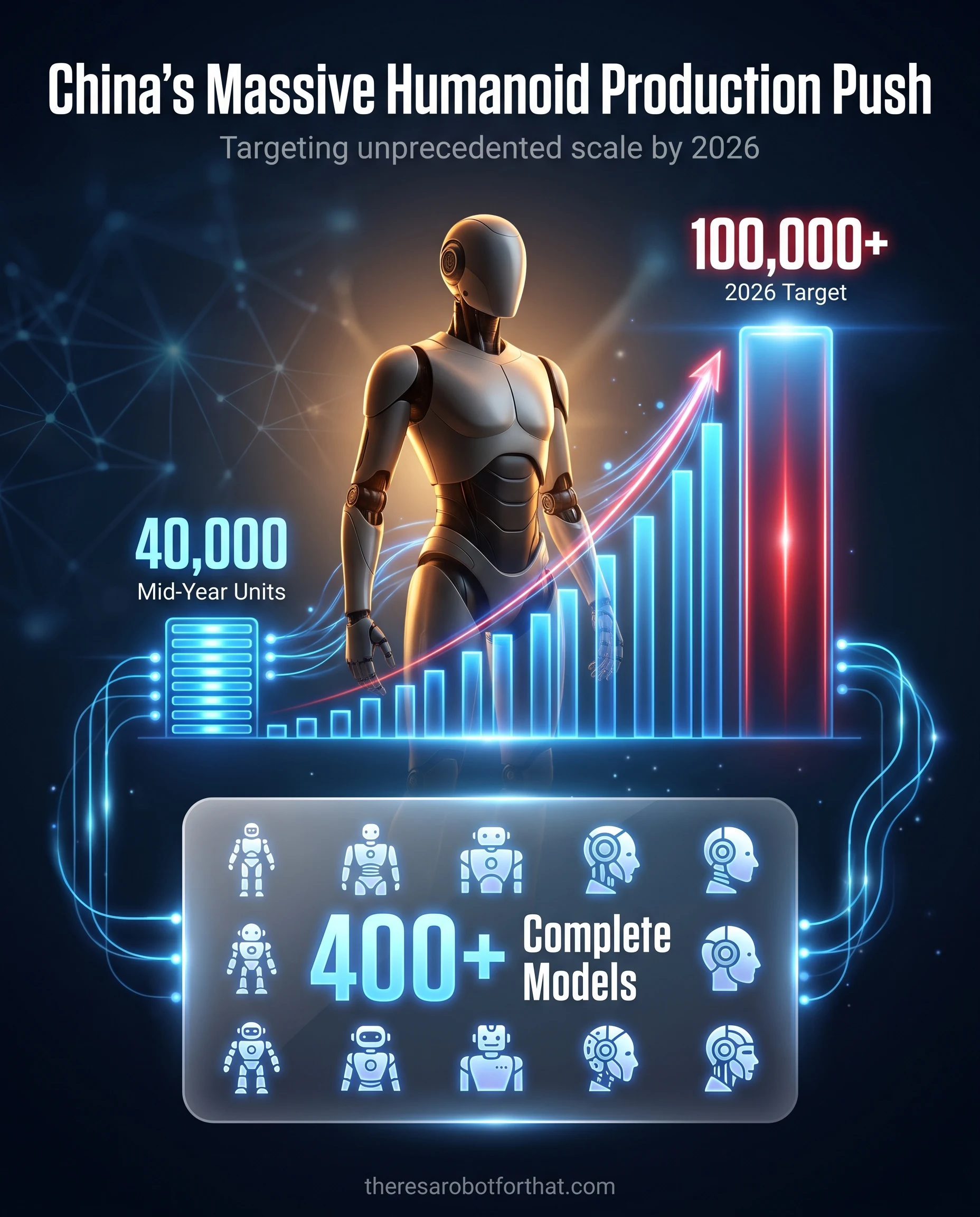
China expects its factories to turn out more than 100,000 humanoid robots in 2026.
Welcome back to your Robot Briefing
This week the humanoid story stopped being about what the robots can do in a highlight reel and started being about how many of them get built, and where. A national output target in China, a named factory pilot in Kansas, a line in Taicang where robots assemble the parts for other robots, and a frontier lab finally saying the word "humanoid" out loud.
The through-line for operators is supply, not spectacle. When output curves and funding rounds and government targets all point the same way at once, component prices and real deployment dates are the things that actually move.
The 60-Second Read
China expects to build more than 100,000 humanoid robots in 2026, with Beijing steering them into factories, shops, and homes.
Agility Robotics will pilot its Digit humanoid at an AGCO farm-equipment plant in Kansas starting in 2027.
Schaeffler opened a Chinese factory where humanoid robots assemble the joint modules for the next generation of humanoids.
OpenAI confirmed it is building a humanoid robot and expects a demo in 2027.
News
China sets a six-figure humanoid output target for 2026
Image Source: There's A Robot For That
Snapshot: China's government expects its makers to build more than 100,000 humanoid robots in 2026, as Beijing moves embodied AI out of the lab and onto factory floors, shop counters, and into homes.
Breakdown:
By the end of June, Chinese manufacturers had already produced over 40,000 humanoids across more than 400 complete models, putting the full-year goal of 100,000 units within reach.
Wei Wei, director general of the science and technology department at the Ministry of Industry and Information Technology, described humanoids as the entry point into a much larger embodied-AI industry.
The output target arrived alongside newly released national guidelines on technology-driven commerce, a sign Beijing wants humanoids validated in real settings rather than demo halls.
Officials pointed to benchmark applications across industrial, retail, and everyday consumer settings as the proving grounds for the next wave.
Takeaway: A six-figure national output target is a demand anchor for everything upstream, the reducers, servo motors, actuators, and tactile sensors where most of a humanoid's cost and lead time still sit. For operators, the read is that component availability should widen and unit prices should ease as volume climbs, which makes a pilot you shelved on cost worth re-pricing for 2027.
News
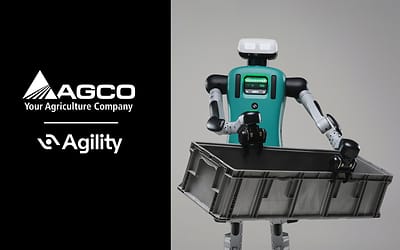
Agility's Digit humanoid lands at an AGCO factory
Image source: Agility Robotics
Snapshot: AGCO and Agility Robotics have signed a commercial agreement to pilot Agility's Digit humanoid at AGCO's farm-equipment plant in Hesston, Kansas, with the deployment expected to begin in 2027.
Breakdown:
The pilot starts narrow: Digit will handle parts sorting and stacking and place totes into storage, the repetitive material-handling tasks that wear on human bodies.
AGCO, a major agricultural-equipment maker, framed the agreement as a move toward more flexible, intelligent factories rather than a headcount cut.
The deal adds farm-machinery production to a Digit track record that already spans automotive and logistics customers.
For Agility, a named public pilot with a listed manufacturer turns "warehouse-ready" from a pitch into a customer commitment with a date attached.
Takeaway: Pilots like this are how humanoids earn their way onto a real line, one bounded task at a time, measured against a human baseline. Ops leaders should read the 2027 start date as the honest timeline: the robots are capable enough to sort parts, not yet to run a cell unsupervised, and the distance between those two is where your integration budget goes.
⏱️ The Compliance Clock
91 days
until the EU Machinery Regulation becomes mandatory (Jan 20, 2027)
As humanoids move from demo videos onto real production lines, the rules that govern them are catching up. The EU Machinery Regulation (2023/1230) replaces the decades-old Machinery Directive and applies to any machine placed on the EU market, humanoid robots included. If you are piloting a humanoid for a European site, confirm now that the supplier can hand over a compliant Declaration of Conformity, because adding that paperwork after the robot is on your floor is the expensive path.
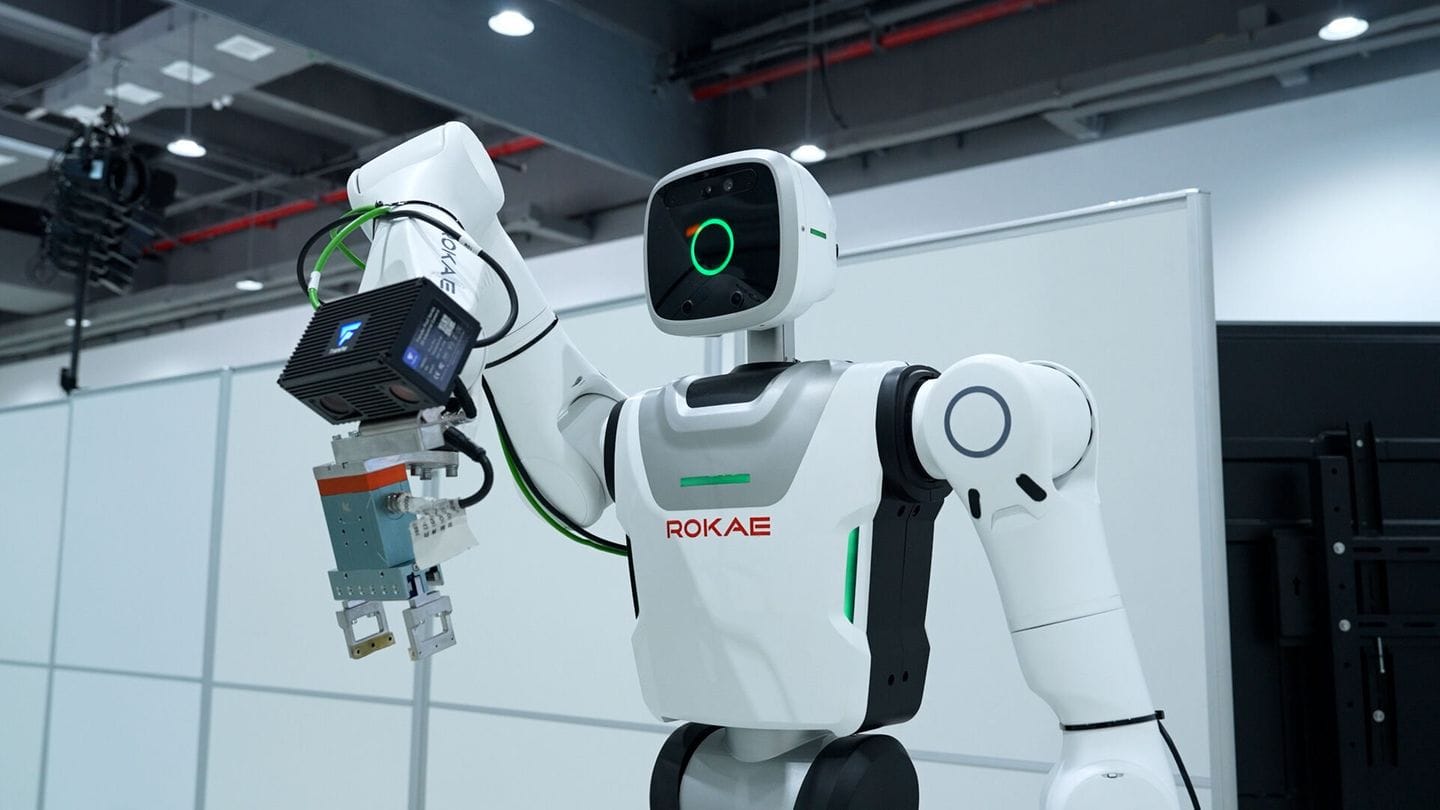
Schaeffler opens a line where humanoids build humanoids
Image source: Schaeffler
Snapshot: German motion-technology supplier Schaeffler opened a lighthouse factory in Taicang, China, where humanoid robots assemble the joint modules that go into the next generation of humanoids.
Breakdown:
Across roughly 7,500 square meters, six humanoids work five stations on a single line, staging and sorting parts, joining them, then inspecting, labeling, and packaging the finished modules.
Those modules are the linear and rotary actuators at the core of any humanoid, and the plant marks the start of Schaeffler's mass production of them.
A digital twin mirrors the line in real time, capturing assembly accuracy, cycle time, and energy use so changes can be tested virtually before they reach the floor.
Schaeffler said the third quarter of 2026 brought two new Greater China customers and lifted its global humanoid-robotics order book to around 400 million euros.
Takeaway: "Humanoids making humanoids" is a tidy marketing line, but the real signal is vertical integration: the companies that supply the actuators and bearings are now building the robots that assemble them. For buyers, that concentrates the supply chain in fewer hands, which can shorten lead times but also leaves fewer independent sources if you ever need to second-source a critical joint.
News
OpenAI confirms it is building a humanoid robot
Snapshot: OpenAI CEO Sam Altman confirmed the company is building its own humanoid robot and said he expects a compelling demonstration of the technology in 2027.
Breakdown:
Altman argued the human form makes sense because the physical world is already designed for people, so matching that shape lets a robot slot into spaces that already exist.
He framed the hard part as the robot's intelligence, the software that lets it perceive and act, rather than the mechanical body.
OpenAI has not described what the machine will look like, what it will cost, or when it might reach businesses or consumers.
Altman cautioned that a 2027 demo is not a product launch, and that robots in everyday public spaces remain years away.
Takeaway: An OpenAI humanoid is a long way from a purchase order, but the entry still matters for buyers because it pulls another frontier-model lab into physical AI, alongside the chipmakers and China's output machine. The companies that win will be the ones with the best manipulation data and the most real deployments, which is exactly what this week's factory pilots are quietly accumulating.
▶ Operator's Playbook
Before you sign a humanoid pilot like AGCO's, ask the vendor for the robot's Declaration of Conformity and the exact safety standards it was assessed against, ISO 10218 for the robot and ISO/TS 15066 if it will share space with workers. If the supplier cannot name them, you are the one who inherits the compliance gap when the machine reaches your floor. Scope the first deployment around a single bounded task, parts sorting or tote placement, so you can measure cycle time against a human baseline before anyone talks about scaling.
Eka Roboticsraised $150 million at a $1.45 billion valuation in a round led by a16z and F-Prime, backing a force-sensitive "vision-force-action" model its investors say is approaching superhuman dexterity on some manipulation tasks.
Germany's governmentsigned a pact with Nvidia at the Invest in Germany Summit to co-develop open industrial Physical-AI models on Nvidia's Nemotron and Cosmos, aimed at putting the country's Mittelstand to work on robotics and factory AI.
Fairinoclosed two rounds led by Meituan and its Long-Z arm, bringing the Chinese collaborative-robot maker's cumulative funding to nearly $150 million for core-component capacity and larger deployments.
Siemenstargets up to 80% factory automation with AI, up from 30 to 40 percent today, a shift board member Cedrik Neike cast as a way to keep manufacturing jobs in high-wage countries like Germany.
NEURA Roboticsteamed with Austria's NXAI to give cognitive robots a memory system built on NXAI's xLSTM architecture, adding the model to NEURA's Neuraverse platform alongside its own Neuron AI foundation model.
Ardaemerged from stealth with $230 million at a $1.5 billion valuation, the manufacturing-AI startup from former OpenAI research chief Bob McGrew, whose software for designing assembly lines is already running at defense maker Anduril.
Compliance tool
Where does your robot documentation stand?
The ISO 10218:2025 Gap Analysis Checklist finds every gap in 62 audit questions.
The hard part of a humanoid was never the walking or the backflips. It is doing the same unglamorous task ten thousand times, without a person nearby to reset it when it fumbles. The factories opening this month are buying exactly those boring hours, and that is where the real progress tends to hide.