SoftBank's $18B robot-guard bet, Digit 5's 9-minute charge, Unitree's free swarm app, Hong Kong's robot proving ground, Renesas's humanoid-chip team, and Hyundai's factory-AI road map.
The Big Number
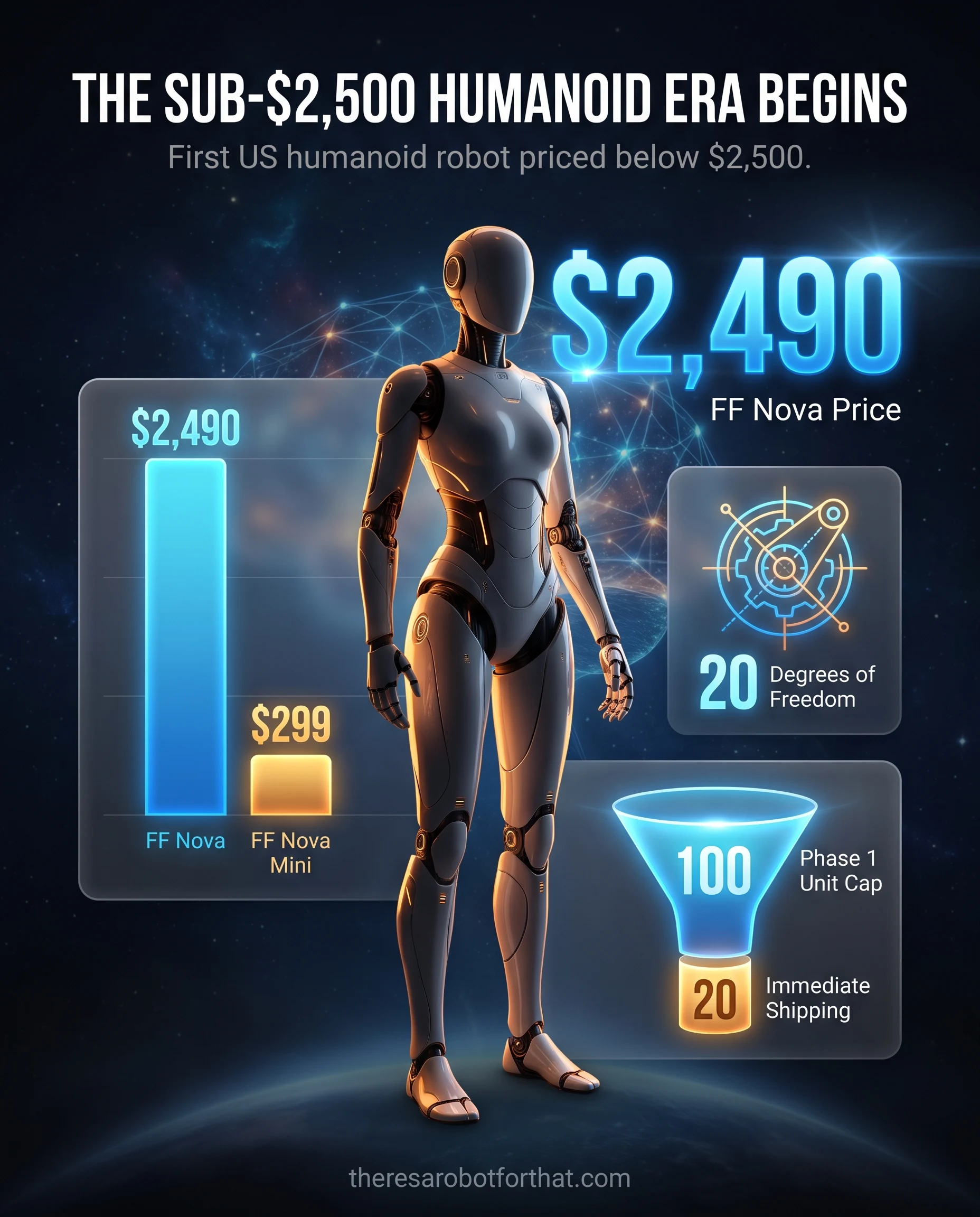
The first humanoid robot openly offered for sale in the United States now lists at $2,490.
Welcome back to your Robot Briefing
This week the humanoid business chased two very different buyers at once: the developer who wants a robot on the desk for a few thousand dollars, and the factory that needs one running two shifts a day. Both got an answer.
The thread underneath all of it is cost. Cheaper hardware, faster charging and in-house production are aimed at the same question operators keep asking, which is when the math finally works. This issue follows the price tags and the uptime numbers to where that answer is starting to show.
The 60-Second Read
Faraday Future put a $2,490 humanoid, FF Nova, on sale in the US, plus a $299 Nova Mini for classrooms, the first offered under $2,500.
Boston Dynamics now builds a complete Atlas in about a day and is aiming for one hour by 2027.
Agility's Digit 5 will run more than 20 hours a day on a 9-minute charge, turning uptime into the humanoid business case.
SoftBank is weighing an $18 billion deal for the largest US security firm, with robots meant to take over some guard shifts.
News
Faraday Future Puts a $2,490 Humanoid on Sale in the US
Image Source: There's A Robot For That
Snapshot: Faraday Future and its sister company FFR launched two humanoid robots on October 15, the $2,490 FF Nova for developers and schools and the $299 FF Nova Mini for classrooms, which the companies call the first US humanoid robot priced below $2,500.
Breakdown:
FF Nova is a 20-degree-of-freedom bipedal robot with lidar, depth and wide-angle vision that can walk, ride a detachable base and get back up after a fall, sold with a $390 developer skills package and an open ROS 2 SDK.
The launch runs in three phases: phase one is invitation-only and capped at 100 units, with the first 20 shipping immediately, before any wider developer or consumer release.
FF Nova Mini weighs under one kilogram, targets ages eight and up, and pairs with a $499 curriculum of 16 live classes aimed at K-12 physical-AI education.
The robotics business is being folded into FFR in an all-stock deal that values it at about $200 million, at $2.246 per share, roughly a 50% premium to FFR's October 12 closing price.
Takeaway: A sub-$2,500 humanoid reads like a breakthrough until you read the fine print. Faraday Future warns in the same filing that it may not be able to continue as a going concern and that all its robots come from Chinese contract manufacturers exposed to possible US import limits. For a buyer, this is a development and classroom platform to watch, not a production worker to deploy, and the real test is whether those first 20 units ship and do what the launch video shows.
News
Boston Dynamics Can Now Build an Atlas in a Day
Image source: Boston Dynamics
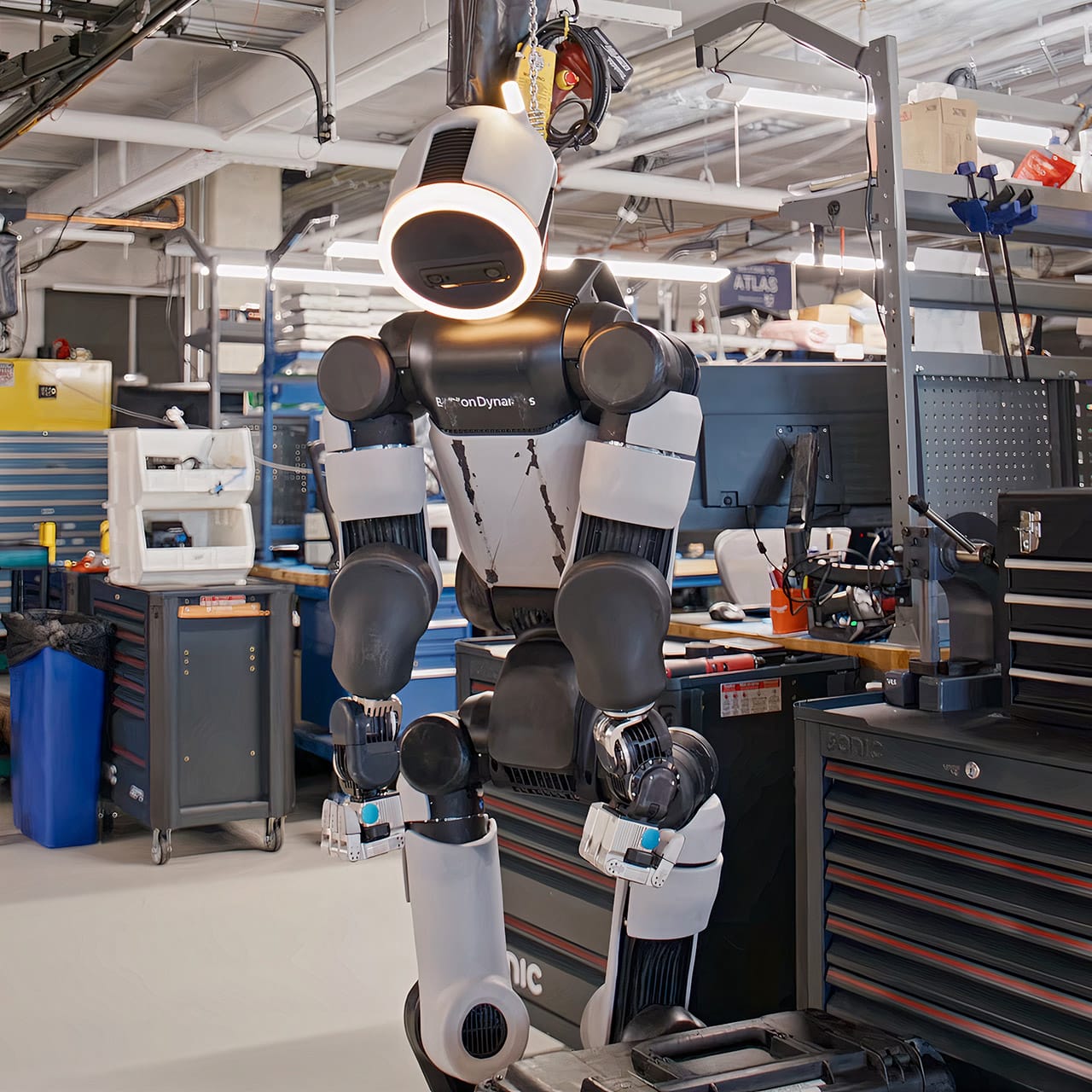
Snapshot: Boston Dynamics opened its Atlas prototype shop on camera, showing that a humanoid that took multiple days to assemble a year ago now comes together in roughly a single day at its Waltham, Massachusetts headquarters.
Breakdown:
Technical program manager Katie Conner says the current benchmark is about one day per robot, with a stated target of one hour by 2027 and minutes in the years after that.
The plant keeps machining, assembly and repair under one roof, so an engineer can hand a design change to a machinist and have the revised part running in an assembled Atlas the same day or the next.
Robotic arms already handle repetitive steps like bolting on the line, while people focus on fit and function, and a fault found on a Monday can be fixed and retested by the end of the week.
Boston Dynamics unveiled the commercial Atlas at CES in January and began production immediately, moving a three-decade research platform toward serial manufacturing.
Takeaway: Build speed is a quieter signal than a dancing demo and a more useful one for operators. A maker that can assemble a unit in a day can iterate hardware fast and, eventually, supply fleets without the long lead times that have stalled pilots. The figure to track is not the one-hour target, it is how many finished units actually leave Waltham each month.
⏱️ The Compliance Clock
93 days
until the EU Machinery Regulation becomes mandatory (Jan 20, 2027)
This week's European robot work, from Fincantieri's shipyard deployments to collaborative humanoids built to stand next to people, all falls under the EU Machinery Regulation (2023/1230), the rulebook that replaces the old Machinery Directive as the mandatory basis for placing a machine on the EU market. For a humanoid sharing a floor with workers, it raises what an operator has to document before deployment: a risk assessment, the technical conformity file and the CE declaration, not a demo afterward. If you are running an EU pilot, the countdown below is how much time is left to get that file in order.
News
Fincantieri Puts Nearly $100M Into Shipyard Robots
Snapshot: Fincantieri is investing nearly $100 million through 2030 to roll robotics, physical AI and automation across 13 shipyards under its BOOST² program, shifting from pilots into full industrial deployment.
Breakdown:
The money expands collaborative robotics, digital twins, smart supply-chain systems and additive manufacturing, which Fincantieri is now embedding into daily shipyard work without halting production.
BOOST², the Shipyard of the Future program launched three years ago, has already run across 13 yards and more than 450 employees, including the Marinette Marine yard in Wisconsin.
CEO Pierroberto Folgiero frames bringing AI into physical industrial operations as the next axis of competition in manufacturing, with the goal of scaling proven tools rather than one-off experiments.
The company is widening its supplier search, including a dual-use hackathon in Silicon Valley, to pull startups into future shipyard technology.
Takeaway: Heavy industry is where humanoids and cobots have to earn their keep against hard safety rules. A shipyard running collaborative robots next to welders in the EU is exactly the setting the EU Machinery Regulation was written for, and the documentation burden lands on the operator. The lesson for any plant is that the robot budget and the compliance budget are the same project.
News
Japan's Shimizu Backs a US Startup for Construction Humanoids
Snapshot: Shimizu, one of Japan's largest builders, has invested in Noble Machines, a Silicon Valley startup building humanoid robots for construction sites, and opened a full development partnership around its MOBY robot line.
Breakdown:
The plan pairs Noble Machines' hardware and software with Shimizu's site expertise to build humanoids that can take on physically demanding and hazardous construction tasks.
Shimizu will fold its BIM and CIM building data into virtual simulations, then test the robots at real sites, starting with material transport, site navigation and patrols.
Simulation work begins by the end of 2026, with physical-robot trials at active construction sites from spring 2027.
Noble Machines, founded in May 2024 and led by CEO Wei Ding, develops the MOBY series along with its control systems and application software.
Takeaway: Construction is the labor-shortage case that keeps resurfacing, and Japan is treating it as an engineering problem rather than a showcase. Shimizu did not disclose how much it put in, so the signal here is the staged plan, simulation first and then supervised site trials, not a deployment date. For contractors, the question to ask a humanoid vendor is which specific task it has survived on a real site, not in a render.
▶ Operator's Playbook
If you are scoping a humanoid for an EU site, ask the vendor this week for its EU Machinery Regulation conformity file: the risk assessment, the list of safety functions with their declared performance levels, and the CE Declaration of Conformity. Map each robot task you plan to the hazard it creates near a worker, and require the vendor to show the validation method, not a demo clip. The makers racing to cut prices and build faster are not the ones who will file that paperwork for you, so the conformity gap is yours to close before the first shift, and before an auditor finds it.
SoftBankis weighing an $18 billion deal for Allied Universal, the largest US security firm, with a plan to eventually hand some guard shifts to robots.
Nyoboltwill power Agility's Digit 5 with a battery that charges in 9 minutes and runs for 90, letting the robot work more than 20 hours a day at a 10:1 run-to-charge ratio.
Unitreereleased UniUni , a free Windows and macOS app that lets owners choreograph and monitor fleets of its H2 and G1 humanoids with a one-tap emergency stop.
Hong Konglaunched an embodied-AI hub with seven technology partners and eight scenario partners, a proving ground to test robots in real factories, warehouses and public spaces before deployment.
Renesasset up a physical-AI team of more than 108 people to supply chips and full-system support for humanoids, a segment where its robotics-chip revenue from humanoids is still 8% but more than doubling each year.
Hyundai Motoris widening its factory-AI push , developing AI inspection systems and logistics robots while working with Nvidia on its Polaris manufacturing platform, and targeting humanoid robots in its plants from 2032.
Free for subscribers
Deploying humanoids this year?
Our Facility Readiness Checklist walks your site before the robot arrives, 77+ items, one complete toolkit module.
A $2,490 robot and a plant that finishes one a day make the same promise, that the price of a humanoid is finally falling toward something an ordinary budget can carry. The honest part is what sits just underneath: a going-concern warning, a supply chain in someone else's country, a safety file nobody has filled out yet. Cheaper and faster are real. They are just not the same thing as ready.