South Korea Lets Humanoids Onto Live Factory Lines
Mujin's $224M raise, a Danish night-shift robot crew, D.R. Horton's robot homes, and XPeng's European date.
The Big Number
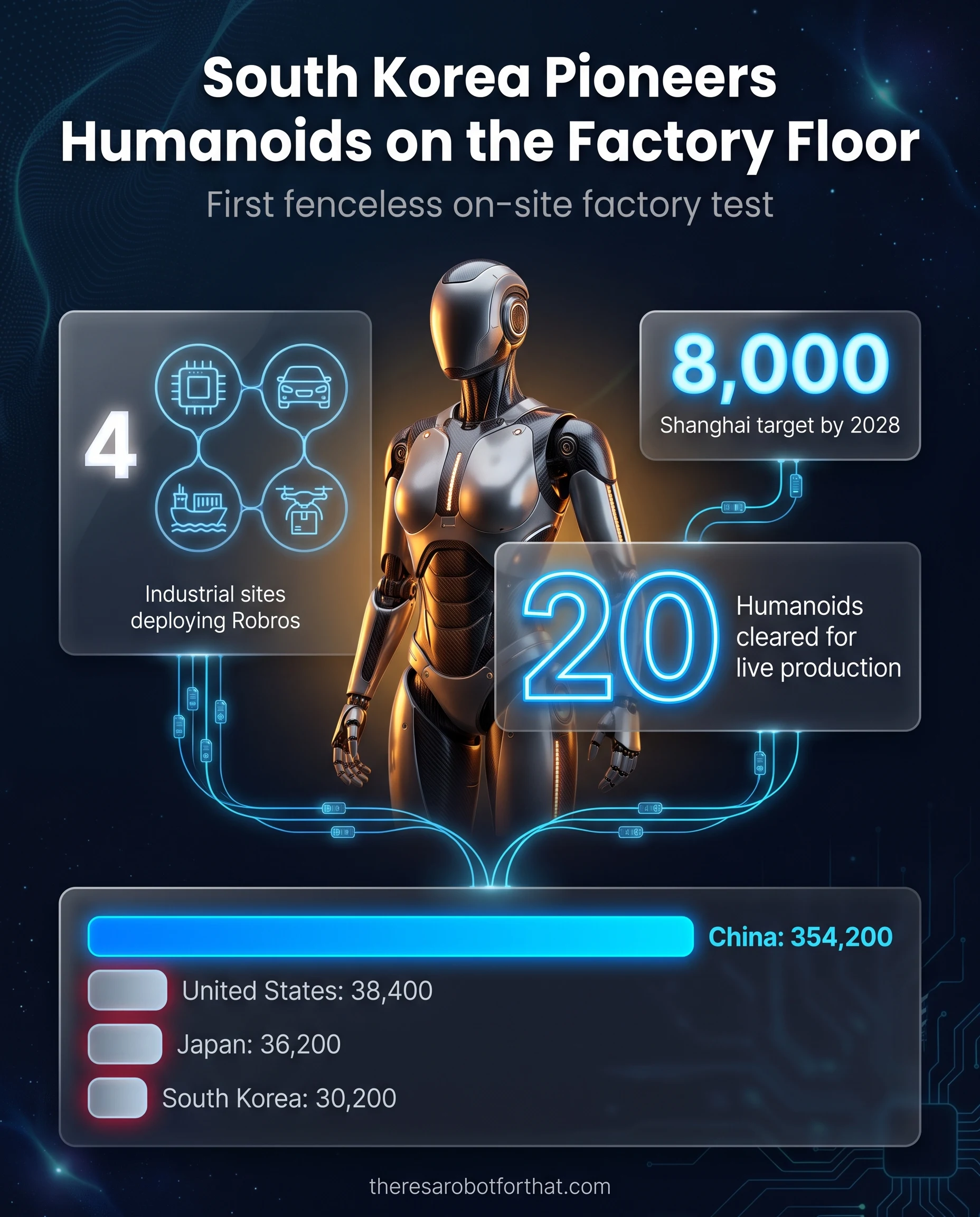
South Korea cleared its first 20 humanoid robots to work live production lines beside human workers, the country's first on-site factory test of the machines.
Welcome back to your Robot Briefing
The week's throughline is permission. Regulators and buyers stopped asking whether humanoids can do factory work and started writing the rules, contracts and timelines for when they will.
South Korea tore up safety rules built for caged machines, a Japanese warehouse-software maker raised a quarter of a billion dollars, a Danish grocery chain handed night shifts to robots, and America's largest homebuilder signed up to rent robotic factory capacity. Here is what moved and what it means for operations.
The 60-Second Read
South Korea cleared 20 humanoids to work live production lines beside people, easing safety rules built for caged, stationary robots.
Japan's Mujin raised about US$224 million as SK Square bets its warehouse and fab control software can run "autonomous fabs."
A Danish grocery chain put Unitree humanoids on overnight shelf restocking, aiming for independent night work by early 2027.
D.R. Horton became the first major U.S. homebuilder to rent robotic factory capacity, for more than 1,250 homes.
News
South Korea Opens Live Factory Lines to 20 Humanoids
Image Source: There's A Robot For That
Snapshot: South Korea's trade ministry cleared the country's first on-site factory test of humanoid robots, granting a regulatory exemption so 20 bipedal machines from Robros can work alongside people on real production lines.
Breakdown:
The 20 Robros humanoids will deploy at four sites: cleaning contaminants off semiconductor packaging parts at Nepes, placing auto body components at Sungwoo Hitech, stacking shipbuilding scaffolding brackets at HD Hyundai Samho, and moving refrigerated logistics packaging at Delivery Lab.
Existing rules assumed stationary robots and required safety fences to separate people from robot work areas, a structure that does not fit humanoids moving near workers, so the ministry's Industrial Convergence Regulatory Sandbox granted a live-testing exemption and plans to use the data to rewrite the standards.
For scale, BMW ran a Figure 02 humanoid at its Spartanburg plant for roughly 10 months, where it handled more than 90,000 parts across production of over 30,000 X3 vehicles, and Shanghai has set a goal of 8,000 factory humanoids by 2028.
Korea installed 30,200 industrial robots last year by the International Federation of Robotics count, behind China's 354,200, the United States' 38,400 and Japan's 36,200.
Takeaway: The bottleneck for humanoids on the factory floor has been regulatory, not mechanical, and Korea just showed how a government clears it: a time-boxed exemption that treats the pilot as the evidence base for permanent rules. Operators watching this should expect the safety case, not the hardware, to decide their own deployment timeline.
News
Mujin Raises $224 Million as SK Square Bets on Autonomous Fabs
Snapshot: Japanese physical-AI company Mujin raised a Series D round of more than 300 billion Korean won, roughly US$224 million, with SK Square's overseas arm TGC Square joining as a key investor.
Breakdown:
Founded in 2011, Mujin builds MujinOS, a general-purpose platform that controls and coordinates fleets of robots and automation equipment across factories and logistics warehouses.
The company has now raised more than 600 billion Korean won total from backers including Japan's NTT Group, the Qatar Investment Authority and Salesforce Ventures, and carries a valuation above US$1 billion.
SK Square wants MujinOS to centrally run the autonomous mobile robots inside semiconductor plants across the SK Group, framing the deal as a step toward "autonomous fabs" and tying it to chip packaging, logistics and fab construction.
The investment brings to eight the number of U.S. and Japanese AI and semiconductor companies SK Square has backed through TGC Square.
Takeaway: The money is flowing to the orchestration layer, not the robots themselves, because a buyer with dozens of robot types has a fleet-control problem long before it has a hardware problem. Any operator running mixed automation should ask who owns the layer that coordinates it, since that is where this round says the leverage sits.
⏱️ The Compliance Clock
When a humanoid shares floor space with a person instead of standing behind a fence, the governing safety reference shifts to ISO/TS 15066, which sets concrete force and pressure limits for any contact between a robot and a human body. South Korea's clearance is notable precisely because its old rules assumed bolted-down robots and physical barriers, the exact gap ISO/TS 15066 exists to fill. Any operator running a humanoid near staff should be able to show where those limits were measured and met.
A Danish Grocery Chain Hands Night Shifts to Humanoids
Snapshot: Danish supermarket chain Føtex is trialing humanoid robots that restock shelves overnight, built on Unitree hardware and developed by Denmark's Hive Robots.
Breakdown:
Human operators began teaching the robots movements and procedures in June 2026, with the goal of independent overnight restocking by early 2027.
Most of the work is planned for hours when stores are closed to customers, freeing daytime staff for tasks that involve helping shoppers rather than repetitive manual stocking.
Future functions under consideration include monitoring product expiry dates, detecting empty shelves and flagging misplaced items.
The split matters: this is a named retail chain running a production trial, not a one-off demo, pairing Chinese humanoid hardware with local software integration.
Takeaway: Retail is testing humanoids where the economics are easiest to defend, on the overnight shift that is hard to staff and runs with no customers in the aisle. The first durable humanoid jobs in stores will look like this, scheduled around people rather than next to them, which lowers the safety bar and the resistance at the same time.
News
D.R. Horton Becomes the First Major Homebuilder to Rent Robot Factories
Snapshot: Promise Robotics signed a multi-year agreement with D.R. Horton, America's largest homebuilder by volume, to produce more than 1,250 homes through its Factory-as-a-Service platform.
Breakdown:
Factory-as-a-Service takes a builder's existing home designs and translates them into a coordinated process spanning robotic manufacturing, factory operations and onsite installation, so builders get automated capacity without building or running their own plants.
D.R. Horton is the first major U.S. homebuilder to use the platform, and the deal expands as Promise builds out its U.S. production network.
Promise frames the move against persistent housing demand, labor shortages and rising costs, pitching repeatable factory output as the fix for homebuilding's chronic capacity problem.
D.R. Horton's strategic growth lead said the platform gives the builder a new way to improve cycle times and add production capacity with more predictability.
Takeaway: The Factory-as-a-Service model matters more than the robots in it, because it lets a buyer add automated capacity as an operating expense instead of a capital project. For any operations leader weighing automation, the question this deal raises is whether to own the line or rent the output, and the largest homebuilder in the country just chose rent.
▶ Operator's Playbook
Before a humanoid pilot that shares space with staff, ask the vendor for a written risk assessment that cites ISO/TS 15066 force and pressure limits at every point where the robot can contact a worker, and model the cost of converting a fenced cell to a fenceless one, including re-layout and re-training, before you sign. That document is what a regulator or insurer will ask for first.
XPengset a timetable to roll out its IRON humanoid in Europe in the second half of 2027, its first regional date, with sales-center jobs such as guided tours and shopping assistance coming first.
JAKA Roboticsdebuted the Kargo50 wheeled humanoid for factory tote handling and a 50 kg Zu50 cobot at Shanghai's China International Industry Fair, both billed as global firsts.
Omronagreed to buy U.S. industrial-PC maker OnLogic and its parent for US$675 million, folding rugged computers into its push toward factory-floor physical AI.
Rivian spinoff Mind Roboticshired former Ford EV chief Doug Field as president, a year after launching with more than US$1 billion in backing to automate industrial work using Rivian's own factories as a training ground.
Ubitiumraised US$14 million for a single RISC-V processor that merges sensing, AI inference and real-time control, aiming to replace the separate chips most robots and drones use today.
Archon Roboticsdemonstrated a Whole-Body Intelligence system driving a humanoid through household chores, linking high-level task planning to coordinated full-body motion.
Compliance tool
Where does your robot documentation stand?
The ISO 10218:2025 Gap Analysis Checklist finds every gap in 62 audit questions.
A robot earns its place on a line the day the paperwork says it is safe to stand next to, not the day it first picks up a part. The engineering was ready a while ago. This week was about the signatures catching up.