Agility Heads to Wall Street as China Scales Humanoids
a 576K euro microfactory bet, Hesai's robot-training camera, Physical Intelligence opens its API, ABB's fashion-logistics AI, DexForce's synthetic-data humanoids, and Honeywell's building brain.
The Big Number
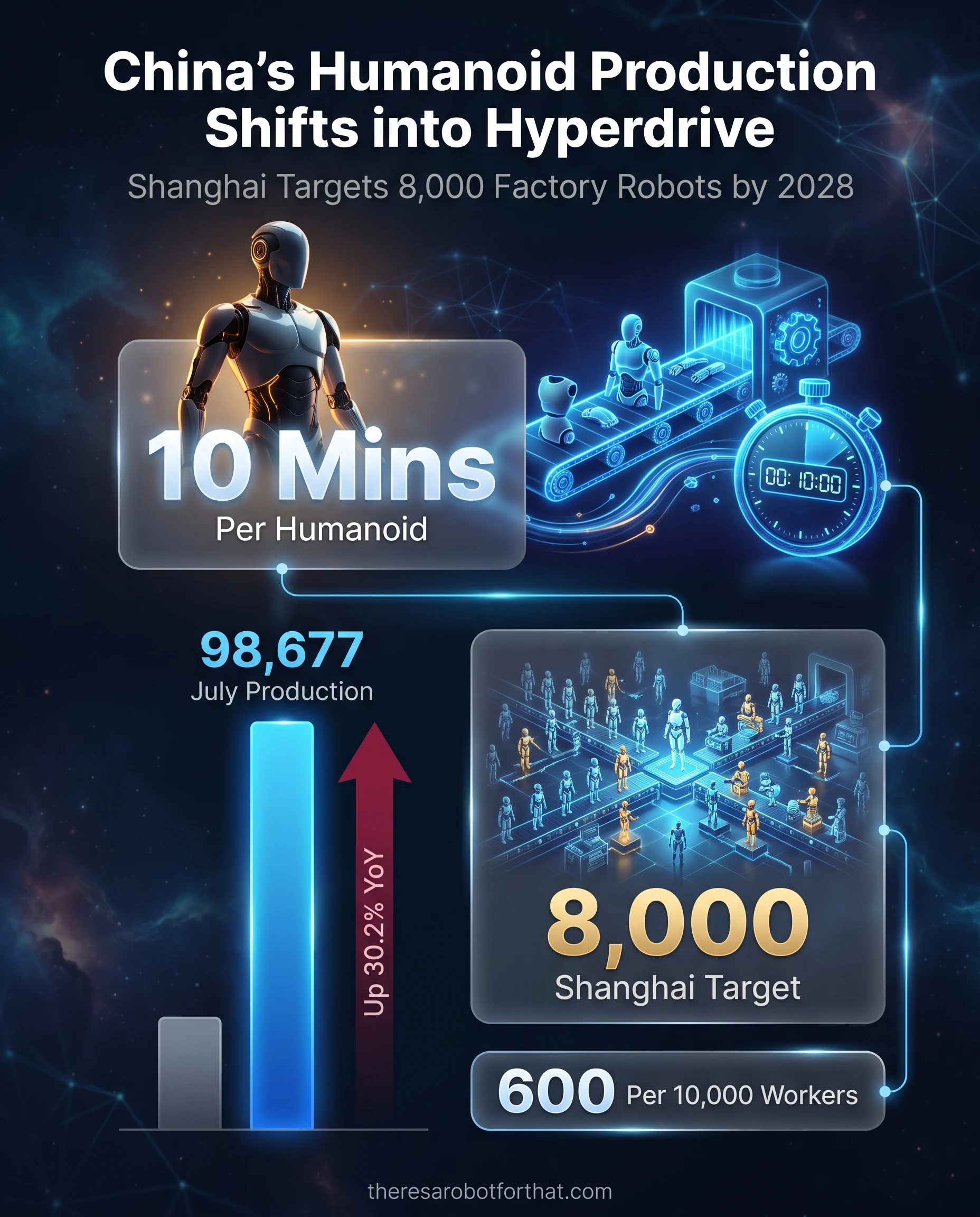
A new Chinese factory can now roll out a fully assembled industrial humanoid every 10 minutes.
Welcome back to your Robot Briefing
The humanoid industry spent this week doing two things at once: proving it can raise money and proving it can build at scale. One maker is about to open its books to Wall Street, while a Chinese city is treating factory humanoids like a production quota.
Underneath the headlines, the same question keeps surfacing for operators. Not whether the robots can move, but whether the economics, the safety paperwork and the supply actually line up yet. This issue follows the money and the machines to where that answer is starting to show.
The 60-Second Read
Agility Robotics is set to become the first US-listed pure-play humanoid maker, with more than $620 million in proceeds and a November shareholder vote.
Shanghai wants 8,000 humanoids in its factories by 2028, and a single Chinese plant can now build one roughly every 10 minutes.
A Singapore hotel precinct will run service robots across 772 rooms, with a modeled 10% cut to selected monthly costs.
Icon pulled in $200 million to scale its construction robots as the US runs about 4 million homes short.
News
Agility Clears the SEC and Heads for a Nasdaq Listing
Snapshot: Agility Robotics cleared its last regulatory hurdle toward a public listing after the SEC declared its Form S-4 effective, with a shareholder vote set for November 2 and a close expected later in November.
Breakdown:
The deal, a merger with blank-check company Churchill Capital Corp XI, is expected to bring in more than $620 million in gross proceeds, roughly $424 million from Churchill's trust and about $200 million from a Foxconn-led stock PIPE.
The combined company would trade on Nasdaq as AGLT and, by Agility's own description, become the only US-listed pure-play humanoid maker with active commercial deployments.
Its Digit robot is already working at Schaeffler, GXO and Toyota Motor Manufacturing Canada, with earlier generations logging more than 65,000 hours of real-world operation.
Agility says it holds more than $300 million in committed Digit 5 orders and plans to grow committed facility deployments from nine today to as many as 25 by the end of 2027.
Takeaway: A humanoid maker opening its books to public markets means quarterly disclosure on orders, deployments and losses. That is the first real scoreboard operators can use to judge whether humanoid return on investment is arriving or still living in a pitch deck.
News
Shanghai Wants 8,000 Humanoids on Its Factory Floors by 2028
Image Source: There's A Robot For That
Snapshot: Shanghai set a target of putting 8,000 humanoid robots into factories by 2028 under a smart-manufacturing action plan unveiled at the China International Industry Fair.
Breakdown:
The plan also calls for 500 advanced smart factories, more than 2,000 AI manufacturing use cases, and industrial-robot density of about 600 units per 10,000 workers by 2028.
Supply is scaling to match: UBTech's new plant in Liuzhou can produce 10,000 industrial humanoids a year, which the city describes as roughly one every 10 minutes, with Siemens software behind the line.
China's industrial-robot output reached 98,677 units in July, up 30.2% from a year earlier, with 635,056 units made in the first seven months of 2026.
The robots on the floor are mostly UBTech's Walker S and Cruzr lines, built in a facility the company says moves humanoids from pilot runs to full-scale manufacturing.
Takeaway: For operators sourcing humanoids, the signal is supply, not just ambition. When one Chinese line can turn out 10,000 units a year, lead times and unit prices for factory-grade humanoids should start moving in the buyer's favor over the next two years.
⏱️ The Compliance Clock
As humanoids move onto real factory floors, the standard that governs them is ISO 10218, whose 2025 revision raises the documentation bar and pulls collaborative, work-alongside operation into the core industrial-robot requirements. In practice that means a humanoid sharing space with workers has to carry a documented risk assessment and validated safety functions, not just a convincing demo. For any operator running a pilot, it is the paperwork a buyer should be asking to see.
A Singapore Hotel Hands 772 Rooms to Service Robots
Snapshot: YYForce signed a partnership with the Novotel and Mercure hotels on Stevens in Singapore to roll service robots across a 772-room precinct, with humanoid housekeeping kept to a later research phase.
Breakdown:
Phase one puts specialized robots on guest deliveries, food and beverage logistics, scheduled cleaning and concierge support, though deployment has not yet begun.
A pre-deployment model projects about 10% lower monthly operating costs across selected housekeeping, concierge and food-and-beverage tasks with robot costs already counted in, plus a separate estimate of 5% lower rooms-department overtime.
The hotels, part of Accor, will supply the operating environment and workflows while YYForce, listed on Nasdaq as YFOR, provides hardware, maintenance and technical staff under a memorandum of understanding.
A second phase would observe room-attendant and banquet work to train YYForce's humanoid system, which the company stresses cannot yet clean an occupied guestroom on its own.
Takeaway: This is the honest version of hospitality robotics. Wheeled service robots deploy now with a modeled 10% cost case, while humanoids stay in the training wing. Operators weighing either should ask for the cost model's scope before trusting the headline percentage.
News
Icon Raises $200M to Scale Its Construction Robots
Snapshot: Icon raised $200 million in a Series D co-led by Baillie Gifford and BlackRock funds to scale its robotic construction systems across more US markets.
Breakdown:
The money funds production of Titan, Icon's multi-story printing system, a new Austin research facility, and expansion into Texas, Florida and Washington, D.C.
Icon says it is on pace for 4x revenue growth in 2026 and has built more than 270 homes and structures across five states and two countries.
Its defense and space unit has won more than $370 million in government contracts, including 10 3D-printed barracks at Fort Bliss and NASA's lunar-construction Project Olympus.
The company frames the bet against a US housing shortfall of roughly 4 million homes and a construction workforce where 41% is expected to retire by 2031.
Takeaway: Construction automation is now being funded as infrastructure, not a demo. For facility and real-estate operators, the near-term question is whether printed walls rated for higher wind and fire loads change the insurance and permitting math, not whether the robots can print.
▶ Operator's Playbook
This week, pull the safety documentation on any humanoid you are piloting and check it against the 2025 revision of ISO 10218. Ask the vendor for the written risk assessment, the declared performance level of each safety function, and the validation method for operation near people. If the answer comes back as a demo video instead of a document, you have just found your compliance gap before an auditor does.
120ftemerged from stealth with a 576,000 euro angel round from 22 investors to build container-sized microfactories run by humanoid robots in Stockholm.
Hesailaunched Kosmo , billed as the world's first 8K AI spatial camera paired with a cloud engine, to turn real spaces into 3D training data for robots.
Physical Intelligenceopened its Pi API beta , letting outside developers fine-tune and run its robot foundation models on hosted compute it manages.
ABB Roboticsrolled out its first end-to-end vision-based physical AI, cutting integration and commissioning effort up to 75% for fashion-logistics sorting.
DexForcetrains its W1 Pro humanoids on synthetic data to cut costs, after raising 1 billion yuan, about US$147 million, in a Series B backed by Lenovo Capital.
Honeywelllaunched Forge Cognition with NVIDIA and Dell, putting AI agents and digital twins on top of building and industrial systems, with operators setting how much it runs on its own.
Compliance toolkit
The EU Machinery Regulation applies from January 20, 2027.
The Robot Safety Documentation Toolkit gives your team all seven compliance documents, ready to fill in.
A plant that can finish a humanoid every ten minutes is impressive. What matters more is the quieter work around it, the safety file, the cost model, the first boring shift that actually gets done. The robots are arriving. The real question is whether the paperwork and the economics arrive with them.