Figure's robots walk into 30 strange homes, D-Robotics banks $400M, and Korea wires a billion dollars into its factory floors.
The Big Number
Agility just put the first hard price on a general-purpose warehouse humanoid, about $8,500 a month to rent one that works next to people without a safety cage.
Welcome back to your Robot Briefing
This was the week the humanoid stopped being a demo reel and started being a spreadsheet. A price tag, an order book, a payback period, a billion-dollar national budget: the numbers that decide whether a robot ever reaches your floor all showed up at once.
The lead is the one operators have waited three years for, a real cost to put a general-purpose humanoid to work. Below it, a home robot that no longer has to relearn every kitchen, a chip supplier fueling the machines underneath, and a government buying its way to the one thing money struggles to acquire.
The 60-Second Read
Agility's Digit 5 ships with a real price and more than $300 million in orders, but not until 2027.
Figure's robots did household chores in 30 homes they had never seen, with no retraining for each house.
D-Robotics raised $400 million to put its chips inside the next wave of humanoids.
South Korea committed about a billion dollars to turn two manufacturing regions into physical-AI test beds.
News
Agility Puts a Monthly Price on the Warehouse Humanoid
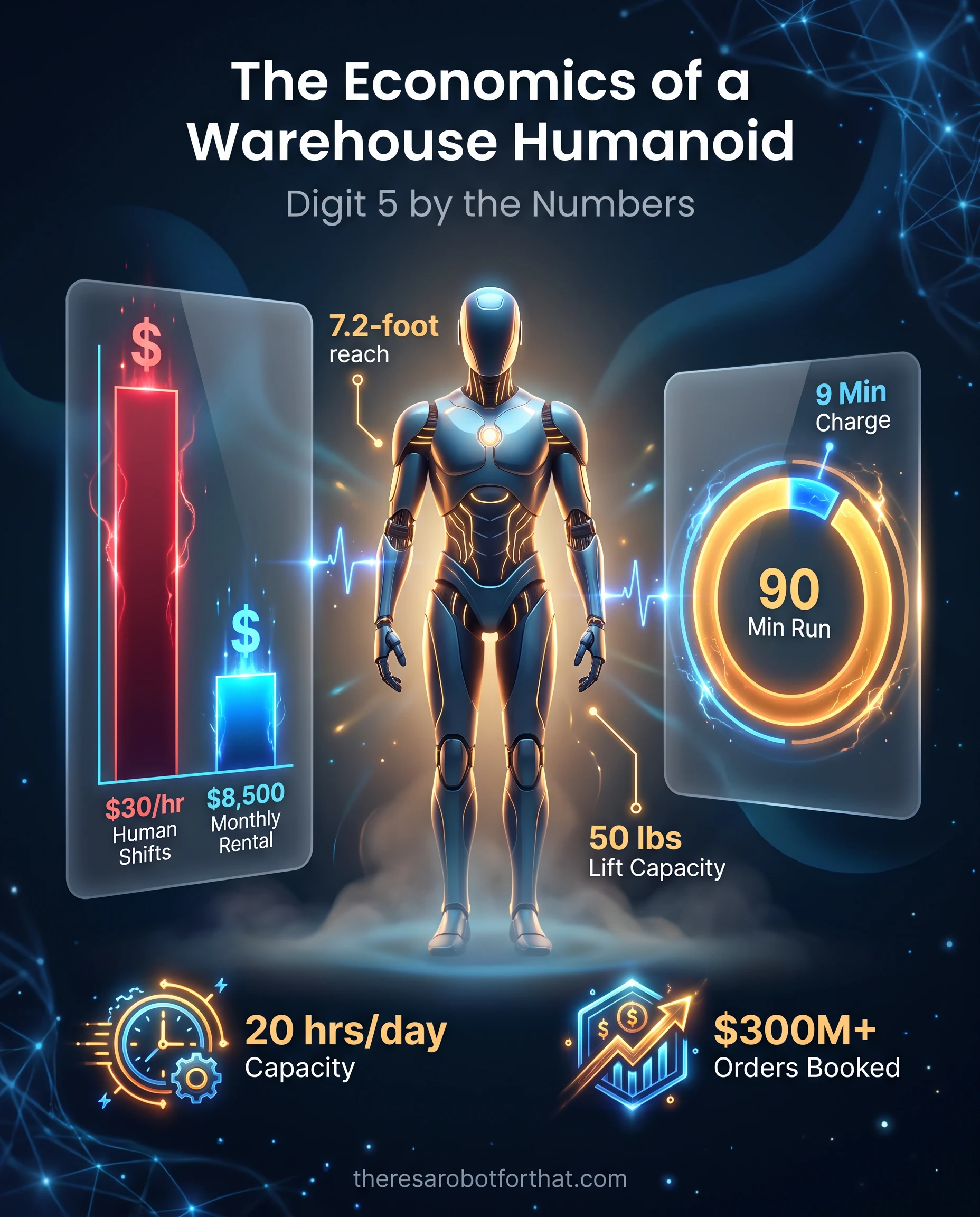
Image Source: There's A Robot For That
Snapshot: Agility Robotics unveiled Digit 5, a 284-pound humanoid engineered to work next to people without a safety cage, and for the first time attached hard economics to the machine.
Breakdown:
Digit 5 lifts up to 50 pounds repeatedly, 40% more than Digit 4, reaches shelves up to 7.2 feet, and runs 90 minutes on a 9-minute charge, a 10-to-1 run-to-charge ratio Agility says supports more than 20 hours of work a day.
An independent safety controller and onboard AI track nearby people, so Digit 5 steers around them, stops, or sits down and cuts motor power when someone gets close; Digit 4 was the first humanoid to pass an independent OSHA field evaluation on a customer production line.
Illustrative robots-as-a-service pricing in Agility's SEC S-4 filing runs about $8,500 a month per robot, roughly $102,000 a year, or about $200,000 to buy one outright, set against a fully loaded human labor cost near $30 an hour.
Digit 4 has logged more than 65,000 hours at GXO, Schaeffler, Amazon and Toyota's Canada plant, hitting 100,000 totes at about 98% accuracy at one GXO site; Agility reports more than $300 million in multi-year Digit 5 orders as of May, with early access in the first half of 2027.
Takeaway: A monthly number is what turns a humanoid from a science project into a line item you can model. At roughly $8,500 a month against labor near $30 an hour, Digit 5 pencils out only where a station runs long shifts and the work is genuinely single-person lifting. The order book says buyers believe that math, but nothing ships until 2027, so the window to run your own pilot and size the real payback is open right now.
News
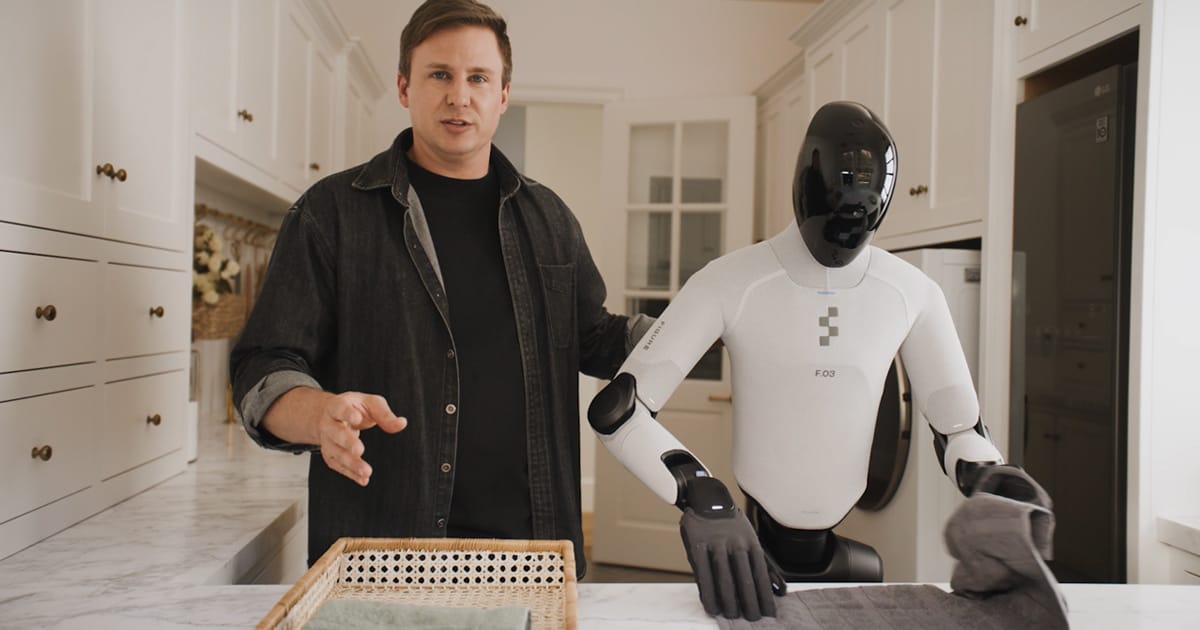
Figure's Robot Walked Into 30 Strange Homes and Got to Work
Image source: Figure
Snapshot: Figure put its humanoids into 30 homes they had never seen and had them tidy rooms, fold towels and make beds with no new training for each house.
Breakdown:
Helix 2.5 is the most advanced neural network Figure has built; across the 30 unseen Bay Area homes it ran all three tasks zero-shot, meaning no data collection or fine-tuning per home.
The pretrained model hit 56% zero-shot success against 9% for a model trained from scratch, more than six times higher, and reached it with about half the task-specific data of an earlier Helix behavior.
Figure credits its Index data engine, which it says is generating roughly 35 minutes of new human-experience data every second, for most of that jump in generalization.
Takeaway: Generalization is the number that matters for home robots, because a machine that has to be retrained for every kitchen never scales past a demo. Fifty-six percent is not deployable on its own, but the gap between 56 and 9 is the real signal, the same policy starting to carry across homes it has never seen. For anyone tracking when domestic humanoids stop being one-off installations, watch this success rate climb rather than the choreography in the launch video.
⏱️ The Compliance Clock
124 days
until the EU Machinery Regulation becomes mandatory (Jan 20, 2027)
Agility says Digit 5 will carry a CE mark for sale in the European Union and United Kingdom starting in 2027, which drops it squarely under the EU Machinery Regulation. That regulation replaces the decades-old Machinery Directive and, once it applies, makes a documented safety and conformity assessment mandatory before any machine, humanoids included, can be placed on the EU market. If you are scoping a humanoid for a European site, the compliance file is now part of the purchase, not an afterthought.
D-Robotics Banks $400 Million for the Chips Under the Humanoid
Snapshot: D-Robotics raised $400 million in Series C funding to put its Sunrise chips and software inside more of the robots the industry is racing to build.
Breakdown:
The round drew a strategic investment from an unnamed global internet company plus institutional and existing backers, and follows a $270 million Series B the Chinese company closed in April.
D-Robotics says Sunrise chip shipments have passed 8 million units, its S600 processor has been designed in by more than 20 embodied-AI customers, and revenue rose several times year over year in the first half of 2026.
The capital goes to widening the Sunrise line across compute tiers and building a software stack that spans the full robot development chain, from training in simulation to deployment on the robot.
Takeaway: The humanoid race is usually told as a story about arms and legs, but the harder bottleneck is the compute that runs the model on the machine, cheaply and reliably. A chip supplier raising $400 million and shipping in the millions is a sign the picks-and-shovels layer is consolidating fast. When you evaluate a humanoid vendor, it is worth asking whose silicon and software sit inside, because that choice, not the chassis, shapes upgrade paths and lock-in.
News
Korea Commits a Billion Dollars to Turn Factories Into AI Test Beds
Snapshot: South Korea's science ministry set aside about 1.4131 trillion won, roughly US$1.01 billion, over five years to turn two manufacturing regions into national test beds for physical AI.
Breakdown:
The Ministry of Science and ICT set a 2026 to 2030 roadmap in which Gyeongsangnam-do province focuses on precision manufacturing with AI working alongside people on the line, while Jeollabuk-do province runs a "dark factory" where AI designs and operates an entire plant built from different makers' equipment.
Manufacturers will hand over previously undisclosed production data, the accumulated know-how of skilled workers, to train models that then control real equipment and learn from the results.
Physical-AI specialist NC AI was selected for tasks in both regions, covering digital twins, world models and foundation models, and the government wants validated technology exported as "K-manufacturing plants."
Takeaway: State money at this scale changes the competitive map for factory automation, because it subsidizes the one thing private robotics cannot easily buy, real production data from skilled workers. Korea is betting that whoever owns that data owns the factory floor. For operators elsewhere, the signal is that your process data is turning into a strategic asset, worth protecting and, increasingly, worth a vendor asking to use.
▶ Operator's Playbook
Pull the robots-as-a-service math on one real station this week, before a vendor does it for you. Take a task you would hand a humanoid, multiply the fully loaded hourly wage by the hours that station actually runs, and compare it to roughly $8,500 a month plus a one-time deployment fee and yearly software. If the station runs two shifts of genuine single-person lifting, the payback pencils; if it runs one light shift, it does not. Write the assumptions down, because that one page is also where the safety and conformity file starts, the file any humanoid needs before it can work uncaged on your floor.
Other Top Robot Stories
Wonik Roboticsis running proof-of-concept tests of wheeled robots with Samsung and other chipmakers as it angles to supply humanoids to the semiconductor clean room.
Bain Capital Venturesclosed a $1.6 billion Fund XI, earmarking part of it for physical AI alongside AI infrastructure and security startups.
Treble Technologiesraised $18 million, about 15 million euros, to scale acoustic simulation and synthetic sound data for training physical-AI systems.
RealMan Roboticslaunched a Global Link Network deployment program at the World Robot Conference in Beijing, pushing its robot arms into real work sites.
AIM Intelligenceformed a Physical AI Safety Consortium, or PASC, to study how robots and humanoids fail safely as they move off screens and into shared space.
Googleopened early access to a Home MCP server, letting outside AI agents read and control Nest and Matter devices for users on its $20-a-month premium tier.
Zoomlionfielded its own full-stack humanoids at the second World Humanoid Robot Games, a construction-equipment maker showing how far its robotics arm has come.
Compliance toolkit
The EU Machinery Regulation applies from January 20, 2027.
The Robot Safety Documentation Toolkit gives your team all seven compliance documents, ready to fill in.
For years the honest answer to what a humanoid costs was a shrug and a demo reel. This week it became a monthly invoice, an order book, and a payback period you can argue with. That is a smaller, less cinematic milestone than a robot doing a backflip, and a far more important one. A machine becomes real to a business the day it shows up on a spreadsheet, not the day it goes viral.