NVIDIA's GR00T 2, Amazon's next home robot, a 50-billion-parameter hand model, and a 24/7 warehouse.
The Big Number
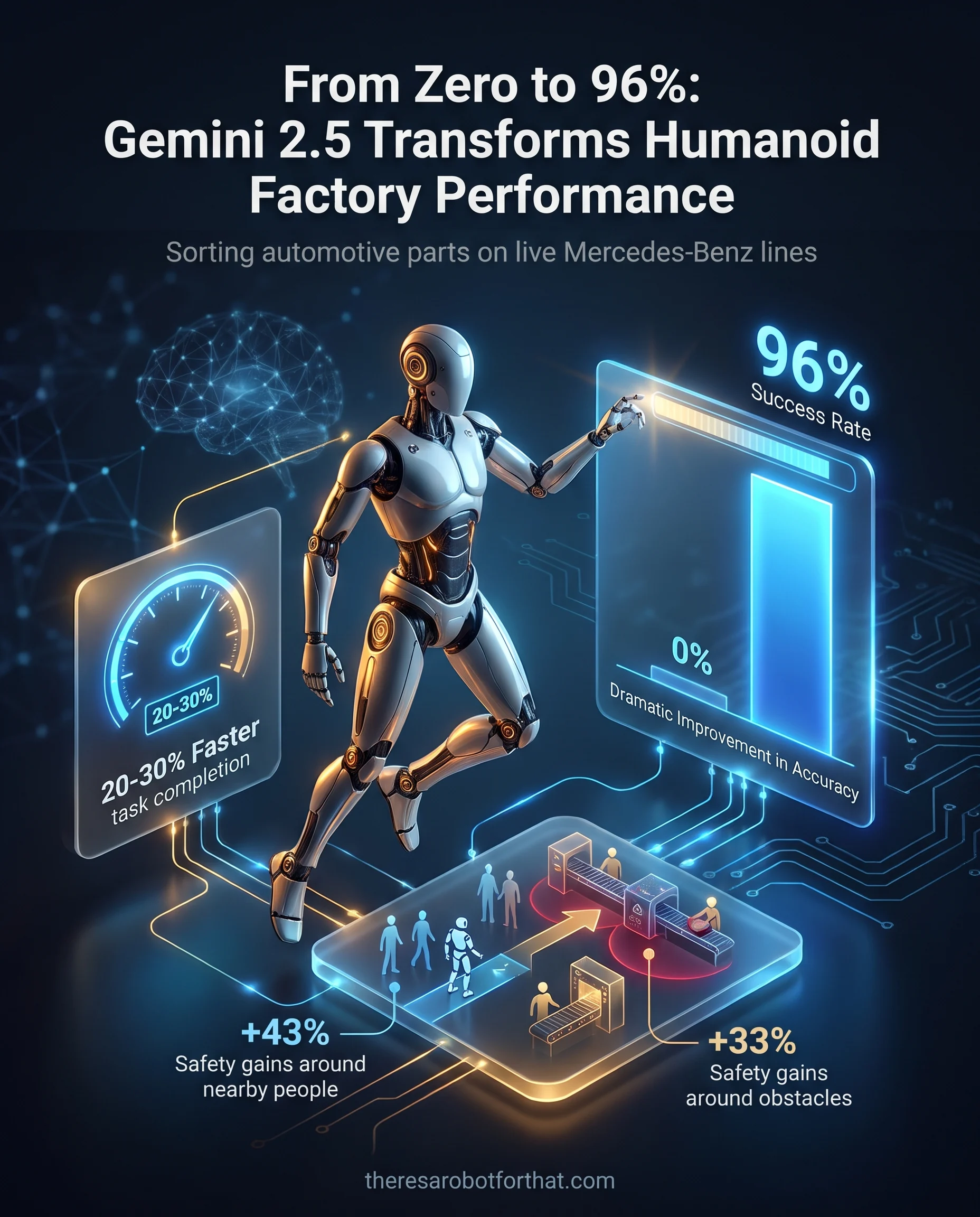
A humanoid running Google DeepMind's new robot model sorted automotive parts on live Mercedes-Benz lines with a 96% success rate.
Welcome back to your Robot Briefing
Apptronik's Apollo 2 humanoid spent its trial run sorting metal brackets out of bulk bins and into sequencing trays on live Mercedes-Benz lines in Hungary and Germany, and it got 96% of them right. The model driving it, Google DeepMind's Gemini Robotics 2.5, is the same family that scored zero on some of these tasks one version ago.
Below that, Boston Dynamics put wheels on Atlas to stress-test its motors, Apple taught a humanoid to walk through houses it learned entirely in simulation, and Path Robotics raised $300 million on the back of welding. The short stories cover NVIDIA's new GR00T 2 model, Amazon's second run at a home robot, and a 24/7 warehouse plan from Geek+.
The 60-Second Read
A humanoid hit 96% sorting parts on two working Mercedes-Benz lines, the clearest real-factory number a general robot model has posted.
Boston Dynamics swapped Atlas's feet for scooter wheels, and a simulation-trained controller nailed a 360-degree jump on the first try.
Apple's HALO learned to move through homes it never saw by training on a thousand synthetic ones, then cleared 91% in six real houses.
Path Robotics nearly quadrupled its valuation to $2.45 billion, built on automating welding.
News
Gemini Robotics 2.5 Sorts Parts on a Live Mercedes-Benz Line
The job was automotive kitting: picking individual metal brackets out of bulk bins and placing them into trays in the exact order each vehicle on the line needs, the repetitive prep work that keeps assembly moving.
Gemini Robotics 2.5 is a vision-language-action model that DeepMind says runs 30% to 100% higher success than its previous version depending on the task, while finishing 20% to 30% faster.
Apollo 2 carries a five-finger hand with 22 degrees of freedom, and the system paired an embodied-reasoning model that tracks the workflow with the action model that controls the hands and arms.
DeepMind also reported safety gains, lifting safe task completion around obstacles by 33% and around nearby people by 43%.
Takeaway: The hardware is the Apollo 2 that Apptronik already sells, so the jump came from software. Apptronik says the models reached this level in a few weeks of post-training and carried over to the Mercedes-Benz lines with very little drop-off. One model version back, several of these exact kitting tasks scored zero.
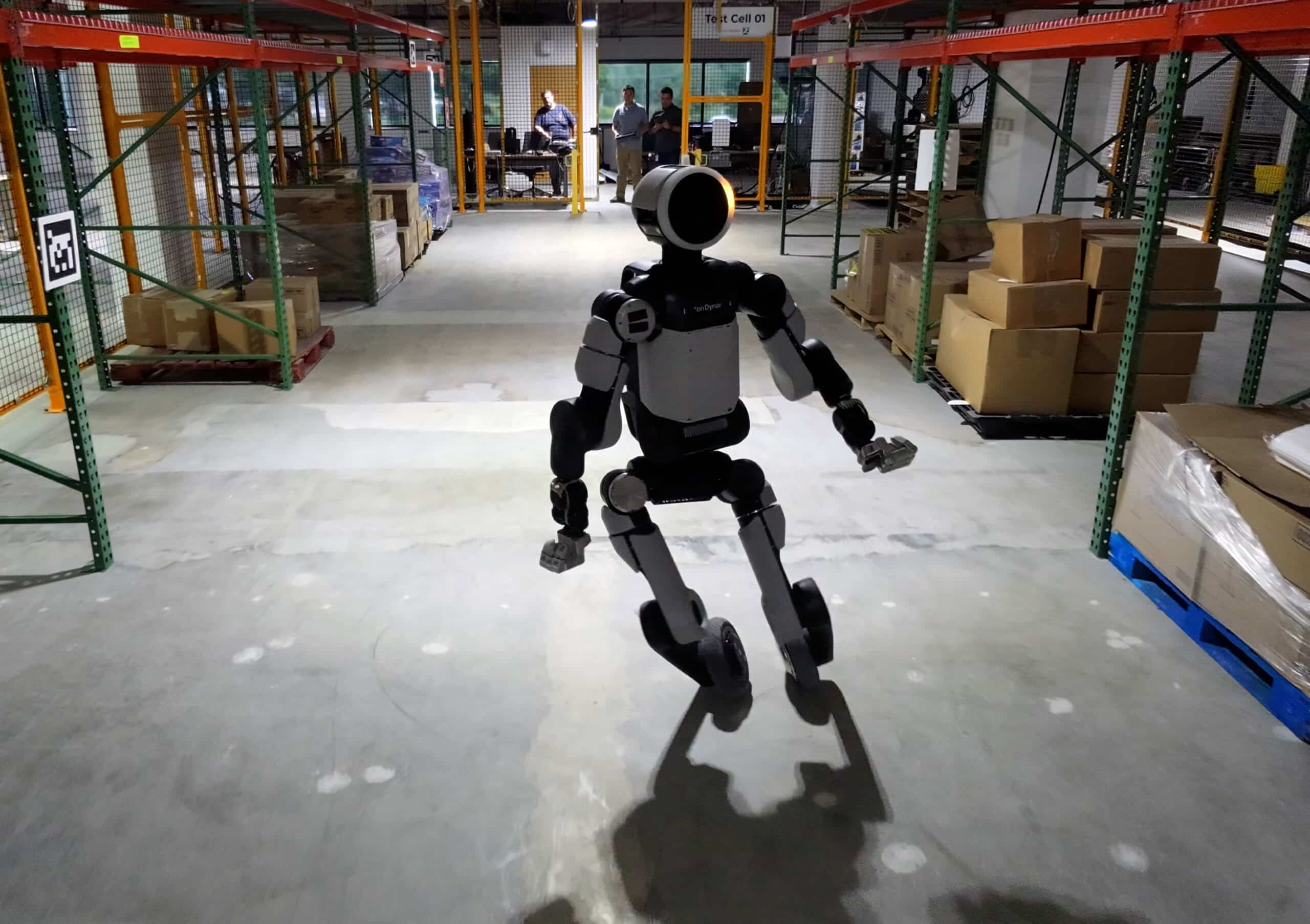
The conversion used one new part: a custom adapter that mounts an off-the-shelf scooter rim onto the existing ankle actuator, with each wheel modeled in software as an ankle that can spin continuously.
The robot drifts, side-dashes and performs a 360-degree jump, with the moves drawn from a library of human motion-capture clips.
The company is explicit that a wheeled Atlas is a research testbed, not a product, meant to close the gap between simulation and real hardware.
The 360-degree jump followed a recording of a person doing the same move and worked on the first attempt on hardware.
Takeaway: Boston Dynamics is blunt that a wheeled Atlas will never ship; the wheels were a way to run the motors at full torque and speed, and the actuator models that came out of it are already being folded back into the standard robot.
⏱️ The Compliance Clock
This week's lead puts a humanoid on a live automotive line in the EU, and before any machine works on that floor its maker has to issue a Declaration of Conformity and apply the CE marking, the paperwork that says it meets EU health and safety law. For a mobile humanoid that conformity file has to cover software behaviour and the loss of a fixed safety fence, on top of the usual mechanical guarding. The operator running the robot is the one who has to hold that file when an inspector asks.
News
Apple's HALO Learns a House It Never Saw
Snapshot: Apple's AI research team built HALO, a humanoid autonomy system that learns to move through homes entirely from simulation, then reached a 91% success rate across 360 trials in six real houses it had never mapped.
Breakdown:
HALO is trained on paired video, language and motion generated across a thousand procedurally built homes, so the dataset scales with compute instead of with hours of human teleoperation.
It transfers zero-shot to the physical world, handling tasks such as sitting on chairs, stepping sideways through half-open doors, crouching under tables and pushing boxes.
The system runs on an off-the-shelf Unitree G1 humanoid with 29 joints, carrying its planning and tracking stack onboard.
The motion generator uses a frozen Qwen3.5-2B encoder, and composite long-horizon requests are broken into subtasks by an onboard vision-language model.
Takeaway: Teleoperation, the standard way to gather humanoid training data, buys about an hour of data for an hour of human work; HALO sidesteps that by generating a thousand simulated homes, so its dataset grows with compute instead of with people. Running on a stock Unitree G1 with its full stack onboard, it still cleared 91% in six houses it had never mapped.
News
Path Robotics Raises $300 Million on Welding
Snapshot: Path Robotics raised $300 million in a Series E led by Georgian at a $2.45 billion valuation, nearly four times its previous level, to extend its physical-AI platform beyond welding.
Breakdown:
The Columbus, Ohio company says its annual recurring revenue grew 17-fold over the past 18 months as it scaled across North American manufacturers.
Its customer list runs from HII, Lockheed Martin and Saronic to mid-sized fabricators, and it signed a $600 million production agreement with HII earlier this year for US Navy shipbuilding.
Its welding model, Obsidian, lets robots identify weld joints, plan and run the weld, and adapt as conditions change, work that fixed-path industrial robots cannot do.
The round brought in D. E. Shaw Ventures and NAVER Ventures alongside existing backers, and the company has raised more than $610 million since 2018.
Takeaway: Welding carried Path to a $2.45 billion valuation, close to four times its level a year ago, because it is one of the hardest jobs on the floor to automate and the one its Obsidian model proved out first. Revenue is up 17-fold in 18 months, headcount is up 97% in a year, and the new money goes toward the tasks that come before and after the weld.
▶ Operator's Playbook
Before you sign a humanoid pilot, write the acceptance test yourself. Pick one real workflow, hand the vendor your own parts and bins, and require a measured success rate over a fixed number of runs on your own floor. A 96% demo number means little until it is reproduced on your SKUs, in your lighting, at your cycle time, so put the threshold, the run count and who pays if it misses into the contract.
Other Top Robot Stories
NVIDIAreleased GR00T 2 , a robot foundation model that predicts future video and actions together, learning a new task from five demonstrations and under three minutes of robot data, with a lighter Turbo version running onboard a Unitree G1.
Amazonbuilt a new home-robot team and is hiring for a "new-to-world robot product," its second run at the living room after the Astro stalled, this time built around the 3.5-foot Sprout humanoid it acquired with Fauna Robotics.
Nature Willlaunched Natura-1 , a 50-billion-parameter foundation model for dexterous robot-hand control, pretrained on more than a million hours of egocentric human video.
Geek+unveiled a 24/7 warehouse autonomy plan to run fulfillment around the clock, using embodied AI for picking and exception handling so warehouses lean less on overnight staffing.
Oversonic Roboticstook its RoBee R20 to Munich and Lisbon , an Italian-built industrial humanoid rated to work in ISO Class 6 cleanrooms, aimed at semiconductor and other contamination-controlled lines.
Compliance tool
Where does your robot documentation stand?
The ISO 10218:2025 Gap Analysis Checklist finds every gap in 62 audit questions.
The wheels on Atlas this week came down to one bought-off-the-shelf part, a scooter rim bolted to an ankle the robot already had. The drifts and the first-try 360 came from motor models accurate enough that a move learned in simulation held up on real hardware.