A warehouse-robot startup renting instead of selling, the UK's £40M adoption push, and an Indian lab's safety layer for machines.
The Big Number
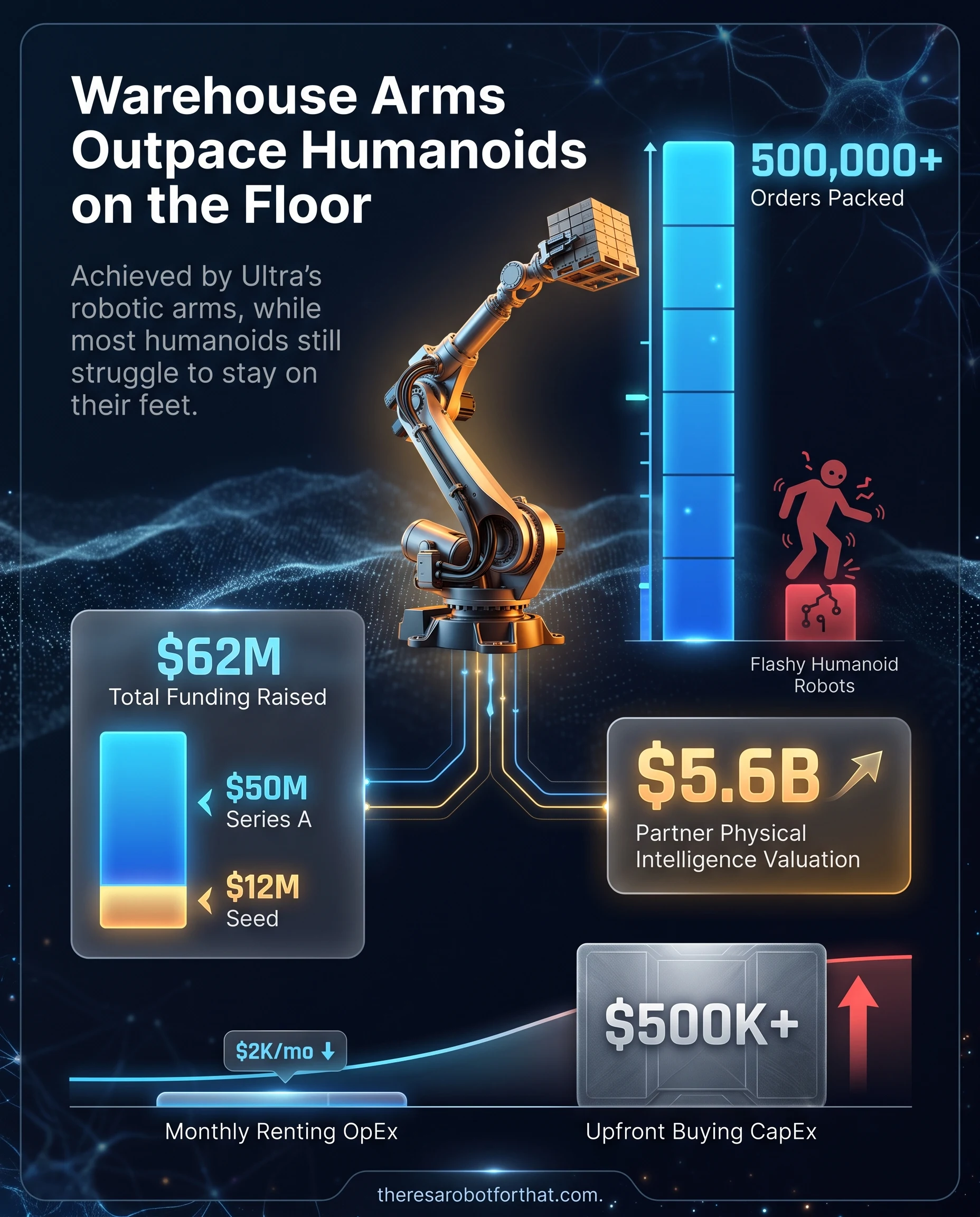
Ultra's warehouse robots have packed more than 500,000 orders for shipping, even as most humanoid robots still struggle to stay on their feet.
Welcome back to your Robot Briefing
This week the robot story moved down the stack, into the silicon, the balance sheet and the safety logic that decide whether a machine ever reaches your floor.
The flashiest humanoids stayed in the lab. The money, the policy and the engineering went to the quieter parts: who makes the chip, who owns the robot, and who proves it is safe to stand next to.
The 60-Second Read
GlobalFoundries is building a physical-AI chip in Europe, targeting 7nm-class performance from its Dresden fab in 2028.
Warehouse-robot startup Ultra raised $62 million by renting its machines by the month instead of selling them.
The UK is spending £40 million on eight hubs whose only job is to get businesses to actually adopt robots.
A Mumbai lab unveiled a physical-AI platform whose headline feature is a safety layer that can veto a robot's move.
News
GlobalFoundries builds Europe's chip for the physical-AI era
Snapshot: At the topping-out of its Dresden fab expansion, GlobalFoundries unveiled FDX Fusion, a new chip platform built not for data-center compute but for machines that sense, think, act and communicate in the physical world.
Breakdown:
FDX Fusion is the next generation of GF's fully depleted silicon-on-insulator (FD-SOI) line, engineered to deliver seven-nanometer-class digital performance with more than twice the density of first-generation FDX.
Rather than raw logic alone, it combines dense compute with the parts a robot actually needs: RF up to 0.5 THz, analog and mixed-signal blocks, low-leakage operation, in-memory computing and embedded non-volatile memory on one platform.
GF plans to manufacture FDX Fusion in Dresden from 2028, with demonstrator silicon for early customer evaluation in early 2027 and a first process design kit in mid-2027, under the European Chips Act.
Bosch, Infineon, NXP, Siemens, BMW and Tesla all went on record supporting the roadmap, naming robotics, automation and edge intelligence as the target.
Takeaway: For operators, the signal is where the robot economy's margins are moving. The scarce, expensive part today is data-center GPUs, but the chips that ride inside a robot have to sense, decide and act on a tight power budget, and that is a separate race. A European foundry committing to it for 2028 means the edge silicon under your future machines may not trace back to the same two suppliers everyone is queued behind now.
News
A warehouse-robot startup raised $62M by renting, not selling
Image Source: There's A Robot For That
Snapshot: Brooklyn-based Ultra raised $62 million for a business that leases its machines to warehouses by the month, and deepened its tie-up with robot-brains firm Physical Intelligence.
Breakdown:
The raise came in two parts: a $50 million Series A led by Framework Ventures with Y Combinator, on top of an earlier $12 million seed led by Y Combinator and NextView.
Ultra does not sell its robots. Customers pay an upfront integration fee, then an ongoing monthly charge, a robots-as-a-service model the company says has worked well enough that it has raised prices.
Its machines have packed more than half a million orders for shipping, and CEO Jon Miller Schwartz argues the robots doing real work today are not the humanoids but the unglamorous arms already bolted into logistics sites.
Ultra builds the hardware while Physical Intelligence, valued at $5.6 billion, supplies the AI, a division of labor that gives the lab out-of-the-building data to train on.
Takeaway: The lesson for anyone sizing an automation budget is that you no longer have to buy the robot to use it. A monthly model turns a capital project into an operating line, which is how a mid-sized third-party logistics operator pilots without a board fight. The humanoids get the headlines, but the machines booking revenue this quarter are the arms already working the floor.
⏱️ The Compliance Clock
100 days
until the EU Machinery Regulation becomes mandatory (Jan 20, 2027)
As physical AI moves out of the lab and onto real production floors, the EU Machinery Regulation is the rulebook that decides what can legally switch on. It replaces the decades-old Machinery Directive and sets a single, mandatory conformity bar for machines placed on the EU market, humanoids and mobile manipulators included. Any operator planning a European deployment should be mapping their robots to it now, because the paperwork behind a compliant machine, the risk assessment, the technical file and the CE declaration, takes far longer than the install.
Snapshot: The UK government launched eight Robotics Adoption Hubs, backed by £40 million, to help businesses and public services move automation out of the research lab and into daily operations.
Breakdown:
The hubs are deliberately not research centers. They offer expert advice, help users pick the technology that fits their need, and run real-world demonstrations where a potential buyer can get hands-on before committing.
The eight span sectors and regions, from a national surgical-robotics hub to a Lincoln hub for agricultural and food-manufacturing automation, plus Milton Keynes, South Wales, Yorkshire and the Greater Southwest.
A separate £1.7 million body called AURA will connect the hubs so lessons and resources are shared nationally rather than siloed.
The rollout began on 9 October, aimed at the gap between building capable robots and getting organizations to use them.
Takeaway: The bottleneck in robotics has never been only the hardware, it is that a plant manager cannot easily try one before committing. A vendor-neutral hub that lets you run your own parts through a demonstration cell is worth more than another spec sheet. If you operate in the UK, the cheapest due diligence available this quarter is booking time at the hub closest to your sector.
News
An Indian lab's answer to the robot-safety question
Snapshot: Mumbai-based Inner Sky Labs unveiled a full-stack physical-AI platform whose centerpiece is Kavach, a safety layer that checks every proposed machine action and blocks the unsafe ones.
Breakdown:
The platform bundles perception models for vision, audio and touch with action models that generate and anticipate physical movement, aimed at manufacturing, logistics, agriculture and healthcare robots.
Kavach runs as an independent check: before a motion executes, it weighs factors such as the presence of people, movement speed and the machine's permitted zones, and vetoes anything that breaks the operator's rules.
Inner Sky is closing a 300 crore rupee round, about US$31 million, with backers YourNest Venture Capital and Keshav R Murugesh alongside new global investors, and says it has raised more than US$80 million to date.
The team built the approach over a decade running Miko, its consumer robot sold in more than 140 countries, and is now extending that safety work to industrial machines.
Takeaway: The question CEO Sneh Vaswani names, why anyone should trust a machine standing near a person, is the real gate on every deployment, not the demo reel. A separate layer whose only job is to veto an unsafe motion is exactly what an EHS lead needs to sign off and what an auditor will ask to see. Treat an independent safety check as a purchasing requirement, not a bonus feature.
▶ Operator's Playbook
This week, put one question to every robot vendor on your shortlist: show me the independent safety check. Ask exactly how the system decides a motion is unsafe, how it stops it, and where that logic is written down. Then line the answer up against the risk assessment and technical file your EU Machinery Regulation conformity will require. A vendor who cannot point to a documented safety-arbitration layer has just shown you the gap to close before the pilot, not after.
BYDunveiled the design of its first self-developed humanoid, a bipedal machine for service, education and industry revealed through a Chinese design patent, with a formal debut still pending.
Westlake Roboticsshowed its WR1 "general brain" driving two humanoids through a dexterous trouser fold it calls a world first, plus a nonstop kitchen-to-bedroom chore run with no reset between tasks.
Striding AIunveiled a three-part system, a bipedal H1, a wheeled-arm C1 and an M1 fleet manager, for 24/7 convenience stores it says need no shelf or layout changes, targeting a 2027 service launch.
Kawasakibuilt a prototype of Home LEO, a pet-like, four-legged eldercare robot that watches for falls, fetches items and alerts family or carers, with a commercial launch targeted for fiscal 2028.
UCLA researchersopen-sourced PhoneBot , a 19-inch humanoid that runs on an old Android phone and costs about $400 to build, not counting the phone.
The University of Colorado Colorado Springsadded humanoid robots to its innovation classes as teaching tools, including one named Ami, donated to help students build AI skills.
Free for subscribers
Deploying humanoids this year?
Our Facility Readiness Checklist walks your site before the robot arrives, 77+ items, one complete toolkit module.
The robots that change how work gets done rarely look the part. The ones already earning their keep are arms in a warehouse and a safety check no customer ever sees, while the two-legged machines we picture are still learning to stand. Progress tends to arrive dressed as plumbing.