
Apptronik's 90,000 sq ft humanoid data factory
PLUS: surgical camera that blinks like human eye, soft robotic hand harvests strawberries, and South Korea's 3-year physical AI deadline
Welcome back to your Robot Briefing
Google-backed Apptronik just opened a 90,000 square-foot facility in Austin where fleets of humanoid robots run logistics and manufacturing tasks around the clock. The goal isn't just testing. It's generating massive amounts of real-world training data to fuel Apollo 3, their first true commercial humanoid slated for 2027.
After years of pilots and prototypes, this marks a shift from demo videos to industrial-scale data collection. The big question: can capturing thousands of hours of robot work in controlled environments actually translate to the messy, unpredictable conditions of real warehouses and factories?
In today's Robot update:
Apptronik unveils 90,000 sq ft 'data factory' for humanoid robots, teases Apollo 3
Snapshot: Google-backed Apptronik opened Robot Park, a massive Austin facility running fleets of humanoids in logistics and manufacturing tasks to generate training data, positioning Apollo 3 as the company's first true commercial product for 2027 deployment after years of pilots.
Breakdown:
Takeaway: The data factory model reveals why humanoid timelines keep extending: these companies are discovering that robot hardware is less valuable than the operational data needed to make robots useful. Apptronik's 2027 commercial target and emphasis on data collection over current deployments suggests the industry is still 2-3 years from volume production, despite the funding hype.
Researchers build AI-powered surgical camera that blinks and cleans itself like a human eye
Snapshot: University of Florida and University of Tennessee researchers developed a magnetically driven surgical camera that mimics human eye functions, blinking with eyelid wipers and using fluid to clear blood and smoke during laparoscopic procedures without pulling the camera out to clean it.
Breakdown:
Takeaway: This addresses a practical surgical workflow problem rather than attempting to automate the surgeon's role, a pattern worth watching as robotics finds traction in augmentation over replacement. The technology demonstrates how bio-inspired design plus AI can solve specific high-value problems in medical settings where equipment reliability directly impacts patient outcomes.
Soft robotic hand picks produce and assesses ripeness without bruising
Snapshot: West Virginia University researchers developed a starfish-inspired soft robotic hand that harvests delicate fruits like strawberries and avocados while using integrated sensors to assess ripeness, targeting the 25% crop losses farmers currently face from bruising and mistimed harvesting.
Breakdown:
Takeaway: Agriculture robotics is moving beyond simple picking tasks to integrated quality assessment, which matters because knowing *what* to harvest is as valuable as the harvesting itself. This technology targets a specific economic problem, 25% waste reduction, with measurable ROI potential, making it more viable for commercial deployment than general-purpose farm robots.
South Korea designates physical AI as national strategic industry with 3-year deadline
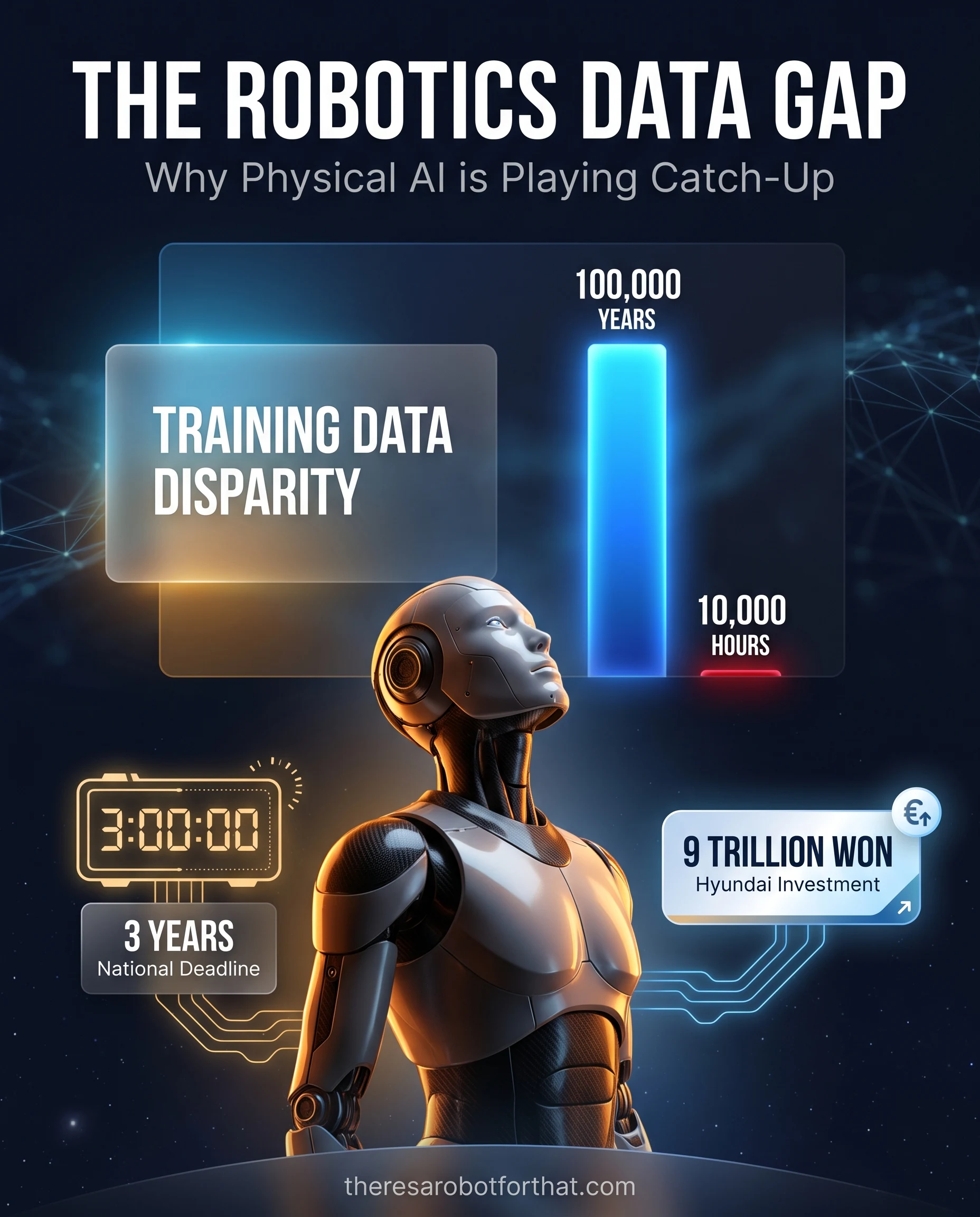
Image Source: There's A Robot For That
Snapshot: South Korea declared physical AI a national strategic industry with a government-led push to build a general-purpose robotics foundation model within three years, while Hyundai commits 9 trillion won to robot facilities at Saemangeum as part of a coordinated industrial policy.
Breakdown:
Takeaway: When a national government sets a three-year deadline and commits industrial conglomerate resources, it signals both opportunity and competitive threat. Korea is treating this as a winner-take-most race. The candid admission about data scarcity (10,000 hours versus 100,000 years) explains why humanoid robots remain clumsy, and suggests that companies with access to real operational environments have a structural advantage that's hard to replicate.
Other Top Robot Stories
CATL deployed Galbot's S1 humanoid on its battery production lines to directly replace human workers in high-intensity material handling and picking, with the dual-arm robot carrying a 50kg payload and running up to eight hours per charge, as the world's largest battery maker signed a global strategic cooperation agreement to scale humanoids across its smart manufacturing lines.
AI2 Robotics raised nearly $735 million at a $2.8 billion valuation, while rival X Square Robots also reached the same valuation across four consecutive funding rounds, as Chinese embodied AI firms continue aggressive capital deployment.
Vinmec launched Vietnam's first multi-connected robotic surgery network linking Da Vinci Xi, Hugo RAS, and 5G-enabled Toumai MT-1000 systems across six hospital sites, establishing the country's only "3-in-1" robotic surgery model combining AI-enabled assistance with standardized clinical protocols.
Bernstein favors Nvidia over Qualcomm in the humanoid robotics market, citing Nvidia's position providing the "brain" behind robots through chips and software that process data and enable decision-making, while Qualcomm trails despite offering competitive AI chips and a robotics platform.
🤖 Your robotics thought for today:
Apptronik just spent $520 million to build a facility that doesn't ship robots — it generates data. That's the real business model emerging here. We're watching companies realize the hardware is just the sensor array for collecting the training data that actually has value.
I'm tracking how many others quietly make this same pivot.
Until Friday,
Uli


