2,056 robots descend on Beijing, Schaeffler stamps out a cheaper humanoid joint, and a fourth US airline shuts robots out of the cabin.
The Big Number
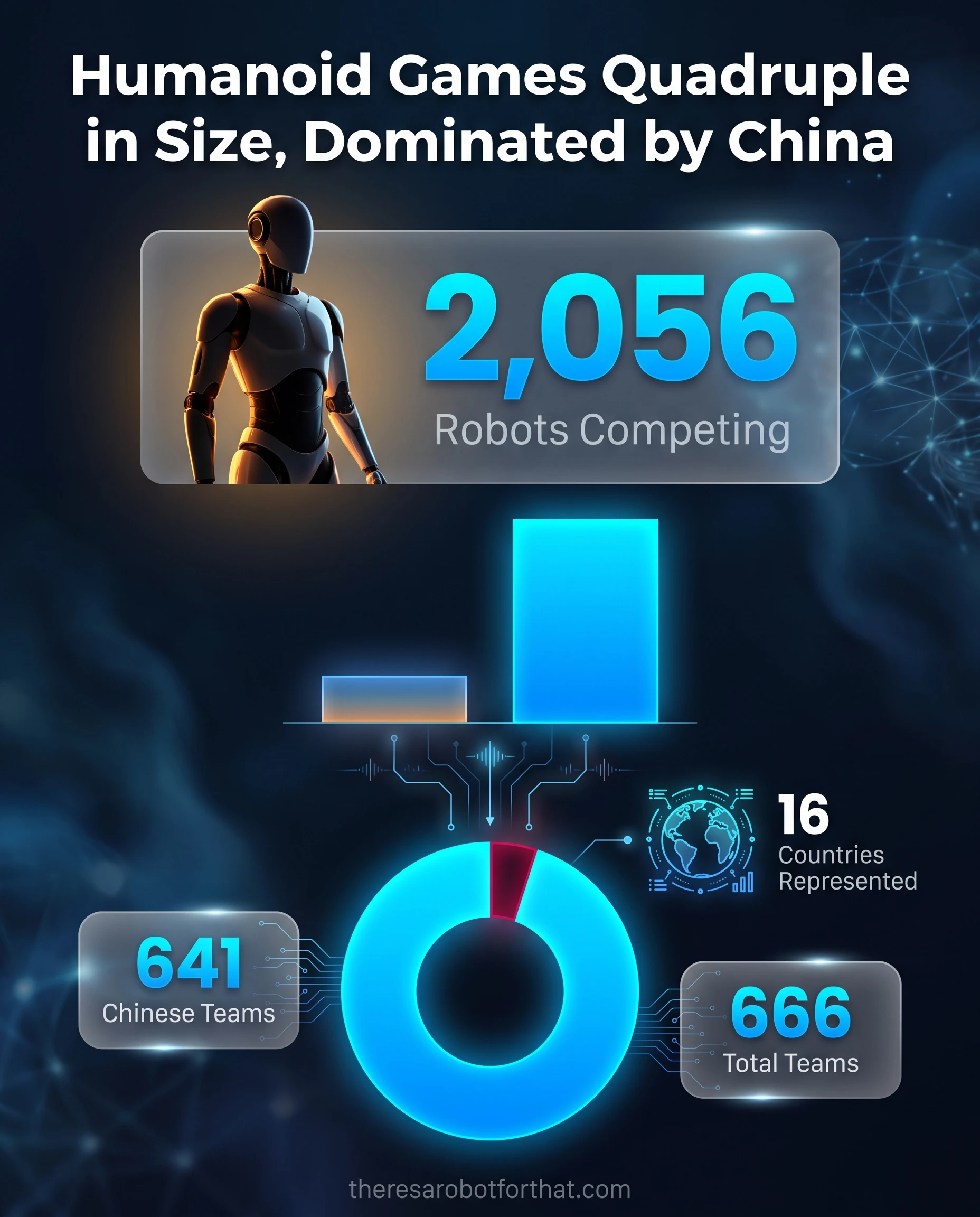
This month, 2,056 humanoid robots will compete at a single event in Beijing, roughly four times the field that showed up a year ago.
Welcome back to your Robot Briefing
The loudest humanoid news this week came from Beijing, where more than 2,000 machines are about to race, wrestle and stack boxes for the cameras. The news that actually moves deployments was quieter, and it happened in boardrooms and component plants.
LG committed to Nvidia's robot stack, a German bearing maker found a way to stamp out a key joint in seconds, and a Korean tractor group put a humanoid into a greenhouse. Underneath the spectacle, the humanoid race is turning into a supply-chain race.
The 60-Second Read
LG will build a bipedal humanoid on Nvidia's Jetson Thor and Isaac GR00T for a Q1 2027 debut, and test a wheeled robot on a Tennessee line first.
Beijing's second World Humanoid Robot Games drew 666 teams and 2,056 robots from 16 countries, quadrupling last year's field.
Schaeffler can now form the strain wave gearbox, half of a humanoid's cost sits in actuators, for more than 25 percent less.
Four major US airlines have now banned large humanoid robots from flights over lithium-battery fire risk.
News
LG hands the brain of its next humanoid to Nvidia
Snapshot: LG agreed to build a next-generation bipedal humanoid on Nvidia's platform, signing a memorandum of understanding with the chip maker on August 13 at Nvidia's Santa Clara headquarters.
Breakdown:
The humanoid will run on Nvidia Jetson Thor for onboard compute and reasoning and be developed with Isaac GR00T, Nvidia's open humanoid foundation model, with a public unveiling planned for the first quarter of 2027.
Before that, LG will put a wheel-based robot called CLOiD on LG Electronics' washing-machine line in Tennessee this year, a real-world validation ahead of any bipedal rollout.
The MOU spans three areas: robotics, AI-factory reference sites built on Nvidia DSX and the Vera Rubin platform, and an AI-defined vehicle platform on Nvidia DRIVE Hyperion.
Takeaway: LG is the latest large manufacturer to rent the robot brain rather than build it, and that choice is starting to define the market. When LG, and before it several rivals, standardize on the same compute module and foundation model, the humanoid supply chain consolidates around a handful of platforms. For an operations leader, that lowers integration risk but raises a dependency question worth asking early: whose roadmap does your future robot fleet actually ride on.
News
Beijing lines up 2,056 humanoids for a five-day contest
Image Source: There's A Robot For That
Snapshot: The second World Humanoid Robot Games drew 666 teams and 2,056 robots from 16 countries, set to compete in Beijing from August 22 to 26.
Breakdown:
Participation roughly quadrupled from the inaugural 2025 event, which fielded more than 500 robots from 280 teams, with squads this year from the United States, Germany, Japan and Brazil.
The program runs to more than 30 competitions, from running and football to newly added events like weightlifting and tug-of-war, alongside work tasks such as assembly, housekeeping, emergency response and book sorting.
Chinese teams account for 641 of the 666 entries, and organizers said some competition rules could eventually feed into technical standards for industrial robots.
Takeaway: The Games are a spectacle, but the task list is the tell. Assembly, sorting and logistics are exactly the jobs vendors will point to when they pitch you a humanoid next quarter. Treat a strong Games result as a controlled demo, not a deployment proof: the interesting question is not whether a robot can win a rehearsed event, but whether the same hardware holds up across an eight-hour shift with unscripted variation. Ask for the shift data, not the medal count.
⏱️ The Compliance Clock
The world's humanoid makers are now industrializing the same joints and control systems that ISO 10218 governs. The current revision of ISO 10218-1 and -2 folded collaborative-operation limits into the core industrial-robot safety standard, so a humanoid working a production line, like the wheeled unit LG plans for Tennessee, inherits a higher documentation and integration bar than a caged arm ever did. If you are scoping a humanoid pilot, ask the vendor which parts of ISO 10218 the integrator will certify against before the robot shares floor space with people.
Schaeffler makes the humanoid's most expensive joint cheaper to build
Snapshot: Schaeffler brought to market a formed strain wave gearbox for humanoid joints, a part it says is ready for mass manufacturing in 2027.
Breakdown:
Strain wave gearboxes live inside actuators, which make up around half the total cost of building a humanoid, so the price of this one component shapes the price of the whole robot.
Schaeffler's forming process shapes key parts in seconds instead of minutes, cutting manufacturing cost by more than 25 percent and material use by more than 75 percent against the precision machining that the company calls a looming scaling bottleneck.
Validation testing is complete, mass production starts in Germany in 2027 before rolling out to other regions, and Schaeffler notes it has already shipped more than 2 million formed strain wave gearboxes into the automotive sector over the past decade.
Takeaway: This is the plumbing of the humanoid boom, and it matters more than most demo videos. If actuators are half the bill of materials, an actuator supplier that can strip a quarter off the gearbox is pulling directly on the price every robot buyer will eventually pay. For anyone modeling humanoid total cost of ownership, the component makers are now a leading indicator of where unit prices land, well ahead of the brands on stage.
News
A Korean tractor group sends a humanoid into the greenhouse
Snapshot: Daedong Group is co-developing an agricultural humanoid called Agroid with Rainbow Robotics, and a first prototype is already in tomato-harvesting field tests.
Breakdown:
The two split the robot: Daedong, through Daedong Robotics and Daedong AgTech, builds the autonomous lower drive unit plus the crop-recognition and harvest-decision systems, while Rainbow Robotics supplies the upper-body arms, precision control and digital-twin work.
The current prototype pairs Rainbow's humanoid upper body with Daedong's lower platform, and the companies plan to validate and certify it jointly.
Daedong aims to deploy Agroid as a core robot in a fourth-generation AI greenhouse under South Jeolla Province's national agricultural transformation platform by 2028.
Takeaway: Agriculture is an honest test for humanoids because the labor math is unforgiving. Crops are seasonal, produce bruises, and a picker that is slower or clumsier than a human loses money on every row. A greenhouse pilot with a 2028 deployment date and a named site is a more concrete commitment than most stage demos, so this is one to track on throughput. Watch for a harvest rate per hour, not another clip of a robot holding a tomato.
▶ Operator's Playbook
Before you approve a humanoid pilot for a line where the robot will work near people, ask the integrator for a written mapping of the build to ISO 10218-1 and -2: which clauses apply, who signs the risk assessment, and what the CE Declaration of Conformity will cover. Put that mapping in the contract rather than the kickoff deck, so the safety case exists before the robot arrives on the floor, not after.
Other Top Robot Stories
American Airlinesbanned large humanoid and animal-shaped robots from cabins, seats and checked bags starting this week, becoming the fourth major US carrier after Delta, United and Southwest to cite the fire risk of oversized lithium-ion batteries.
BYDrolled out its Xiao Di humanoid at Di Space experience centers in Zhengzhou, Shenzhen and Shanghai, putting a greeter robot in front of car buyers as the automaker leans on new technology to offset slowing domestic vehicle sales.
Foundationpitched its Phantom humanoid for US southern-border monitoring, with CEO Sankaet Pathak saying the robots could eventually detect people and flag activity across uneven terrain, a capability he still describes as aspirational.
Canada's Defence Ministrymoved to boost its supply of military drones and ground robots, with Defence Minister David McGuinty meeting equipment makers to prepare the Armed Forces for a changing style of warfare.
Researcherstaught two Unitree G1 humanoids to turn a long skipping rope in rhythm for a third robot jumping through it, a multi-robot coordination result they call Marope, with the paper still under review.
Ukrainian FPV dronesdisabled a rare Russian Impulse-M tracked ground robot near Kamianka, a platform the Ukrainian military says is not a common piece of Russian equipment.
Free for subscribers
Deploying humanoids this year?
Our Facility Readiness Checklist walks your site before the robot arrives, 77+ items, one complete toolkit module.
The robots skipping rope and racing in Beijing will win the cameras this month. The story that decides whether any of them reach your floor is quieter, a supplier learning to stamp out a joint in seconds, and a chairman choosing to rent the brain rather than build it. Capability makes the highlight reel. Cost and supply decide the deployment.