
Atlas does handstands in first production demo
PLUS: Chinese humanoids deploy at Japanese airports, Europe's 99% accurate farm robot, and J&J's surgical bot targets FDA approval
Welcome back to your Robot Briefing
Boston Dynamics just showed Atlas doing handstands and L-sits in a video demonstrating its production-ready humanoid. After years as a research showcase, the Hyundai-backed robot is finally signaling it's ready for real industrial deployment.
The question now: can a machine built for viral backflips actually handle the monotony and precision of factory floors? Atlas has always been the poster child for what's possible—now it needs to prove what's practical.
In today's Robot update:
Boston Dynamics' Atlas executes handstands in production demo
Snapshot: Boston Dynamics released footage of Atlas performing gymnastics, including handstands and L-sits, in the first public demonstration of its production-ready humanoid robot. Hyundai-backed Boston Dynamics is signaling Atlas is nearing commercialization for industrial use after years as a research platform.
Breakdown:
Takeaway: This marks the clearest signal yet that Boston Dynamics is moving from research spectacle to commercial product, positioning Atlas for factory environments where robots must navigate constrained spaces and handle complex movements. Operations leaders evaluating humanoid deployment timelines in 2026 and beyond should note this shift from lab demonstrations to production validation.
Chinese humanoids deploy at Tokyo airport and UK recycling plants
Snapshot: Japan Airlines launched a two-year trial using Unitree humanoid robots for baggage handling at Tokyo's Haneda Airport, while Chinese-made robots are simultaneously entering UK recycling facilities and Chinese battery production lines. The deployments signal Chinese robotics manufacturers are expanding beyond domestic manufacturing into global service and logistics roles.
Breakdown:
Takeaway: The parallel deployments across Japan and Europe indicate Chinese humanoid makers are targeting labor-shortage markets with proven use cases rather than waiting for technological perfection. Companies facing similar demographic pressures in logistics, recycling, or manufacturing should track these trials for early ROI signals and operational readiness benchmarks.
Agricultural robot achieves 99% crop identification in European launch
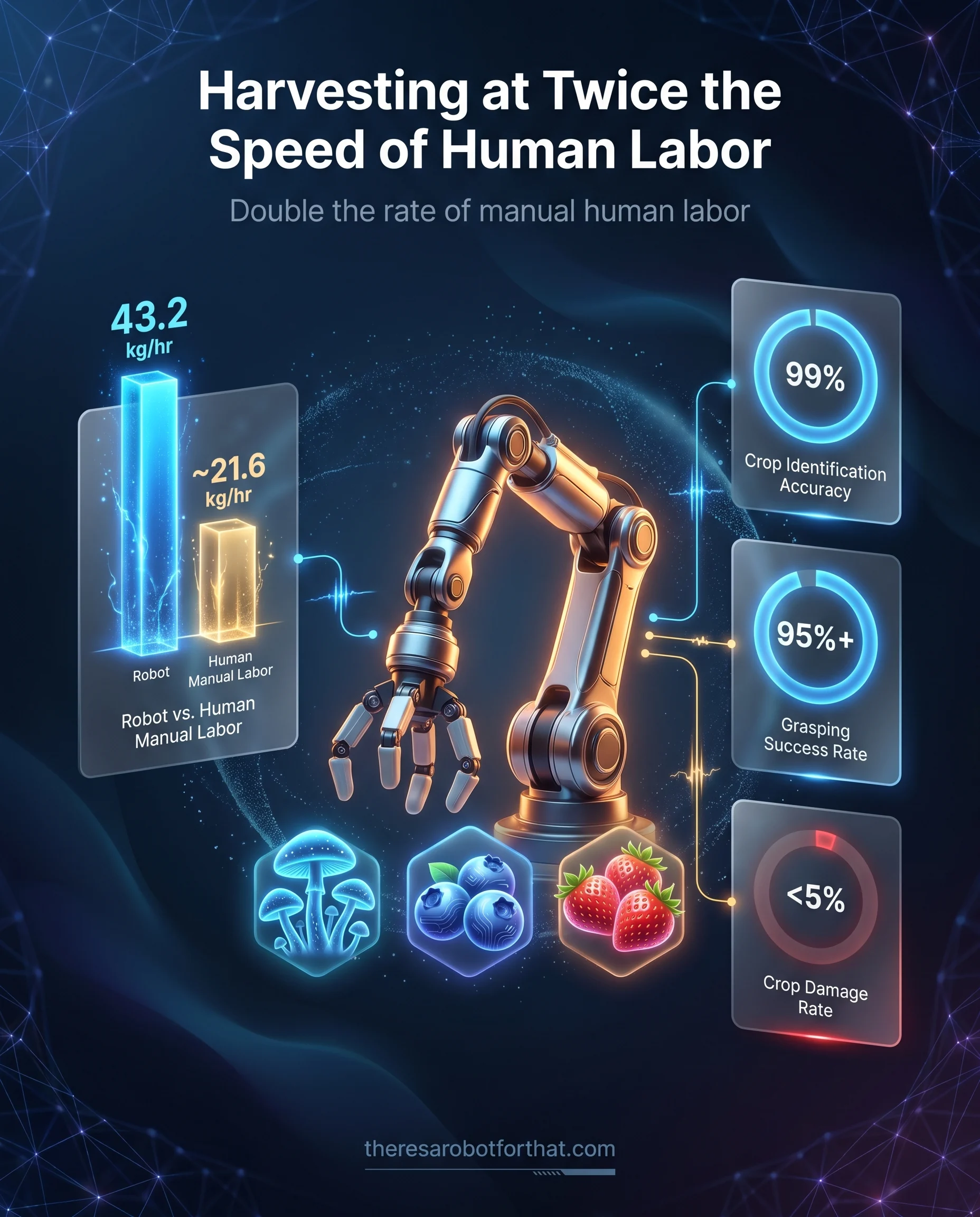
Image Source: There's A Robot For That
Snapshot: Beijing-based INSPIREOMNI launched its H1 agricultural humanoid in Europe, achieving 99% identification accuracy and 43.2 kg/hour peak harvesting speed—double manual labor rates—with over 200 global growers in discussions and 10+ clients signaling firm orders. The dual-arm robot independently manages the full workflow from picking to sorting across mushrooms, blueberries, and strawberries.
Breakdown:
Takeaway: Agriculture is emerging as a proving ground for commercial humanoid deployment ahead of broader industrial adoption, driven by acute labor shortages and well-defined tasks with measurable performance metrics. The firm order pipeline and multi-region interest suggest agricultural robotics has crossed from pilot to procurement phase faster than manufacturing applications.
J&J's surgical robot meets trial endpoints, targets FDA approval
Snapshot: Johnson & Johnson announced its OTTAVA robotic surgical system successfully completed a 30-patient gastric bypass study, meeting all safety and efficacy endpoints with 100% robotic completion and 30 lb. average weight loss at 30 days post-procedure. J&J submitted FDA De Novo classification documents targeting year-end approval for a four-arm system that integrates into a standard surgical table without separate carts.
Breakdown:
Takeaway: J&J's entry positions OTTAVA to compete directly with Intuitive Surgical's dominant da Vinci platform by targeting space-constrained operating rooms and broadening soft-tissue applications beyond single specialties. Healthcare operations leaders should monitor the year-end 2026 FDA decision as a potential catalyst for surgical robotics price competition and expanded clinical access.
Other Top Robot Stories
Addenbrooke's performed the most complex robotic procedure in its decade-long robot-assisted surgery program—a pancreaticoduodenectomy via da Vinci system—marking the first time such a procedure was completed robotically in the East of England, with both patients recovering faster than expected from the eight-hour operations.
Niqo Robotics is expanding its US footprint beyond lettuce into onions, tomatoes, broccoli, kale, melons, and turf grass with 50-plus RoboWeeder units operating in India and 11 deployed across California, Arizona, and Georgia, targeting profitability in fiscal year 2026-27 while emphasizing ROI over AI hype to growers.
Adventist Health Hanford added a second da Vinci Xi robotic surgical system to address four-to-six-month patient wait times, expanding capacity for minimally invasive procedures across colorectal, gynecologic, urologic, thoracic, cardiac, and head-and-neck surgeries in response to high demand for robotic-assisted procedures.
🤖 Your robotics thought for today:
Atlas can do handstands. The Chinese robot at Haneda Airport is hauling luggage. Meanwhile, a farm bot in Europe is picking strawberries at 43 kg/hour with 99% accuracy and actually has paying customers lined up.
Guess which one is closest to positive unit economics?
Enjoy your weekend,
Uli


