
Australian farmer herds cattle from Japanese ski slope
PLUS: Nvidia's new surgical AI model, Sanctuary hits 99.5% success plugging wires, and Amazon backs physical AI unicorn Odyssey
Welcome back to your Robot Briefing
A Queensland cattle farmer just moved his herd to fresh pasture using nothing but a smartphone app while sitting on a ski slope in Japan. GPS collars and virtual fencing did the work—no dogs, no workers, no physical presence required.
It sounds like a tech demo, but it's routine on Australian farms now. When remote livestock control becomes mundane, what happens to the economics of farmland that previously required on-site labor?
In today's Robot update:
Australian farmer moves cattle from Japanese ski slope using virtual fencing
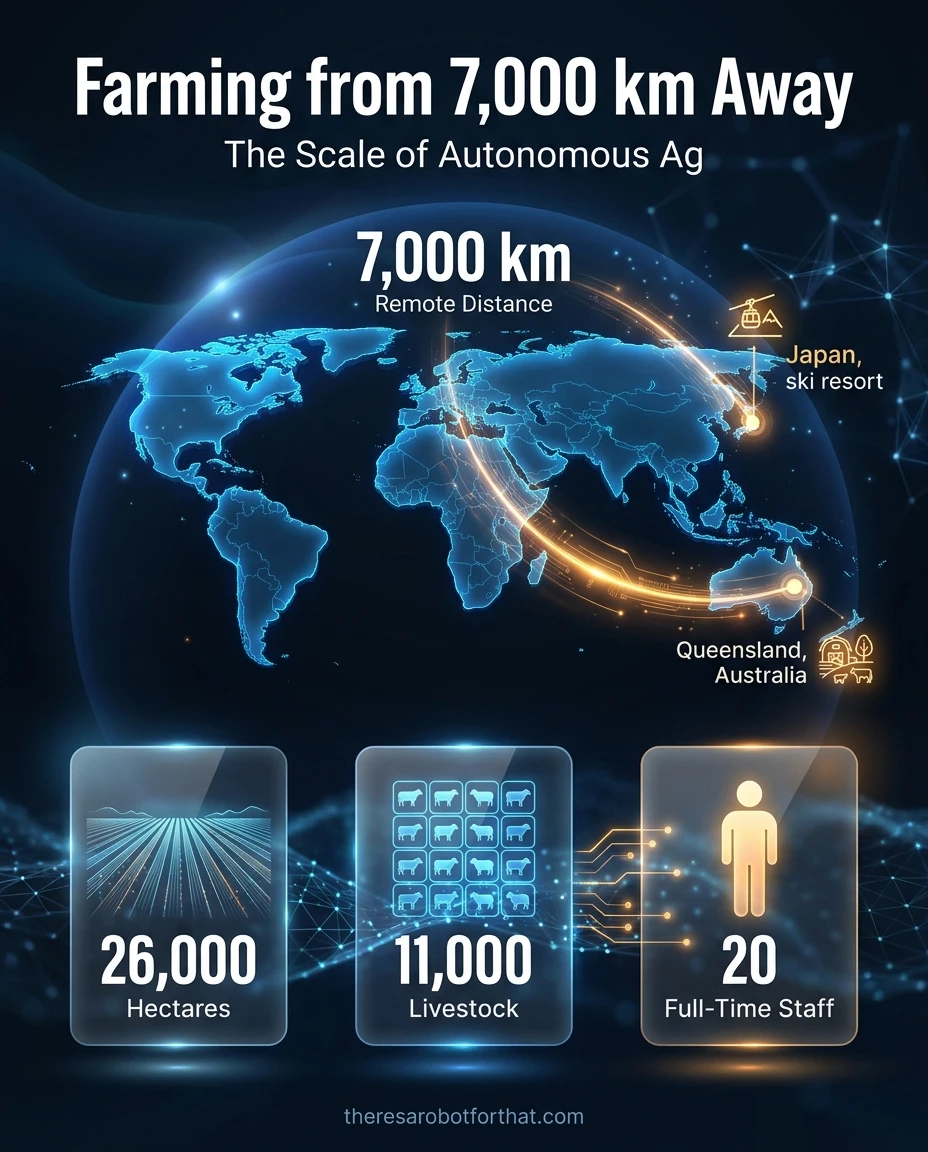
Image Source: There's A Robot For That
Snapshot: A Queensland cattle farmer moved his herd to fresh pasture from a ski resort in Japan using a smartphone app that controls GPS collars, no dogs or workers required. Australian farms now routinely deploy autonomous weeding robots, AI-controlled livestock systems, and virtual fences as remote management tools replace traditional labor across large-scale operations.
Breakdown:
Takeaway: Agriculture represents the clearest signal yet that autonomous systems have crossed from pilot to production scale in labor-intensive industries facing structural workforce shortages. The business case isn't about cutting headcount—it's about maintaining operations when workers simply aren't available at scale, which maps directly to manufacturing and logistics challenges facing mid-market operators today.
Nvidia ships first commercially licensed AI foundation model for surgical robotics
Snapshot: Nvidia released GR00T-H-N1.7, the first commercially licensed AI foundation model for surgical robotics, trained on 770 hours of real operating room video. Developers can now fine-tune a pre-trained model for surgical applications instead of building training datasets from scratch, similar to how foundation models changed software development.
Breakdown:
Takeaway: Foundation models are now moving beyond software into physical systems requiring real-world training data from regulated environments. The pattern matters for operations leaders: when infrastructure providers standardize the hard parts (training data, baseline models), adoption accelerates and deployment costs drop—watch for similar dynamics in warehouse and manufacturing robotics within 18 months.
Sanctuary AI hits 99.5% success rate in automotive wire-plugging validation
Snapshot: Sanctuary AI achieved 99.5%+ task success at 2.54-second cycle time for complex wire-plugging on a live production conveyor at a global Tier 1 automotive supplier. The performance matched industrial production benchmarks for a contact-rich dexterity task that traditional automation couldn't solve, validated against the customer's actual line speed requirements.
Breakdown:
Takeaway: The validation signal is timing: physical AI just proved it can hit industrial cycle times and reliability thresholds today, not in three years. Operations leaders evaluating automation should note the deployment model—advanced AI running on existing robot hardware—which removes the "wait for new robots" excuse and accelerates ROI timelines for high-variability tasks currently done manually.
Amazon backs physical AI unicorn Odyssey in $310M round
Snapshot: Amazon invested in Odyssey, which raised $310 million at a $1.45 billion valuation to build AI systems that simulate the physical world through 3D environment models. The startup will use AWS as its preferred cloud provider and Trainium chips, with Amazon VP Ron Diamant calling the partnership critical to accelerating chip development for physical AI workloads.
Breakdown:
Takeaway: Amazon's investment thesis is clear: the infrastructure layer for physical AI (cloud, chips, training) matters as much as the robots themselves, and they're positioning early. For operations leaders, the signal is less about Odyssey specifically and more about cloud giants validating that physical AI deployment is entering a buildout phase—when infrastructure players make billion-dollar bets, enterprise adoption curves tend to follow within 12-24 months.
Other Top Robot Stories
Autonomique deployed its physical AI platform and mobile manipulator at F&P Manufacturing, a Tier 1 automotive supplier, marking the transition from lab development to production-floor implementation with hardware-agnostic software designed to add human-like dexterity to industrial robots.
Micropolis secured a five-year agreement with Abu Dhabi's Department of Municipalities and Transport to deploy AI-powered autonomous sweepers across the city, integrating perception systems, sensor fusion, and fleet orchestration into a vertically integrated Physical AI ecosystem for municipal operations.
Shifters demonstrated four-legged ground robots at Eurosatory that use its RITA (Robotic Intent to Action) AI control layer and Arena multi-agent orchestration to operate as autonomous teams for dangerous military missions, with backpackable units weighing under 50 pounds deployable by a single soldier.
Karl Storz announced plans to discontinue the Luna and Senhance surgical robot platforms following its 2024 acquisition of Asensus Surgical, instead integrating the company's software engineering expertise, clinical data, and AI technologies into its broader connected operating room ecosystem.
🤖 Your robotics thought for today:
Tom Coggan moved cattle from a Japanese ski slope. Sanctuary hit 99.5% success on a live production line. Nvidia shipped a licensed surgical AI model trained on 770 hours of real OR footage. None of these are prototypes—they're Tuesday. The deployment question isn't "will this work?" anymore. It's "how fast can we integrate it before competitors do?"
That tells you everything.
Enjoy your weekend,
Uli


