
BMW's AI humanoids cut factory waste 50%
PLUS: Accenture deploys warehouse humanoids, Fujitsu-CMU launch physical AI center, and NVIDIA-Google expand robotics infrastructure
Welcome back to your Robot Briefing
BMW just put humanoid robots to work at its Leipzig factory — and they're claiming a 50% cut in material waste without the usual retooling headaches.
These aren't your typical bolted-down industrial arms. AEON humanoids roam the factory floor, adapting to production changes in real-time through AI learning. The question for manufacturers: is this the tipping point where humanoids finally justify their cost over traditional automation?
In today's Robot update:
BMW deploys AI humanoids on factory floor, cuts waste 50%
Snapshot: BMW is deploying AEON humanoids at its Leipzig EV plant, claiming 50% material waste reduction through AI-powered adaptive learning that eliminates traditional factory retooling costs. Unlike stationary industrial robots, these units move freely and adjust to production changes in real-time.
Breakdown:
Takeaway: This signals that humanoid deployment has moved past concept phase at tier-one manufacturers — BMW is betting these systems pay for themselves through waste reduction and retooling avoidance, not just labor savings. Operations leaders should note the emphasis on adaptability over raw speed: the business case hinges on faster model changeovers, which matters more as product cycles compress.
Accenture, Vodafone and SAP pilot humanoid robots in live warehouse operations
Snapshot: Accenture, Vodafone Procure & Connect, and SAP piloted humanoid robots in a Duisburg warehouse where the units autonomously performed visual inspections and fed findings directly into SAP's warehouse management system. The robots identified misplaced products, stacking issues, and safety hazards without human supervision.
Breakdown:
Takeaway: The key development is system integration — this wasn't a standalone robot demo but a pilot feeding structured data into enterprise software that warehouse managers already use daily. Companies running SAP or similar warehouse management systems should watch whether Accenture packages this as a repeatable deployment model, which would dramatically lower the barrier to testing humanoids in existing facilities.
Fujitsu and Carnegie Mellon launch physical AI research center
Snapshot: Fujitsu partnered with Carnegie Mellon University to establish a research center focused on physical AI and human-robot collaboration, with operations based at CMU's Robotics Innovation Center at Hazelwood Green. The center targets applied research bridging academic robotics and industrial deployment.
Breakdown:
Takeaway: Major IT services firms launching dedicated research centers signals they expect client demand for robotics integration expertise within 18-24 months, not five years out. Operations leaders should interpret this as enterprise vendors building the consulting and implementation capabilities they'll need to support scaled deployments — the research investment precedes the go-to-market push.
NVIDIA and Google Cloud expand AI infrastructure for robotics and digital twins
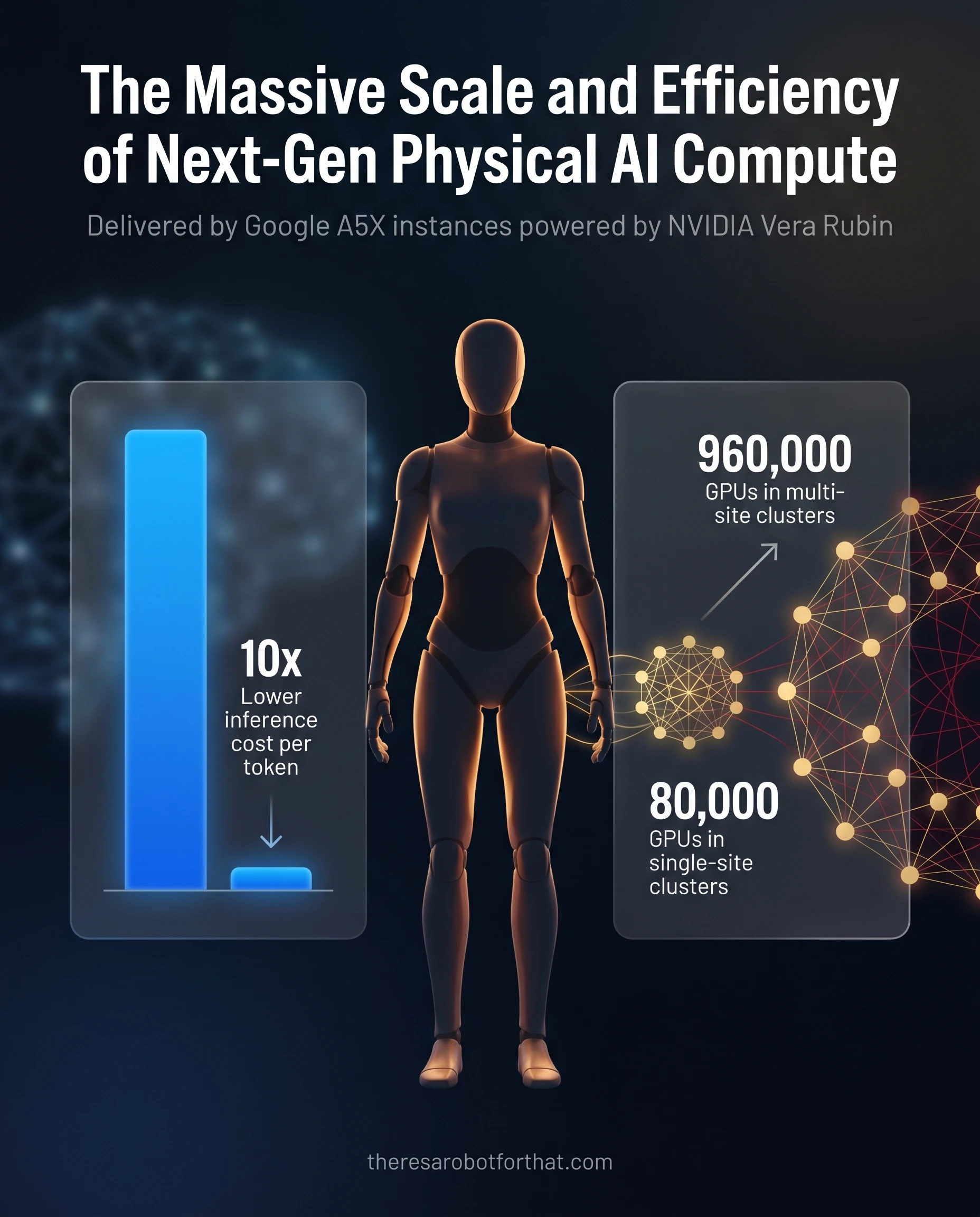
Image Source: There's A Robot For That
Snapshot: NVIDIA and Google Cloud announced next-generation AI infrastructure including NVIDIA Vera Rubin-powered A5X instances and Gemini running on Blackwell GPUs, specifically targeting agentic and physical AI workloads for robotics and factory digital twins. The A5X systems deliver 10x lower inference cost per token than prior generation infrastructure.
Breakdown:
Takeaway: Cloud providers are now building infrastructure specifically for physical AI rather than repurposing language model compute, which validates that robot deployments will generate meaningful cloud revenue within 24 months. The on-premises option through Google Distributed Cloud matters more than the raw performance numbers — it signals that robotics vendors and enterprise buyers have made clear they need hybrid deployment models, not cloud-only.
Other Top Robot Stories
ROBOTIS unveiled AI Sapiens, a 23-DOF open-source humanoid priced at $7,000–$8,700 targeting the Physical AI research market currently dominated by Unitree's G1, with first-half 2026 shipments planned.
Hannover opened its 2026 Messe trade fair with industrial AI and humanoid robots taking center stage for the first time, signaling mainstream acceptance of robotics in European manufacturing infrastructure planning.
Cornell developed a Raspberry Pi-powered soft robotic gripper with fiber-optic sensors that assesses fruit ripeness through touch, addressing the agricultural sector's need for gentle harvesting automation that doesn't damage produce.
St. Bernards Healthcare hosted Robotics Day for regional STEM students to operate Intuitive Surgical's da Vinci 5 system after completing 10,000 robotic procedures, part of a workforce development push as autonomous surgical robotics markets head toward $5.64 billion by 2030.
🤖 Your robotics thought for today:
BMW cut factory waste 50% with humanoids that don't need retooling. Accenture ran warehouse robots that talk directly to SAP. Fujitsu just opened a research center for deployment problems, not lab demos. If you're still waiting for the technology to mature, you're solving yesterday's question.
Enjoy your weekend,
Uli


