
Boston Dynamics' Atlas now 10x simpler to build
PLUS: CATL's 50kg humanoid works its battery lines, Isaac 1 folds laundry at home, and LG locks Tesla battery deal
Welcome back to your Robot Briefing
Boston Dynamics just cracked the code on making Atlas cheaper: strip out nine-tenths of the complexity. The company's fifth-generation humanoid is now simple enough for Hyundai's factories to pump out 30,000 units a year, potentially slashing costs well below the $200,000 barrier that's kept humanoids out of reach for most buyers.
The question now is whether simplification equals capability, or if Boston Dynamics just figured out how to mass-produce a robot that can finally justify its price tag. If Atlas can maintain performance while becoming an order of magnitude easier to build, we're looking at the first real path to commercial-scale humanoid deployment.
In today's Robot update:
From our workbench
Where does your deployment stand against ISO 10218:2025?
Most humanoid deployments run ahead of their paperwork. The robot works, the pilot is funded, and the documentation an auditor or an incident investigation would ask for is scattered across four inboxes. With the EU Machinery Regulation 2023/1230 becoming mandatory on January 20, 2027, that gap now has a deadline.
We built the ISO 10218:2025 Gap Analysis Checklist ($49): 62 audit questions across 8 domains, each with an evidence prompt that tells you what an auditor would ask to see. 60 to 90 minutes with your EHS and operations owners, and you have a scored gap list.
Want to check our quality first? The Facility Readiness Checklist, one complete module from our documentation toolkit, is free.
Boston Dynamics' Atlas Now 10x Simpler to Build
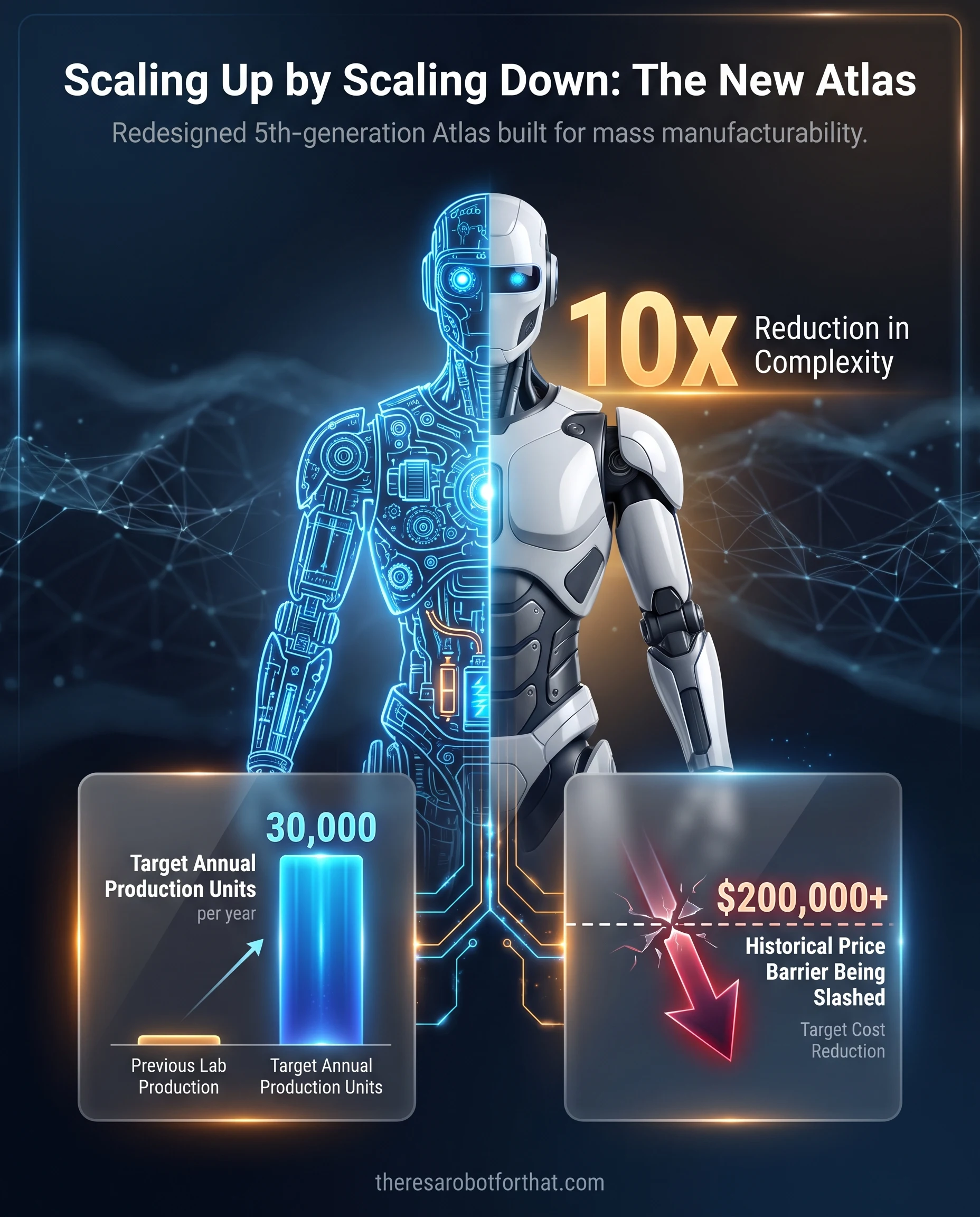
Image Source: There's A Robot For That
Snapshot: Boston Dynamics redesigned its fifth-generation Atlas humanoid with a near 10x reduction in complexity, positioning it for mass production at 30,000 units annually through Hyundai's manufacturing network, a move that could finally bring costs down from the historical $200,000+ price point.
Breakdown:
Takeaway: This is the clearest signal yet that a top-tier humanoid is transitioning from engineering showcase to production product. When a robotics leader redesigns specifically for manufacturability rather than capability, it means they've shifted from proving what's possible to selling what's practical.
CATL Puts Heavy-Duty Humanoid on Its Own Production Line
Snapshot: Battery giant CATL deployed Galbot's S1 humanoid, capable of a 50kg dual-arm payload, on its own battery manufacturing lines, marking one of the first times a major manufacturer has committed to heavy-duty humanoids for actual production work rather than pilot programs.
Breakdown:
Takeaway: When a manufacturer deploys robots in its own high-stakes production environment, it's a stronger validation signal than any pilot program or demo. CATL isn't testing the concept. They're betting their production throughput on it, which suggests the ROI case for heavy-payload humanoids in manufacturing is crossing the threshold from promising to proven.
Weave Robotics Ships Home Robot to Fold Laundry and Make Beds
Snapshot: San Francisco startup Weave Robotics launched Isaac 1, a wheeled mobile home robot that autonomously folds clothes, makes beds, and tidies rooms while switching to remote human operators when it encounters tasks beyond its current capabilities.
Breakdown:
Takeaway: The hybrid autonomy model, AI when possible, humans when necessary, solves the reliability problem that's killed previous home robot attempts. For business leaders watching the robotics space, this approach of augmenting automation with remote assistance is applicable far beyond consumer products, offering a practical path to deploy robots before the AI is perfect.
LG Energy Locks Battery Deals with Tesla, Boston Dynamics, and Figure AI
Snapshot: LG Energy Solution secured battery supply contracts with the top three US humanoid developers, Tesla, Boston Dynamics, and Figure AI, while pursuing deals with Chinese manufacturers including Unitree, positioning itself as the critical infrastructure provider for the emerging humanoid market.
Breakdown:
Takeaway: When a major component supplier commits production capacity to multiple robotics companies simultaneously, it's a leading indicator that the market is moving beyond prototypes. Battery deals get signed when manufacturers have confidence in volume forecasts, which means these robotics companies have provided LG with deployment projections substantial enough to justify dedicated supply lines.
Other Top Robot Stories
CarbonSix raised $40 million to put deploy-ready physical AI on the factory floor, using a task-specific data flywheel and its SigmaKit toolset of AI software, robotic hands, and teaching devices that let manufacturers train a robot on a new task by demonstration and deploy it in under a day without robotics expertise.
Mirsee tested eight units of its wheeled MH3 humanoid ahead of mass production starting in 2027, with the Cambridge, Ontario startup planning to scale to thousands of units over three years targeting dangerous and backbreaking manufacturing jobs.
OneRobotics showcased its affordable Onero humanoid and proprietary embodied AI models at its Shenzhen headquarters, where the Hong Kong Stock Exchange-listed company builds cleaning, companion, and tennis-playing robots for the home market.
SAIC-GM argued wheeled humanoids are the smarter transitional choice for factory deployment, with powertrain technology head Xu Xiaoshun citing safety concerns after a 100-pound bipedal robot toppled over on the factory floor and noting China's mature domestic supply chain now supports mass production.
🤖 Your robotics thought for today:
Boston Dynamics cut Atlas complexity by 10x. CATL deployed 50kg humanoids in its own battery lines. When the engineers stop optimizing for capability and start optimizing for cost, and when manufacturers bet their own production lines on the tech, you're watching a market flip from "someday" to "this year."
I'm tracking how fast those 30,000 units actually ship.
Until Wednesday,
Uli


