China Builds Humanoids Faster Than Anyone Can Use Them
Gemini learns to jump between robot bodies, Boston Dynamics delays its IPO, and Japan builds the house around the robot.
The Big Number
Goldman Sachs raised its 2035 humanoid robot sales forecast to 6.48 million units, nearly a fivefold jump from its earlier estimate.
Welcome back to your Robot Briefing
The loudest robotics stories keep celebrating supply: another factory, another funding round, another forecast measured in millions. This week the quieter signal was demand, and it is not keeping pace.
China can now build humanoids by the tens of thousands, banks are marking the market up fivefold, and yet most of those machines are still practicing rather than working. That gap between a robot that can move and a robot worth paying to keep is where the next year gets decided.
The 60-Second Read
China shipped more than 97% of the world's humanoids in the first half of 2026, but analysts think most are collecting training data, not doing paid work.
Google DeepMind wants one Gemini brain to run many different robot bodies, and it is already driving Apptronik's Apollo humanoid.
Boston Dynamics pushed its IPO past 2027 because Atlas is not yet deployed at scale and the unit is still losing money.
A Tokyo startup is skipping legs entirely, wiring robotic arms into the ceilings of purpose-built homes.
News
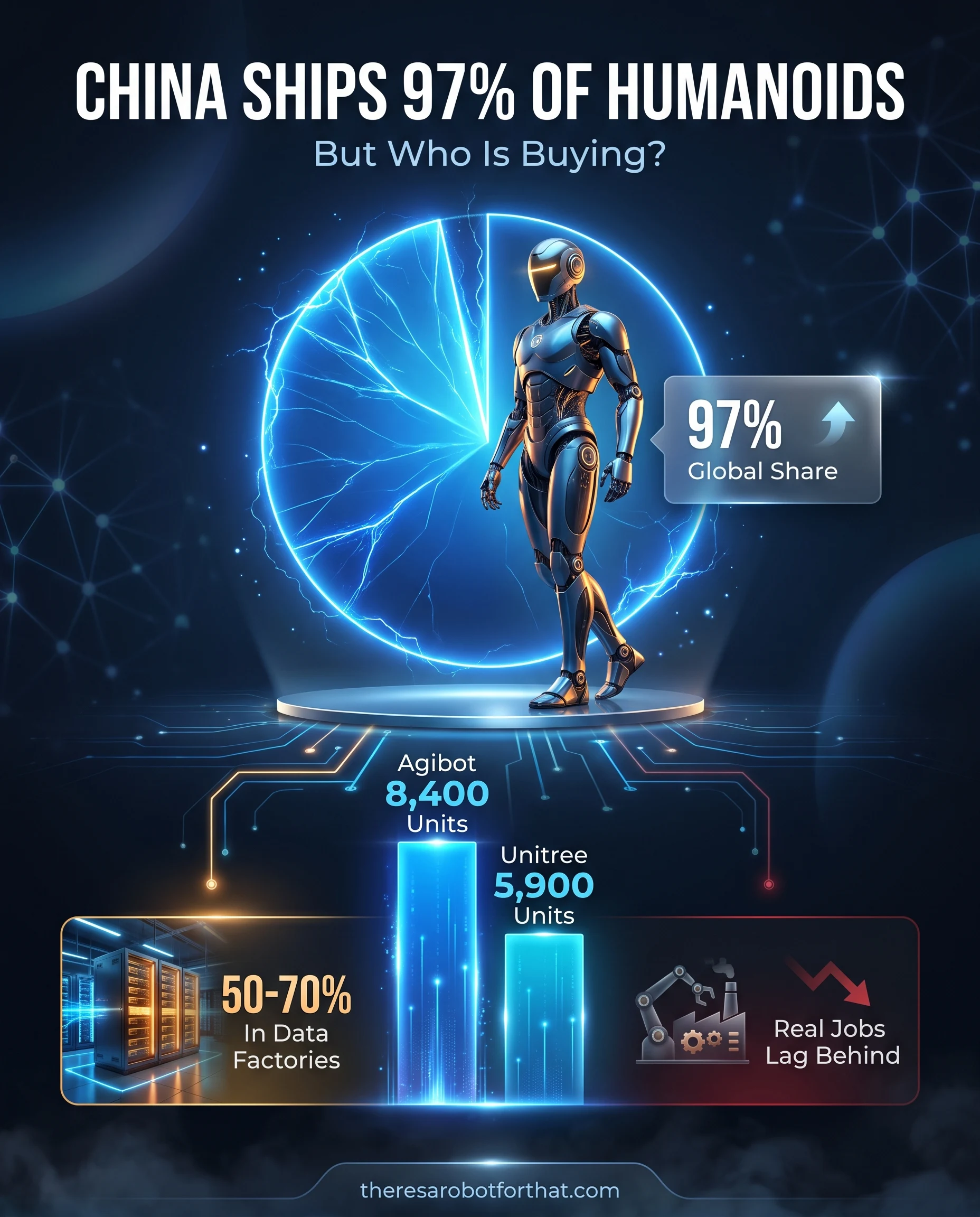
China Ships 97% of Humanoids, But Who Is Buying?
Image Source: There's A Robot For That
Snapshot: Chinese companies shipped more than 97% of the world's humanoid robots in the first half of 2026, yet only a small share are doing productive work.
Breakdown:
Agibot led every vendor with 8,400 units in six months, up 562% from a year earlier, with Unitree second at 5,900, according to market research firm Smart Analytics Global.
Analyst Georg Stieler estimates that 50% to 70% of this year's humanoids will end up in "data factories" that generate training footage rather than performing real jobs.
Nearly three-quarters of Unitree's revenue came from education and research buyers, and more than 90 robot training centers had been established or were under construction across China by June.
The buyers driving those shipments are largely universities, state-backed labs and consumers, not factories paying a robot to earn its keep.
Takeaway: The supply question is effectively answered, China can produce humanoids at scale and cheaply. The open question for any buyer is utilization. Before a purchase, model the hours a unit will actually run on a paying task rather than the sticker price, because a robot parked in a data-collection pen is a cost, not a worker.
News
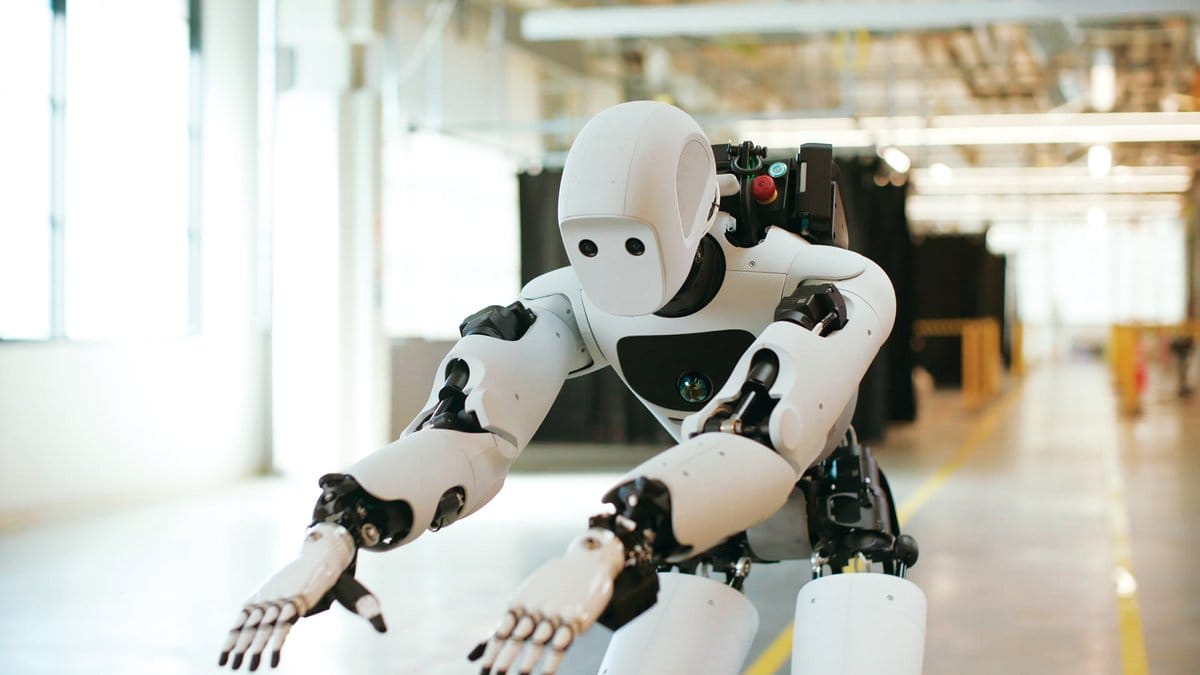
Google DeepMind Wants One Brain to Run Any Robot
Image source: Scientific American
Snapshot: Google DeepMind built Gemini Robotics 2 to run the same AI across different robot bodies, from two-armed research rigs to Apptronik's Apollo humanoid.
Breakdown:
Gemini Robotics 2 now controls full-body movement, legs, torso, arms and fingers, while a companion model, Gemini Robotics ER 2, breaks a spoken request into ordered steps.
The same model drove machines ranging from a bimanual lab platform to Apptronik's Apollo 2, the cross-embodiment goal of writing one policy that transfers across hardware.
Limits remain visible: Apollo scored just 32% on a dustpan-sweeping test, and the system still struggles with soft, fragile and deformable objects.
Researcher Kanishka Rao argues that enough real-world interaction data will let the model generalize to dexterous tasks it was never explicitly taught.
Takeaway: A brain that ports across bodies changes the buying calculus. If one model can run a warehouse arm and a humanoid, the software investment outlives any single robot you buy. Ask vendors whether their control stack is welded to one chassis or designed to move, because lock-in at the brain layer costs more than lock-in at the hardware layer.
⏱️ The Compliance Clock
This week is about humanoids doing real industrial work, from Boston Dynamics' Atlas heading to car lines to Chinese robots leaving the demo stage. The standard that governs an industrial robot on a factory floor is ISO 10218, whose 2025 revision separates the requirements for the robot itself from those for the fully integrated system and raises the documentation an integrator must produce before a cell goes live. If you are scoping a humanoid for production, ask the integrator which parts of ISO 10218 the deployment is being certified against, because a robot that looks safe in a demo is not the same as a cell that is compliant in production.
Boston Dynamics Delays Its IPO Until Atlas Earns Its Keep
Image source: Reuters
Snapshot: Boston Dynamics is unlikely to go public in 2027, a senior Hyundai executive said, because it has not yet put its Atlas humanoid to work at scale and remains unprofitable.
Breakdown:
The unit lost about 528 billion won in 2025 and roughly 1.7 trillion won, near US$1.3 billion, across 2021 to 2025.
Hyundai plans annual capacity for 30,000 Atlas robots by 2028 and will first deploy them at its Georgia plant that year before spreading them across its manufacturing network.
Analysts value the unit widely, from 50 trillion to 100 trillion won, with IBK Securities projecting 141 trillion won and 11 trillion won in revenue by 2030.
Hyundai bought SoftBank's stake of roughly 10% in July, and analysts now peg a realistic listing at 2029 or 2030.
Takeaway: The market is repricing humanoids on proof, not promise. A supplier that cannot show paid, at-scale deployment is being told to wait, which is a useful filter for buyers too. When a vendor pitches you, ask for named production sites and run-hours, the same evidence the capital markets are now demanding.
News
Japan's Answer to Humanoids: Build the House Around the Robot
Snapshot: Tokyo startup MW designed homes with ceiling-mounted robotic arms that glide along rails to fold laundry and put away groceries, skipping legs entirely.
Breakdown:
The MW bot pairs two claw-handed arms with the company's MW Intelligence software and custom residential architecture, its three-part bet against free-standing humanoids.
In a Toyosu demo the system sorted shelf-stable goods from items needing refrigeration and folded a hand towel, though it fumbled a T-shirt.
MW aims to sell its first robot-equipped home in Tokyo by 2028 and build up to 10,000 a year by 2035, about 5% of Japan's new-home construction.
The homes are expected to cost between 200 million and 400 million yen, roughly US$1.3 million to US$2.6 million, with a monthly robot service fee of 5,000 to 10,000 yen, about US$32 to US$65.
Takeaway: MW is a reminder that the home market may not be won by a walking robot at all. Fixing the environment to the machine sidesteps the hardest parts of mobility and balance. For anyone selling into homes or care settings, the lesson is that reliability in a known space can beat versatility in an unknown one.
▶ Operator's Playbook
Turn this week's demand gap into a purchasing question. Before you approve any humanoid pilot, write a one-page utilization case with four lines: the specific task, the hours per day the robot will run it, the human labor it offsets, and the safety standard the cell will be certified against. If the vendor cannot fill in those four lines with named references, you have a demo, not a deployment. The Safety Compliance Kit gives you the standards checklist to anchor that last line.
Exeinraised $270 million at a $1.7 billion valuation, becoming Italy's newest unicorn as it builds a dedicated security layer for physical AI systems.
NVIDIAopen-sourced OSMO , a tool that lets robotics teams orchestrate training, simulation and hardware testing across mixed compute from a single YAML file.
The University of Texas at Austinwon $30 million from the NSF to launch a Center for Human and Robot Co-Adaptation, studying robots in homes, hospitals and assisted living with partners including Apptronik and Google DeepMind.
Faraday Futurepivoted to physical AI , unveiling a six-robot lineup of humanoids, quadrupeds and robotic arms on one platform, led by a US$90,000 Futurist humanoid, as the struggling EV maker aims to ship a few hundred units in the first half of 2026.
Shanghai AI Labshipped a world model called Intern W0, built with native force and tactile sensing to help robots predict the physics of contact-rich tasks.
Dreameunveiled dual-arm Echo service robots, with the two-armed Echo P1 aimed at retail and drink service and the single-arm Echo S1 built to handle laundry.
Compliance tool
Where does your robot documentation stand?
The ISO 10218:2025 Gap Analysis Checklist finds every gap in 62 audit questions.
The numbers this week pulled in two directions. One said the robots are already here, shipped by the tens of thousands and forecast in the millions. The other said most of them are still practicing. The stretch worth watching is the space between a machine that can move and a machine that is worth paying to keep. That is where the next year will actually be decided, one proven task at a time.