China Builds the Robots, Washington Moves to Ban Them
Eric Trump's new robot factory, an Anthropic buyout rumor, and a shape-shifting personal humanoid.
The Big Number
Chinese companies built roughly 80% of the world's humanoid robots shipped last year, according to Counterpoint Research, a lead that is now shaping US policy.
Welcome back to your Robot Briefing
This week the humanoid story stopped being about what the machines can do and started being about who is allowed to build them. Washington moved to keep Chinese humanoids out of the military at the same moment China's factories are producing most of the world's supply.
Around that fault line, the capital kept flowing: a fresh $1.7 billion for physical AI, Optimus rolling onto a real production line, and a Chinese model pitched at the messy reality of home care. Here is what matters for your floor.
The 60-Second Read
The US House passed a defense bill blocking the military from buying or operating Chinese-made humanoid robots.
Travis Kalanick's Atoms raised $1.7 billion to build specialized, non-humanoid robots for heavy industry.
Tesla says Optimus entered production at Fremont, with its biggest hurdle being a supply chain that does not yet exist.
Unitree showed one AI model steering a humanoid through household and bedside tasks from voice and vision alone.
News
Washington Moves to Wall Off China's Humanoid Robots
Image Source: There's A Robot For That
Snapshot: The US House of Representatives passed a defense bill that would bar the Pentagon from buying, leasing or operating humanoid robots linked to China, Russia or Iran, opening a new front in the US-China technology contest.
Breakdown:
Section 163 of the National Defense Authorization Act blocks military procurement of covered humanoid systems from designated foreign adversaries, while stopping short of any commercial ban.
The provision folds in part of Representative John Moolenaar's GUARD Act; the fuller version would put Chinese humanoids and quadruped robot dogs on the FCC Covered List and strip their wireless licences, effectively barring commercial sale.
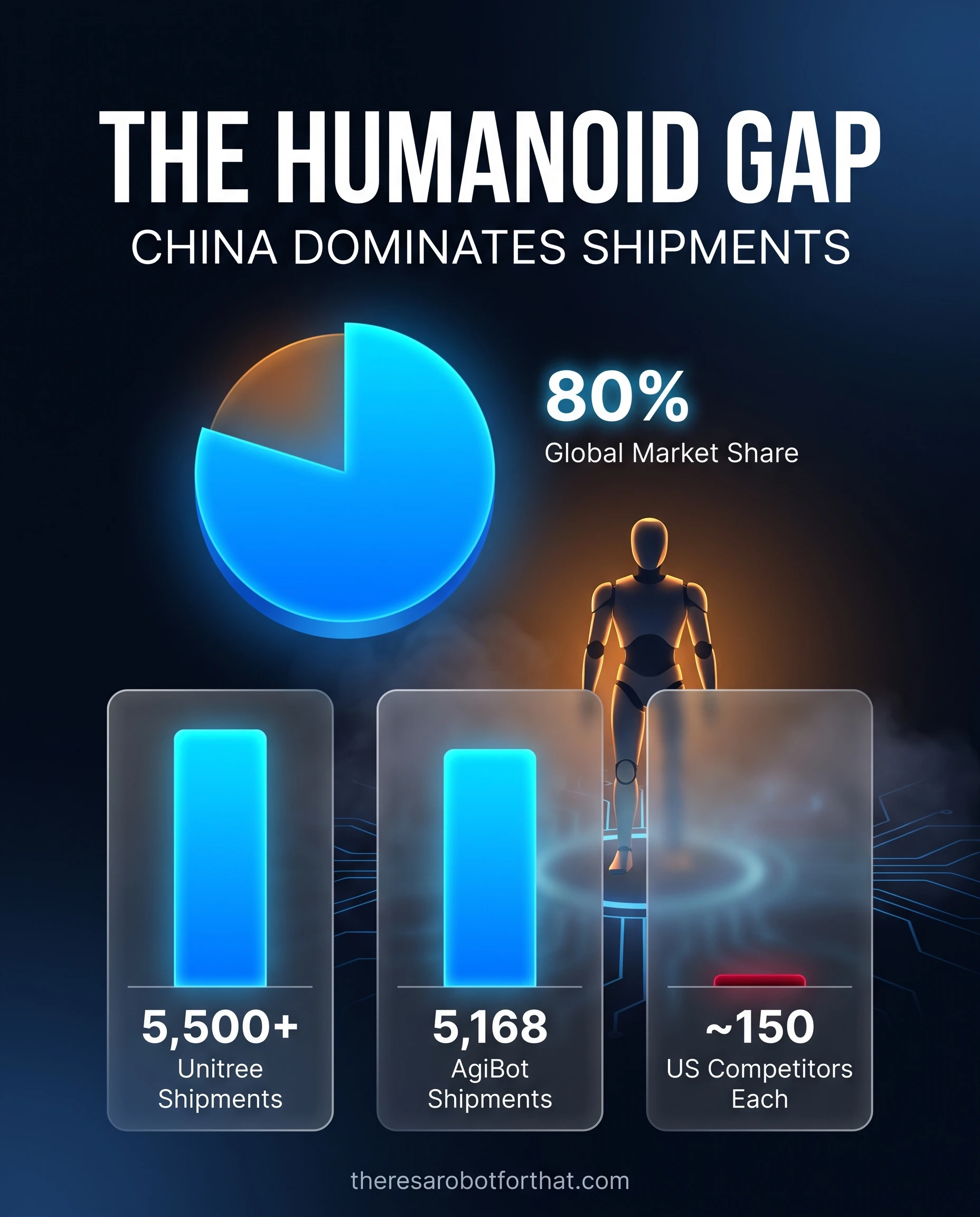
The move reflects a lopsided market. Chinese firms shipped about 80% of the world's humanoid robots last year, per Counterpoint Research.
Unitree said it shipped more than 5,500 humanoid robots in 2025, AgiBot shipped 5,168 according to Omdia, and Figure AI, Agility Robotics and Tesla each shipped roughly 150 units.
Takeaway: The signal for operators is concentration risk, not just geopolitics. If your automation roadmap leans on Chinese humanoids, a US-linked site could face procurement friction well before any full commercial ban, so it is worth mapping country of origin and a second-source option now rather than after a contract closes.
News
Travis Kalanick's $1.7 Billion Bet on Physical AI
Snapshot: Uber co-founder Travis Kalanick's stealth venture Atoms raised $1.7 billion to build what it calls computers for the physical world, specialized robots and AI aimed at atoms-heavy industries.
Breakdown:
The equity round was led by Andreessen Horowitz, with co-founder Ben Horowitz joining the board. Atoms grew out of Kalanick's City Storage Systems, the company behind CloudKitchens.
Kalanick named three units so far, Atoms Food, Atoms Mining and Atoms Transport, targeting mining, construction, heavy transport and food production.
The pitch runs against the humanoid grain. Horowitz argued that while humanoids capture the imagination, specialized robots are better suited to most physical work.
Takeaway: Not every physical-AI dollar is chasing a walking robot. A raise this size behind task-specific machines is a reminder that for a lot of warehouse, mining and logistics work, a purpose-built system still beats a general-purpose humanoid on cost and reliability, and that is the comparison to force when a vendor pitches you one robot for everything.
⏱️ The Compliance Clock
As humanoids move from demo reels onto real production lines, the safety baseline that governs them in most markets is ISO 10218, the international standard for industrial robot safety, updated in its 2025 revision. That revision raises the documentation bar for risk assessment and system integration, and it applies whether a robot walks on two legs or bolts to the floor. If you are weighing a humanoid for a 2026 line, its ISO 10218 conformity file will tell you more about deployability than any highlight video.
Tesla Puts Optimus Into Production, With No Supply Chain
Snapshot: On its second-quarter earnings call, Tesla moved Optimus into production this quarter at its Fremont, California factory, where the humanoid is trained to learn tasks by watching workers instead of running pre-written code.
Breakdown:
Elon Musk said the real obstacle is manufacturing, because Optimus has no existing supply chain, so Tesla is insourcing components and lining up Samsung, Micron and Panasonic for chips and batteries.
The learn-by-watching approach mirrors Tesla's driver-assistance software, with AI vice president Ashok Elluswamy noting the robot learns from footage of the company's own factory workers.
The same principle drives Tesla's robotaxis, which have logged more than 380,000 miles of unsupervised driving across seven US markets with zero notable incidents.
Tesla now guides full-year capital expenditure above $25 billion as the ramp begins.
Takeaway: The demo was never the hard part. Optimus becoming a real product depends on standing up a supplier base from scratch, and that manufacturing build-out, not the AI, is what will set how fast humanoid unit costs actually fall for the buyers waiting on them.
News
Unitree's New Model Aims a Humanoid at Home Care
Image source: Unitree Robotics
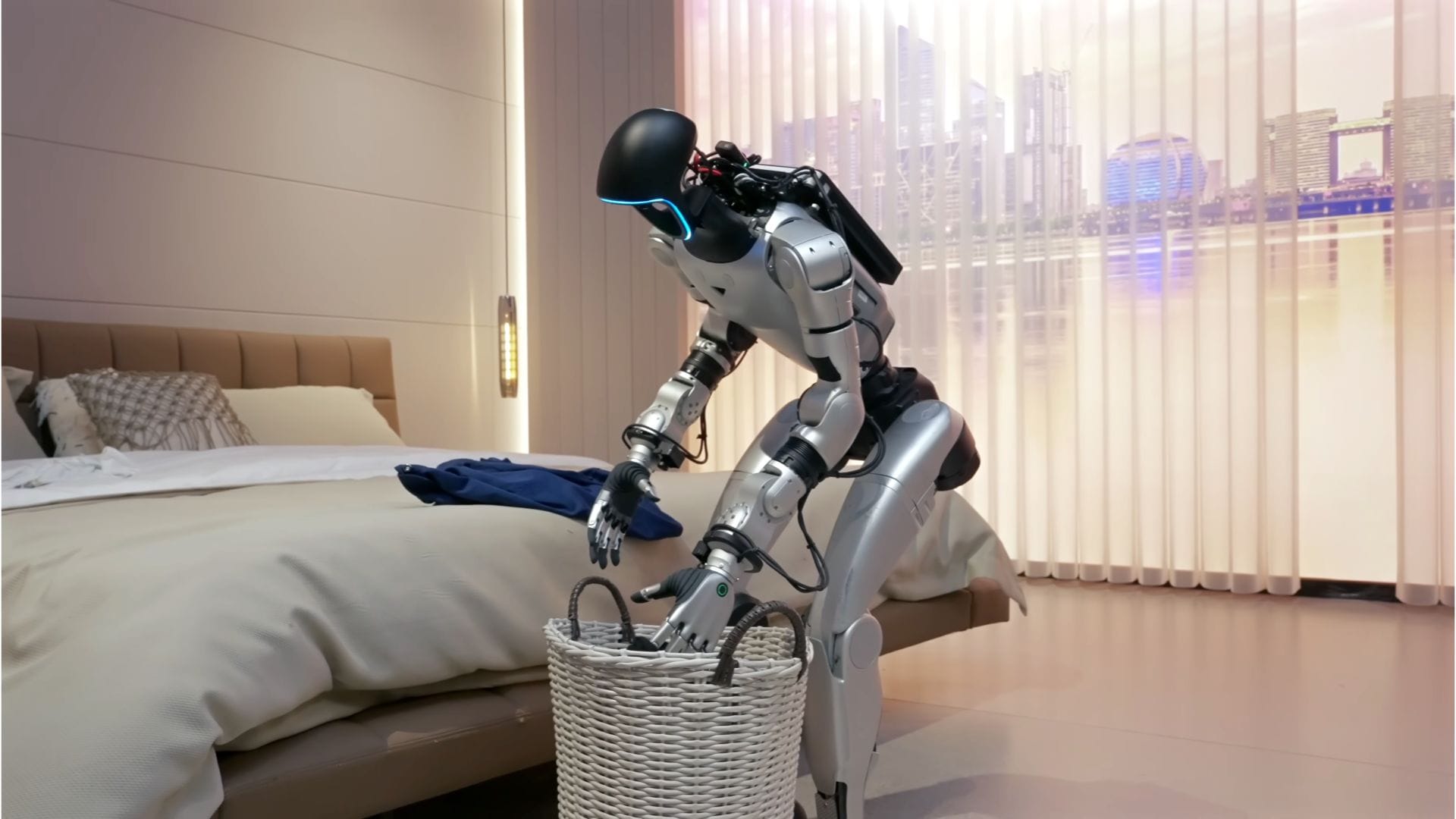
Snapshot: Unitree introduced a single AI model, UnifoLM-OminiA-0.3, that lets one humanoid tidy a room, sort laundry and assist at a bedside using voice and vision alone.
Breakdown:
In the demonstration the robot places a cushion, counts medicine boxes, retrieves a specific box from a shelf, loads a dishwasher and operates an adjustable bed.
It responds to a spoken instruction to stop partway through a task, handling interruptions rather than accepting commands only before it starts.
The claim is one model coordinating perception, reasoning, positioning and manipulation, extending Unitree's earlier UnifoLM-WMA-0 world model and UnifoLM-VLA-0 vision-language-action release.
Takeaway: Homes and care settings do not offer the structured conditions of a factory floor, where objects stay put and no one walks into the workcell. Coping with interruption and change is the real threshold for domestic humanoids, and this is still a demonstration rather than a shipping product, so treat it as a direction of travel, not a purchase order.
▶ Operator's Playbook
Before a humanoid reaches your shortlist this year, ask each vendor for two documents in writing: its ISO 10218-1 and 10218-2 conformity file, and a clear statement of country of origin and component sourcing. The first tells you whether the machine can be safely integrated and defended in an audit, and the second, given this week's move in Washington, tells you whether it carries procurement risk on a US-linked site. Vendors who cannot produce either on request have told you something too.
Eric Trump's Foundationpartnered with AMD to build its Phantom MK-2 humanoid on Ryzen AI embedded chips, with the startup saying its earlier MK-1 units helped build more than 24,000 cars in 2025 and that it will open a factory capable of 5,000 robots a year in October.
Physical Intelligencedenied a rumor that Anthropic was acquiring it, though The Information reported the two held acquisition talks this spring, a complicated prospect given that OpenAI is itself an investor in the robotics startup.
The World Economic Forumwarned that physical AI is reaching the market with unaddressed cybersecurity gaps, describing an industry-leading humanoid sitting open on a lab bench at Capgemini in Cambridge as a case in point.
Chinese startup PrimeBOTlaunched the Qiyuan T1 , which it bills as the first personal humanoid that switches on its own between a wheeled two-legged form and a quadruped stance.
South Korea's Daedonglaid out a plan for a fully autonomous farm, combining AI and robotics to reduce agriculture's heavy reliance on manual labor as the sector faces a shrinking workforce.
Compliance toolkit
The EU Machinery Regulation applies from January 20, 2027.
The Robot Safety Documentation Toolkit gives your team all seven compliance documents, ready to fill in.
The loudest robot news this week was about who is allowed to build the machines, not about what the machines can actually do yet. It is worth remembering that a rule about military procurement and a video of a robot folding laundry are answering very different questions, and only one of them changes anything on your floor this quarter.