
Eno humanoid shows you how it thinks
PLUS: Raspberry-picking bot raises £2.5M, Europe battles China's 87% robot dominance, and India's farm bots go global

Welcome back to your Robot Briefing
Genesis AI just launched Eno, a general-purpose robot that scraps the humanoid body for wheels and an adjustable tower, and includes an optional screen that displays its AI reasoning in real time. It's targeting factories, labs, and hospitals first, with homes on the long-term roadmap.
The transparent reasoning feature is a rare move in an industry obsessed with slick demos. Will showing customers exactly how the AI thinks build trust faster than hiding the messiness behind polished marketing?
In today's Robot update:
Genesis AI unveils Eno: wheeled humanoid with visible AI reasoning
Snapshot: Genesis AI launched Eno, a general-purpose robot that ditches the humanoid form for a wheeled base with an adjustable tower, and includes an optional screen that shows its AI reasoning process in real time. The company is positioning the platform for work across factories, labs, hospitals, and hotels before eventually targeting homes.
Breakdown:
Takeaway: The transparency screen signals Genesis AI understands deployment risk: businesses won't adopt robots they don't trust, especially in healthcare or hospitality where mistakes are visible. The wheeled design also suggests the company is prioritizing commercial viability over anthropomorphic appeal, a pragmatic choice that could accelerate real-world testing timelines compared to bipedal alternatives.
UK's Fieldwork Robotics raises £2.5M for AI berry-harvesting robots
Snapshot: Fieldwork Robotics secured £300k from SEED Innovations as part of a £2.5M round to scale autonomous raspberry-picking robots that use four independent arms with inflatable membranes and AI-powered ripeness detection. The Cambridge spinout is moving from technology validation to commercial trials across UK, Australia, Portugal, and US farms.
Breakdown:
Takeaway: The harvesting-as-a-service model is the business signal here, it eliminates capital expenditure barriers and shifts deployment risk to Fieldwork, which only works if the technology is genuinely field-ready. If a spinout from 2016 is raising growth capital for commercial trials in 2026, it suggests agricultural robotics has crossed from R&D into early deployment phase for specialized crops.
European robotics startups stake claims against China's 87% market dominance
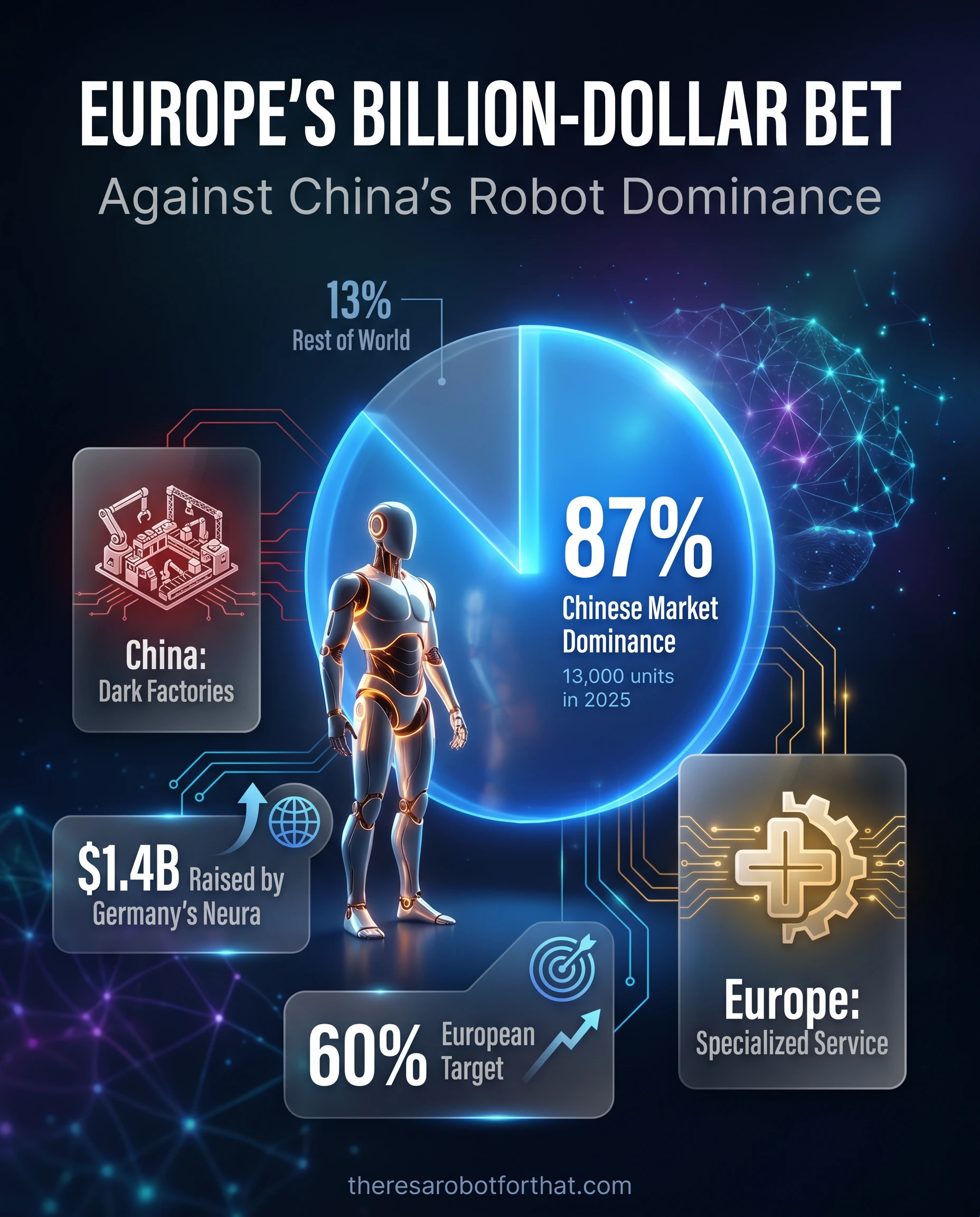
Image Source: There's A Robot For That
Snapshot: At France's Vivatech fair, European robotics firms including Enchanted Tools and Germany's Neura showcased humanoid robots for hospitals and factories, competing for specialized niches as China controls 87% of global humanoid robot production. Europe's strategy appears to be targeting service sectors and industrial applications where customization and trust matter more than manufacturing scale.
Breakdown:
Takeaway: European firms are conceding the manufacturing volume race and instead competing on application-specific AI, regulatory compliance, and service-sector deployment where customer interaction and safety certification create defensible moats. The $1.4B Neura raise suggests venture investors see Europe's aging workforce demographics as a forcing function that will drive adoption regardless of Chinese price competition.
India's Niqo Robotics takes Physical AI farm platform to Europe
Snapshot: Niqo Robotics, selected as India's only precision-AI farm robotics company for the Bharat Innovates 2026 showcase in France, is expanding its autonomous agricultural platform from Indian fields to European and Australian markets with machines that claim day-one ROI without subscriptions or hidden costs.
Breakdown:
Takeaway: The zero-subscription, immediate-ROI positioning suggests Niqo learned from failed agricultural robotics business models that front-loaded costs or added recurring fees farmers wouldn't accept. An Indian company targeting European farms with government backing also signals emerging markets may leapfrog developed ones in building commercially viable agricultural automation, not because of cheaper labor costs, but because of necessity-driven business model innovation.
Other Top Robot Stories
Daedong acquired 195,010 shares worth ₩1.53 billion as seven executives backed the Korean manufacturer's pivot to AI agriculture platforms, following commercialization of the country's first vision AI-based autonomous tractor and selection as lead contractor for the National Agriculture AX Platform Project.
AGIBOT announced a six-day livestream from June 23-28 showing humanoid robots operating alongside humans on a full tablet quality-inspection line at Longcheer Technology's Nanchang factory, marking the first public view of continuous humanoid operations in actual production conditions.
UBTECH generated approximately $119 million in revenue from selling more than 1,000 Walker series humanoids in 2025, with autonomous demos of the Walker S2 model now running at the company's Shenzhen exhibition area.
DEEP developed an upgraded Smart Utility Tunnel Inspection Solution with Joyou Digital that combines autonomous robots, digital twins, and real-time analytics to manage underground infrastructure beneath cities.
🤖 Your robotics thought for today:
Genesis AI put a screen on Eno to show you how it thinks. That's either brilliant trust-building or an admission that the AI makes enough weird decisions that you need constant visibility. Fieldwork Robotics has been working on raspberry-picking since 2016 and is just now moving to commercial trials. Nine years to prove a robot can handle soft fruit without crushing it.
I'm watching whether transparency becomes table stakes or stays a novelty feature.
Until Wednesday,
Uli


