Five Million Robots Now Work in the World's Factories
Qualcomm buys the robot software layer, a repairable humanoid raises in Tokyo, and 300 robots go to work at one theme park.
The Big Number
Factories worldwide now operate a record five million industrial robots, more than double the count of seven years ago.
Welcome back to your Robot Briefing
The humanoid demos get the headlines, but the number that actually moved this week came from a spreadsheet. The International Federation of Robotics published its annual census, and the installed base of factory robots crossed five million for the first time.
Underneath that record sits a widening split. Asia is pulling away, the Americas are growing, and Europe is the one major region moving backward. The rest of the issue follows the money and the plumbing behind that shift, from a chip giant buying the software robots run on to a Tokyo startup betting the real cost of a humanoid is the repair bill.
The 60-Second Read
The world's factory-robot fleet hit a record 5 million in 2025, with China installing 59% of all new units.
Qualcomm agreed to buy PickNik, the steward of the open-source MoveIt framework, to own more of the robotics software stack.
A Tokyo startup founded by two Europeans raised $1.2 million to build humanoids you repair on-site instead of shipping back.
AGIBOT put more than 300 robots to work across a single Chinese theme park and delivered its 20,000th unit.
News
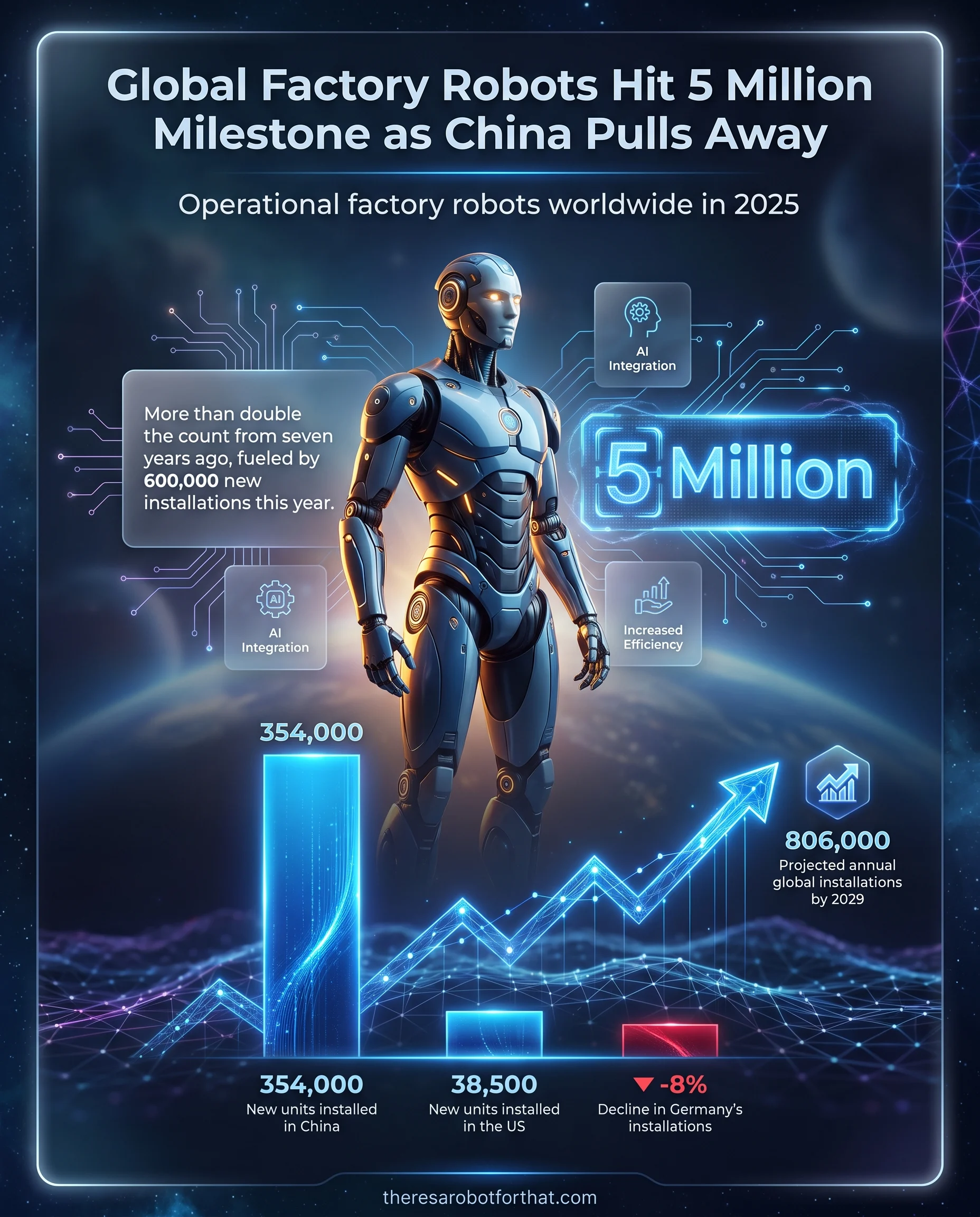
The World's Factories Cross Five Million Robots
Image Source: There's A Robot For That
Snapshot: Factories worldwide installed more than 600,000 new industrial robots in 2025, up 11%, which the International Federation of Robotics recorded in its World Robotics 2026 report, lifting the global operational fleet to a record five million units.
Breakdown:
China installed 354,000 robots in 2025, 59% of the global total, with annual installations up 20% year on year and domestic makers now outselling foreign suppliers at home.
The United States passed Japan to become the second-largest market, with installations up 12% to almost 38,500 units, the third-highest figure on record there.
Europe is the laggard: Germany, the region's biggest market, saw sales fall 8% to under 25,000 units, and Italy, France and Spain all declined.
The IFR expects installations to keep climbing, forecasting 655,000 new units in 2026 and 806,000 by 2029.
Takeaway: The headline is scale, but the signal for operators is geography. Automation capacity is concentrating in Asia while European lines fall behind, so a buyer sourcing robots or spare parts should plan around where supply, service networks and integrator talent are actually growing. The five-million milestone also resets the baseline: robots are now ordinary infrastructure, and the competitive question is no longer whether to automate but how fast your peers already are.
News
Qualcomm Buys the Software Robots Run On
Snapshot: Qualcomm agreed to acquire PickNik, the longtime steward of MoveIt, one of the most widely used open-source robotics manipulation frameworks, deepening its push into the physical AI stack.
Breakdown:
MoveIt will stay open-source under its existing license, with both MoveIt 1 and MoveIt 2 remaining community-driven and supported across third-party hardware.
The framework will integrate tightly with Qualcomm's Dragonwing robotics platforms and, starting with the Arduino VENTUNO Q board, aims to link AI models such as VLAs and VLMs to motion planning and control.
Financial terms were not disclosed, and the two companies are showing MoveIt Pro on Dragonwing and Arduino boards at the ROSCon developer conference in Toronto this week.
Qualcomm and PickNik are both founding members of the Open Source Robotics Alliance, and Qualcomm said it will keep backing ROS projects including the space-hardened Space ROS.
Takeaway: Chipmakers are no longer content to sell silicon into robots, they want to own the layer that turns hardware into a working machine. For anyone building or buying robots, that means the motion-planning software is starting to consolidate around vendor ecosystems, so it is worth asking whether an open framework stays genuinely portable or quietly optimizes for one company's chips over time.
⏱️ The Compliance Clock
117 days
until the EU Machinery Regulation becomes mandatory (Jan 20, 2027)
This week's lead is about industrial robots arriving by the hundreds of thousands, and every new machine placed on the European market soon faces a higher bar. The EU Machinery Regulation replaces the decades-old Machinery Directive and, for the first time, pulls software behavior, AI decision-making and cybersecurity into the conformity assessment a robot must pass. If you are speccing machines for a European site, the compliance file you assemble now is the one an auditor will ask for later, so build it as part of the purchase rather than after it.
Snapshot: O-ID, a Tokyo company building fully modular humanoids for factories, raised $1.2 million in pre-seed funding led by Chicago's TAWANI Ventures, with Hustle Fund and Techstars joining.
Breakdown:
The pitch is repairability: staff can swap a worn shoulder, elbow or compute unit on-site instead of shipping the whole robot back to the maker for months.
Onboard sensors track component wear and flag parts before they fail, so a replacement can arrive ahead of any downtime.
The first prototype is a stationary dual-arm robot; a mobile, stronger version is due to be unveiled at CES 2027, with factory pilots targeted for early 2027.
O-ID has signed a letter of intent with Sumitomo Electric to explore wire harnesses for humanoids and is designing its robots to meet US defense procurement rules.
Takeaway: The founders are aiming at Japan's projected shortfall of more than 11 million workers by 2040, but the sharper idea is financial. For a large plant where an hour of downtime runs into the millions, the cost that matters is not the sticker price but the lifetime repair bill, and a robot you fix on the line rather than crate and return changes that math. Buyers evaluating any humanoid should ask what happens when a single joint fails.
News
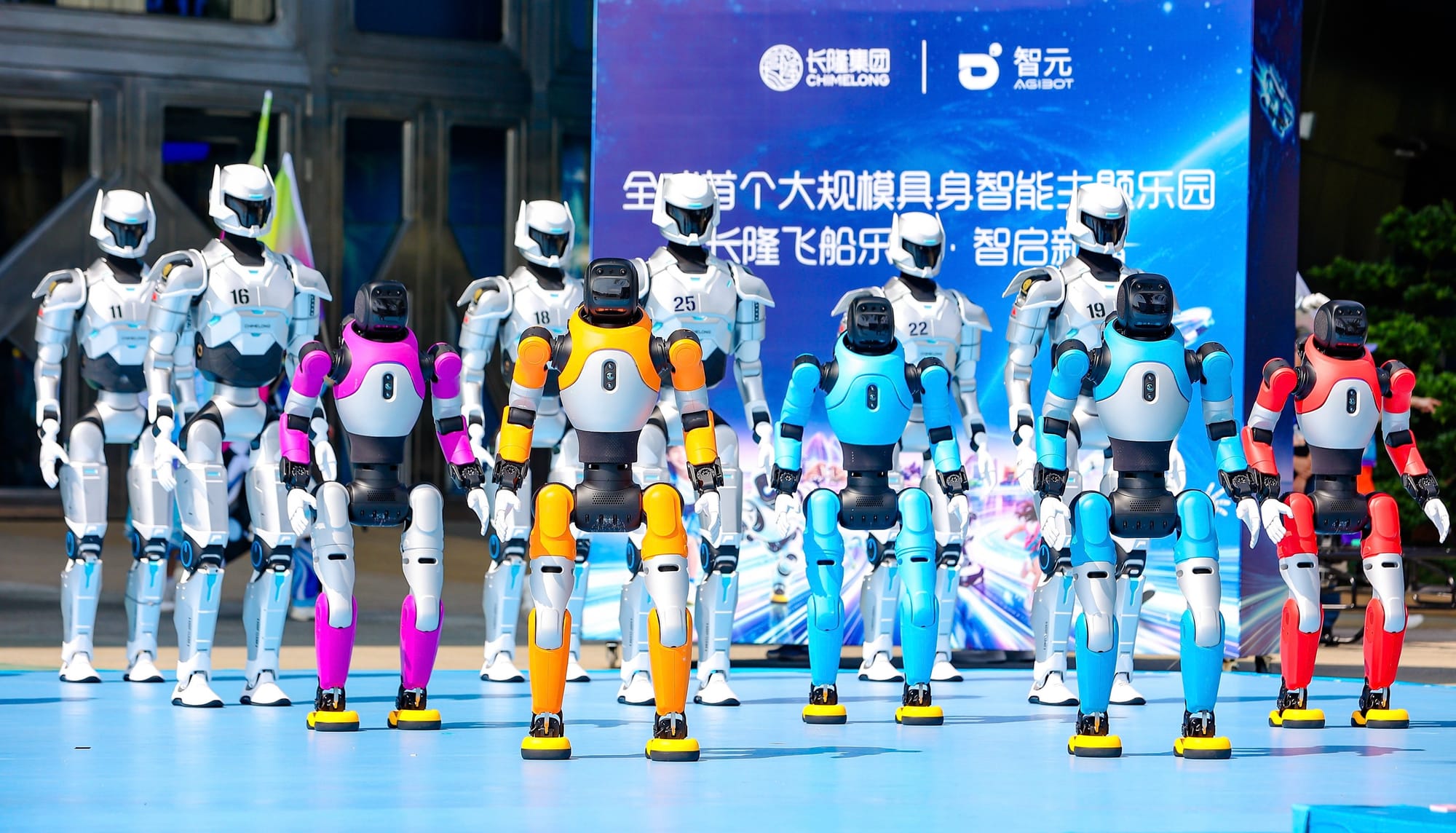
AGIBOT Puts 300 Robots to Work in One Park
Image source: AGIBOT
Snapshot: AGIBOT deployed more than 300 robots across Chimelong's Spaceship Park in Zhuhai, spanning guided tours, retail service, education, hotel operations and live performance, and marked the delivery of its 20,000th production robot.
Breakdown:
The robots run across seven guest-facing and operational scenarios, from answering questions and giving directions to hotel check-in and staffed retail stations.
AGIBOT, Chimelong and China Mobile built a dedicated 5G-A network with centralized multi-robot coordination to keep the fleet responsive across high-traffic areas.
Operational safeguards cover network security, privacy, charging and fire safety, positioning the project as a template for large mixed-robot deployments.
The two partners also launched a joint research institute for embodied AI in culture and tourism, and Chimelong draws more than 40 million visitors a year.
Takeaway: A 300-robot fleet in one venue is less a spectacle than a stress test of the boring parts, connectivity, coordination and safety at scale, which is exactly where most real deployments stall. The reference architecture here, robots plus a dedicated network plus a coordination layer, is the same shape a warehouse or hospital operator will need, and it is a reminder that the hard problem shifts from one clever robot to a hundred that have to work together.
▶ Operator's Playbook
Before you sign for any humanoid or industrial robot bound for a European line, ask the vendor in writing for its EU Machinery Regulation conformity documentation and its ISO 10218 safety file, and model one failure case: if a single actuator dies, how many hours is the robot out of service, and can your own team swap the module on-site or does the unit ship back to the maker. Put both the paperwork and the downtime math into the purchase file so the compliance and total-cost picture is settled before the deposit, not after.
Feather Roboticsis building an "Android of robotics," a hardware-and-software toolkit that lets developers build real-world tasks on a humanoid today rather than waiting for a general-purpose brain.
NVIDIAshipped Isaac ROS 5.0, an open-source release that brings agentic workflows and 5.5x faster object tracking to the roughly 1.3 million engineers who build on ROS.
Anyverse Dynamicsis deploying its first humanoid, the K15, at an Envision battery plant in France and plans cafe trials in South Korea this quarter, after raising $200 million within a year of founding.
DiffuseDriveis expanding its synthetic-training-data platform from self-driving into robotics, after reporting model performance gains of more than 10% when its generated data is added to real datasets.
UBTECHreleased a white paper on ethical governance of humanoid robots, proposing a seven-step risk framework and lifecycle reviews from design through decommissioning.
Toborlife AIbrought Unitree's H2 Plus humanoid to North America, shipping the machine configured and supported from the US for enterprise and research teams.
EdgeCortixunveiled RAIDEN, a scalable AI chiplet for physical AI running outside the data center, with customer design wins secured and sampling due in early 2027.
Compliance toolkit
The EU Machinery Regulation applies from January 20, 2027.
The Robot Safety Documentation Toolkit gives your team all seven compliance documents, ready to fill in.
It is easy to measure robotics by what a machine can newly do, a backflip, a marathon, a dance. The five-million number points somewhere quieter. Most of those robots are bolting the same panel or moving the same pallet they were last year, and no one films it. The real arrival of a technology is not the demo that goes viral, it is the day the work becomes too ordinary to notice.