
Hanwha Ocean pilots humanoid robots in Korean shipyards within a year
PLUS: Nvidia and LG build AI factory for home robots, UBTECH ships $30K consumer humanoids, and China builds 85% of world's humanoids but buyers stay scarce
Welcome back to your Robot Briefing
Hanwha Ocean just put a concrete timeline on industrial humanoid deployment: AeiROBOT's Alice robot, the same one Nvidia's CEO showed welding at CES, will pilot in Hanwha's Korean shipyards within a year. The pilot leans on digital twin simulations to validate safety before live floor work, not after.
That's the pattern worth watching: a heavy-industry employer setting a 12-month clock for putting humanoids next to ship hulls, with workplace safety pre-litigated in simulation. The question isn't whether the technology works in demos, it's whether shipyards become the first credible industrial reference customer.
In today's Robot update:
Hanwha Ocean pilots humanoid robots for shipyard work
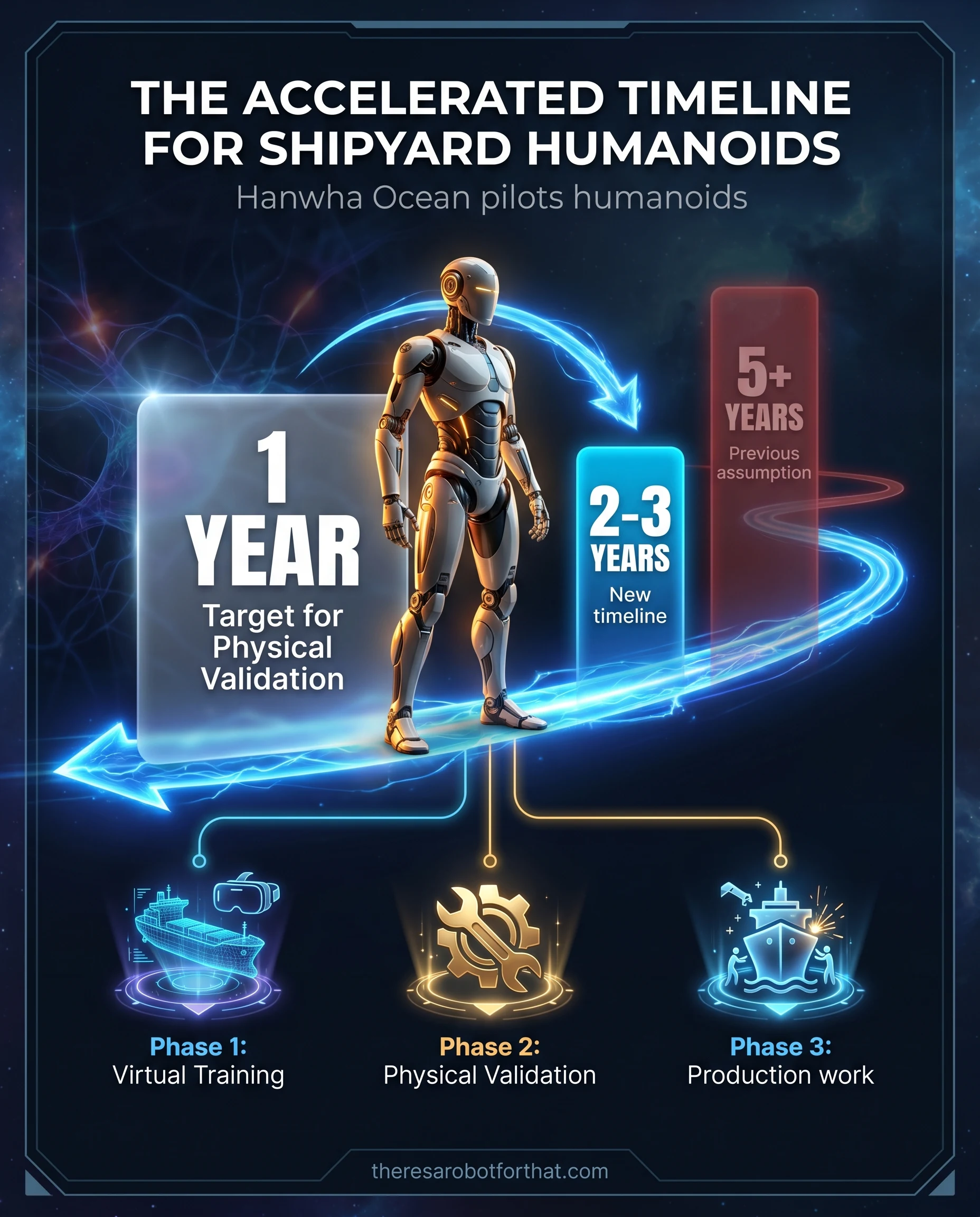
Image Source: There's A Robot For That
Snapshot: Korean shipbuilder Hanwha Ocean will test humanoid robots at its Geoje yard within a year, targeting labor shortages and safety issues in high-risk shipbuilding tasks. The pilot uses digital twin environments to train robots before deployment, focusing on heavy-load transport, autonomous navigation across uneven terrain, and tool handling.
Breakdown:
Takeaway: This is one of the clearest near-term tests of whether humanoids can handle real industrial work beyond controlled demos. If Hanwha validates the technology within 12 months, it signals that heavy industry applications may be 2-3 years from broader deployment rather than the 5+ year horizon many executives assume.
Nvidia and LG build AI factory for home robots and data centers
Snapshot: Nvidia and LG Group are constructing an AI factory to accelerate LG's robotics business, integrating Isaac GR00T models into home robots like CLoiD while building physical AI data infrastructure. The partnership combines Nvidia's AI accelerators with LG's hardware to speed deployment of adaptive robotic systems and next-generation data centers.
Breakdown:
Takeaway: The AI factory model signals a shift from selling standalone robots to building the data infrastructure that trains them at scale—similar to how cloud providers built data centers before SaaS exploded. Companies planning robotics investments should watch whether this integrated approach (hardware + training infrastructure + software) becomes the standard deployment model, which would favor large ecosystem players over point solutions.
UBTECH launches $30K consumer humanoids with 2,100 pre-orders
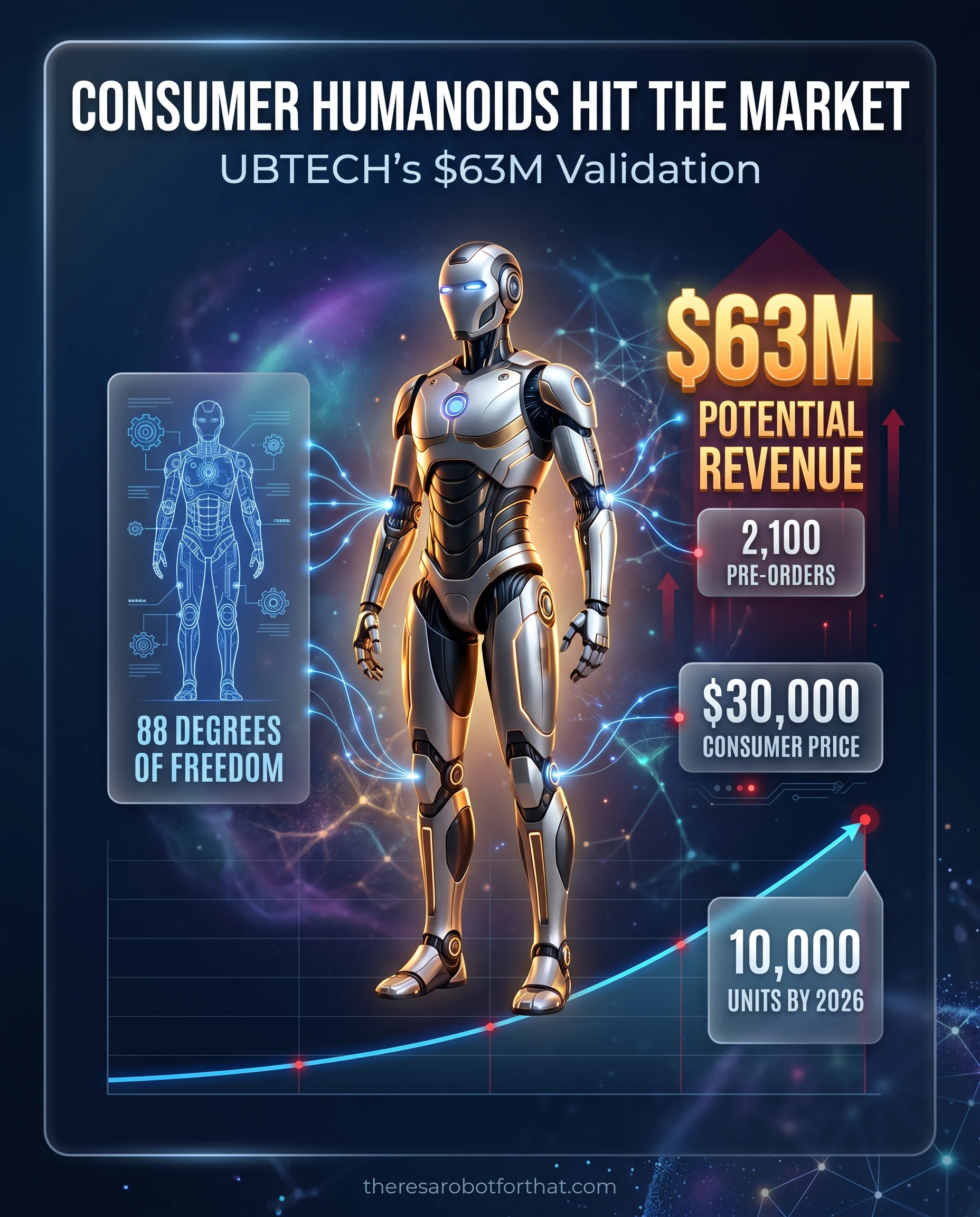
Image Source: There's A Robot For That
Snapshot: Chinese robotics firm UBTECH debuted its UWORLD consumer brand with lifelike U1 humanoid robots featuring 88 degrees of freedom, collecting over 2,100 pre-orders in the first week at approximately $30,000 each. The company plans first deliveries in mid-September after requiring 3,000 yuan (~$450) deposits on JD.com.
Breakdown:
Takeaway: The pricing and pre-order volume provide the first real market test of consumer humanoid demand outside of tech enthusiast circles—2,100 orders at $30K represents $63M in potential revenue if conversions hold. More importantly, UBTECH's pivot from industrial clients to consumer markets suggests the unit economics and manufacturing scale have reached thresholds where companies see viable business models beyond B2B deployments.
China builds 85% of world's humanoids but finding buyers proves tricky
Snapshot: Chinese manufacturers including LY iTech, Unitree, AGIBOT, and UBTECH now produce 85% of the world's humanoid robots at prices as low as $6,000 per unit, compared to $46,000 in other markets, with 28,000 cumulative sales and 13,000 active deployments. But Fortune reports the market is mostly "performative rather than functional", robots that demo well but struggle in real, unpredictable work environments.
Breakdown:
Takeaway: A market where China can ship humanoids at $6,000 each but most can't perform real work yet creates an asymmetric buyer advantage: the floor cost has dropped low enough to absorb experimentation budgets, but the capability ceiling means deployments need narrow, structured use cases. Operations leaders should evaluate Chinese humanoid pricing seriously for confined industrial environments, but discount the consumer-facing pitches until performative-vs-functional gaps close.
Other Top Robot Stories
Amazon revealed a next-generation Proteus warehouse robot that accepts plain conversational language commands to autonomously navigate, prioritize tasks, and move heavy carts, unveiled alongside an €10B (~$11.6B) European logistics expansion as its robot fleet surpasses 1 million units.
Solidion Technology secured seven new patents on composite anode materials for high-energy and fast-charging lithium batteries specifically targeting humanoid robotics applications, strengthening its existing portfolio as humanoid demand pulls battery infrastructure investment alongside the robots themselves.
Hansae unveiled humanoid robot apparel concepts designed with functional materials for sensor integration, joint-friendly movement, and cooling systems at its Wear the Future Media Day, positioning to capture the future robotwear market as humanoids enter consumer environments.
Ukraine's deployed ground robotic complexes completed over 18,000 missions in the Third Army Corps' first year, evacuating more than 600 wounded soldiers and transporting 4,500 tons of cargo across the Lyman–Borova front using every second ground robot fielded by Ukraine's Armed Forces.
🤖 Your robotics thought for today:
Hanwha Ocean just committed to humanoid shipyard pilots within 12 months, using digital twin simulation to pre-clear safety. China makes 85% of the world's humanoids at $6K each but most sit unused. The same week tells you exactly what the constraint is: not hardware, not price, but a structured industrial customer willing to absorb real failure modes.
I'm watching whether more heavy-industry employers follow Hanwha's clock.
Until Friday,
Uli


