
UBTech's emotional humanoid ships to 13,000 Chinese homes
PLUS: Ant Group invests in 12 humanoid startups, farm robots go fully autonomous, and Luxonis raises $14M for vision tech

Welcome back to your Robot Briefing
UBTech just put a silicone-skinned humanoid with emotion-reading AI into Chinese homes, and it's already racked up over 13,000 orders. The UWORLD U1 isn't a research project or a limited trial; it was unveiled on Tuesday in Shenzhen.
Can a robot that claims to recognize your emotional state actually earn a place in the living room, or will consumers discover the gap between detection accuracy and genuine usefulness? The answer could determine whether humanoids break out of the factory floor for good.
In today's Robot update:
UBTech ships emotional AI humanoid to Chinese homes with 13,000+ orders
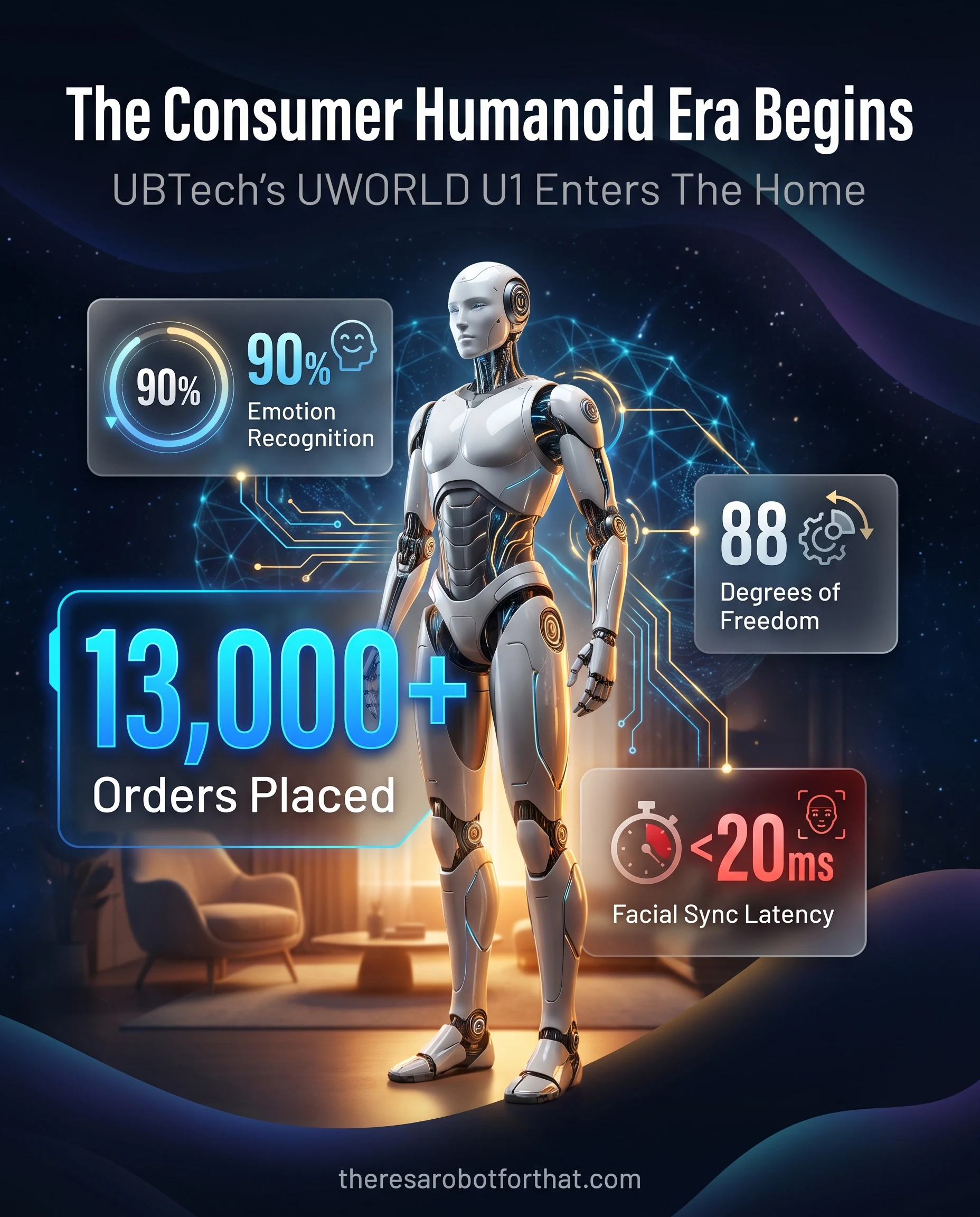
Image Source: There's A Robot For That
Snapshot: UBTech launched the UWORLD U1, claiming it's the first mass-produced consumer humanoid with silicone skin and emotion-aware AI that recognizes over 20 emotional states with 90% accuracy, and has already logged more than 13,000 orders. This isn't a prototype or pilot: it's shipping to Chinese homes now.
Breakdown:
Takeaway: The order volume suggests consumer humanoids have crossed from concept to commercial reality in China, with buyers willing to pay for companionship robots that move and communicate naturally. If demand holds, expect Western companies to accelerate their own consumer humanoid timelines, not in 3 years, but within 18 months.
Alibaba's Ant Group rushes into humanoids with 12 deals in 18 months
Snapshot: Ant Group has invested in 12 humanoid robotics companies since early 2025, including leading a $73.58 million round in Zeroth, while launching its own RobbyAnt subsidiary and releasing a robotics-friendly version of Alipay. This is capital deployment at scale, not exploration.
Breakdown:
Takeaway: When a payments giant builds robot-specific infrastructure and funds a dozen companies in 18 months, it's pricing in near-term commercial activity, not distant R&D. Ant is positioning for a world where humanoids handle transactions in retail, hospitality, and service environments, a signal that Chinese companies expect deployment to accelerate sharply in 2026-2027.
Farm robots get full autonomy with Sabanto-Verdant integration
Snapshot: Sabanto's autonomous tractor system now integrates directly with Verdant Robotics' SharpShooter precision sprayer, enabling fully automated field operations that identify individual plants, adjust speed and implement height, and apply inputs only where needed, without an operator in the cab. This is already running in commercial operations, including sod production at Bethel Farms.
Breakdown:
Takeaway: This integration solves the labor problem and the economics simultaneously: farms can run operations around the clock while cutting input costs through precision application. Agriculture is proving to be a faster path to ROI-positive robotics than manufacturing, with systems that are commercially deployed today rather than pilots scheduled for next year.
Luxonis raises $20M to scale AI vision for physical robots
Snapshot: Robotics perception company Luxonis closed a $14 million Series A led by Denali Growth Partners to scale production of its OAK cameras and DepthAI SDK, which has reached 6 million downloads and powers vision systems for Fortune 500 companies and agricultural robots. The company serves more than 60 Fortune 500 companies and 17 of the Dow Jones 30.
Breakdown:
Takeaway: The breadth of Fortune 500 adoption and 6 million SDK downloads signal that vision systems have moved from bottleneck to commodity, with companies now scaling production rather than proving concepts. When picks-and-shovels suppliers raise growth capital, it means the infrastructure layer is ready. Expect faster robot deployments as perception becomes standardized and affordable.
Other Top Robot Stories
Novares launched one of Europe's first pilot deployments of humanoid robots inside a live automotive manufacturing environment, teaming with Innov8 to test Unitree humanoids on repetitive, physically demanding tasks alongside human workers, with structured trials now underway at a Novares production facility under a new memorandum of understanding.
Weave Robotics unveiled Isaac 1, a home humanoid priced at $7,999 upfront or $449 a month that folds laundry, makes beds, and tidies rooms mostly autonomously with a human teleoperator as fallback, undercutting rivals like 1X's $20,000 Neo as the race to put a robot in the living room heats up, with first shipments due in fall 2026.
SKF formed a China-based joint venture with Leaderdrive, taking a 60% majority stake, to develop high-precision transmission components for humanoid robot joints, with the Swedish bearings maker aiming to bring the venture online by the end of 2026 and supply industrial humanoid makers across China plus Europe, Japan, and the US through its global network.
Rush became the first health system in the Midwest and fifth in the nation to fully upgrade its surgical robot fleet to the da Vinci 5 platform across Chicago, Oak Park, and Aurora facilities, supporting robotic procedures in general surgery, colorectal, bariatric, thoracic, urology, and gynecology.
🤖 Your robotics thought for today:
UBTech shipped 13,000 emotion-reading humanoids to Chinese homes this year. Ant Group invested in 12 humanoid companies in 18 months and built robot-specific payment infrastructure. When a payments giant builds transaction rails for robots, they're not betting on research—they're pricing in revenue.
I'm watching which Western company breaks the "we're 3-5 years away" script first.
Enjoy your weekend,
Uli


