Kawasaki's humanoid timeline, the cost of AI on a factory floor, Korea's data play, and a $10,000 battlefield robot.
The Big Number
FieldAI, a startup building a single AI brain to run any robot, is raising money at a $10 billion valuation, about five times what it was worth just over a year ago.
Welcome back to your Robot Briefing
This week the money and the machines told two different stories. Capital is racing into robot intelligence at valuations that would have looked absurd a year ago, led by a startup now worth $10 billion for software that is still proving itself in the field.
Meanwhile the people actually running AI inside factories, plants and buildings spent the week explaining why autonomy is slower, costlier and more human-supervised than the headlines suggest. Both things are true at once, and the gap between them is where operators have to make decisions.
The 60-Second Read
FieldAI is raising $700 million at a $10 billion valuation, five times its worth a year ago, for one AI brain meant to run any robot.
Kawasaki's own roadmap puts humanoids in factories around 2030 under human control, with full autonomy a decade later.
Honeywell and Ecolab say the best frontier models in the physical world can cost more than the workers they replace.
KT is betting that Korea's guarded factory data, not robot hardware, is the real bottleneck in physical AI.
News
FieldAI Raises $700 Million to Build One Brain for Every Robot
Image Source: There's A Robot For That
Snapshot: FieldAI is raising $700 million at a $10 billion valuation for software it calls a universal brain for robots, a bet that one model can run humanoids, drones and industrial machines in messy real-world settings.
Breakdown:
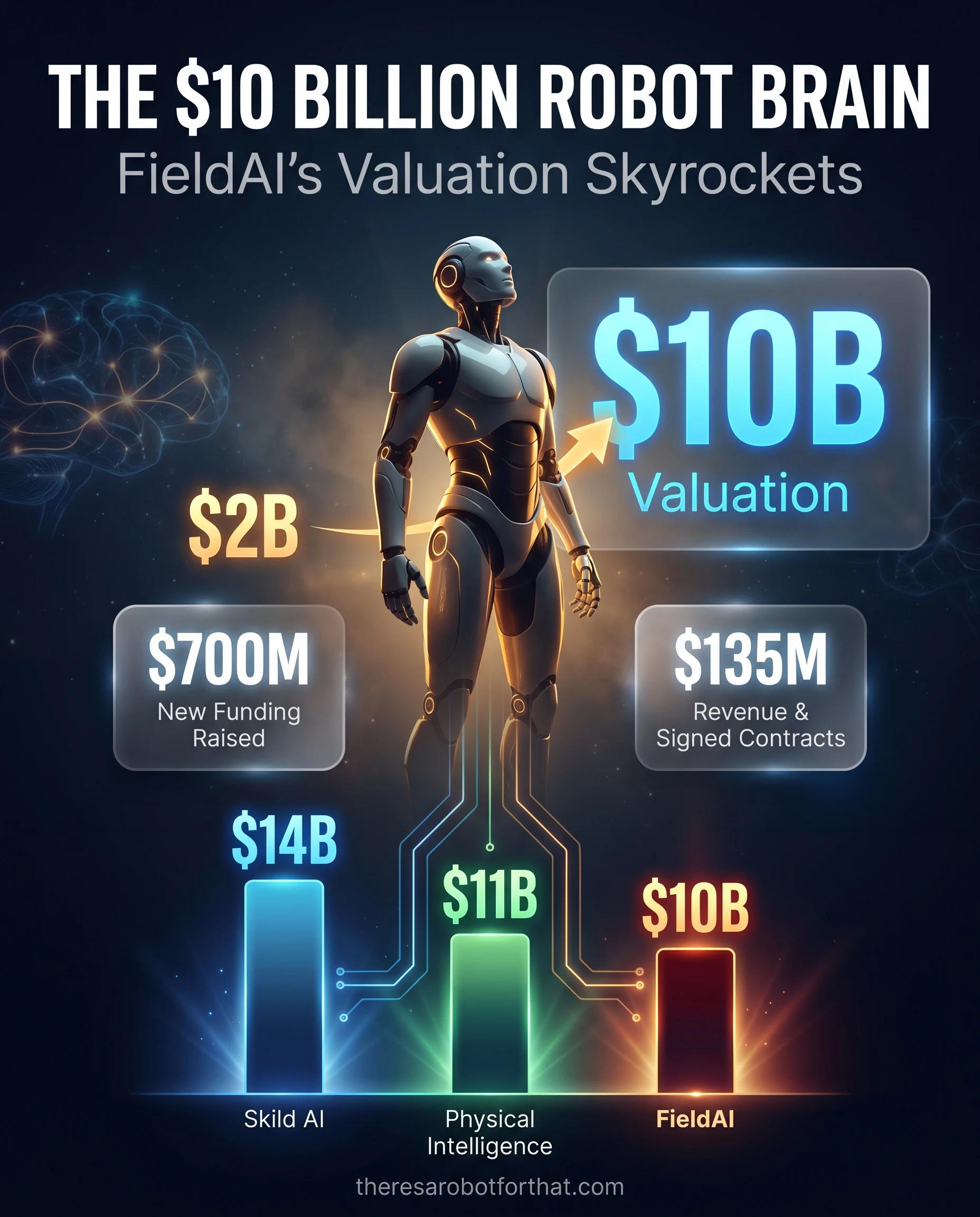
The round would roughly quintuple FieldAI's valuation from $2 billion just over a year ago, when it raised more than $400 million from backers including Nvidia's NVentures, Jeff Bezos's family office and Laurene Powell Jobs's Emerson Collective. The company has signed a term sheet, so the deal may not have formally closed.
Founded in 2023 and based in Irvine, California, FieldAI builds what it describes as a universal general-purpose brain meant to run humanoids, robot dogs, drones and industrial rovers in unpredictable environments.
Revenue and signed contracts now top $135 million across more than 30 customers in construction, data centers and defense, up about $35 million since June.
The valuation pulls FieldAI close to rivals Physical Intelligence, worth roughly $11 billion, and Skild AI, valued at more than $14 billion.
Takeaway: Investors are paying frontier-model prices for robot software before most of these machines have cleared a pilot. For operators, the signal is that capable general-purpose control is coming and worth tracking, but a $10 billion valuation buys a research bet, not a product you can deploy on your line next quarter.
News
Kawasaki Says Its Humanoid Reaches the Factory Around 2030, Not Full Autonomy
Image source: Kawasaki Robotics
Snapshot: Kawasaki Heavy Industries laid out a staged roadmap that puts its Kaleido humanoid to work in factories and plants around 2030, under remote control and alongside people, with hands-off autonomy years further out.
Breakdown:
Kawasaki has been building the Kaleido humanoid since 2015 and is now on its ninth generation, Kaleido 9, which walks autonomously using LiDAR and SLAM to detect obstacles, read stairs and adjust its stride.
The company's published roadmap puts humanoids into controlled settings like factories and plants around 2030, performing work under remote control and supporting people, with humans still making the decisions.
Full autonomous operation in unstructured environments is not expected until around 2040, and all-weather outdoor and disaster-response use is targeted around 2050.
Kawasaki recently opened a physical AI center in Silicon Valley to pair its decades of factory-floor engineering with newer AI work, part of a push to commercialize Kaleido this decade.
Takeaway: One of the world's oldest industrial makers is telling buyers to be patient. Humanoids will arrive on factory floors under human supervision first, and lights-out autonomy is a 2040 problem rather than a 2027 one. Scope pilots around supervised and remote operation, and treat any vendor promise of fully autonomous humanoids this decade as marketing.
⏱️ The Compliance Clock
As humanoids leave the safety cage and start working in the open on factory floors, the rulebook that governs them is ISO 10218, the core safety standard for industrial robots and robot systems. Its 2025 revision raises the bar on risk assessment and documentation and pulls newer collaborative and mobile machines into scope. If you are scoping a humanoid for a working site, the conformity file against that standard is part of the purchase, not a formality you sort out later.
Honeywell and Ecolab Say AI in the Real World Can Cost More Than People
Snapshot: Ecolab found that running the best available AI model on high-volume industrial work sometimes costs more than paying human workers, a blunt counterpoint to the automation hype from two companies that are broadly positive on AI.
Breakdown:
Honeywell technology CTO Suresh Venkatarayalu said industrial customers demand 99.9999% accuracy while frontier models "could be at 85%," a gap that rules out hands-off automation on safety-critical sites.
Ecolab chief AI officer AJ Wijesinghe said putting the best model on high-volume work sent the "tokenomics off the roof," and the company cut token costs 70% to 80% by optimizing and mixing frontier and open-source models.
Both executives described a human-in-the-lead, semi-autonomous approach, noting that physical equipment cannot be patched like a phone and that buildings and plants are mission critical and safety critical.
Ecolab expects $325 million in annual run-rate savings from AI by 2027, but only when data quality, process readiness and cost discipline move together.
Takeaway: The people running AI inside real factories and buildings are describing a slower, cheaper, human-supervised path than the humanoid headlines imply. For ops leaders the useful number is not a model's benchmark score, it is cost per task against a human baseline and the accuracy your safety case actually requires.
News
KT Bets Korea's Factory Data, Not Robots, Is the Real Bottleneck
Snapshot: KT is building a platform that lets manufacturers share their guarded process data for AI training and get paid for it, arguing that data, not hardware, is what holds physical AI back in Korea.
Breakdown:
KT says general models never see the factory layouts, work sequences and equipment know-how that make a robot useful on a specific line, and that Korean manufacturers treat as a locked asset.
Its plan is a platform that keeps that data secure, uses it to tune outside world models and robot foundation models, and compensates data providers by contribution rather than taking it for free.
The company will not build robots. It will add ultra-low-latency networks, edge AI and vendor-neutral control of mixed AGV and AMR fleets using the VDA 5050 standard.
KT plans to train more than 500 field deployment engineers within two years and is already running quadruped robots on the platform at a Korean recreation site.
Takeaway: The scarce resource in factory automation is shifting from robot hardware to the proprietary data that makes a robot work on your specific line. Decide now what your process data is worth and on what terms you will share it, before a platform sets those terms for you.
▶ Operator's Playbook
Before your next humanoid or cobot pilot, request the vendor's ISO 10218 conformity documentation and its measured contact-force data, and get it in writing who owns the risk assessment and who signs off that the machine is safe to run beside your staff. If the vendor cannot produce that file, the pilot is not ready, whatever the demo looks like.
Efficient Computerraised $97 million in a Series B at a $650 million valuation, backed by Toyota Ventures and others, to scale chips it says cut energy use 10 to 100 times across physical AI and data centers.
Wandercraftacquired Ekso Bionics from ChronoScale, combining the two into what it calls the world's leading medical exoskeleton maker across the US and Europe.
Ukraine's former defense ministerlaunched "Army of Robots" , targeting ground robots at about $10,000 per unit and tens of thousands of them to carry ammunition, pull out the wounded and hold positions.
Innodataopened a motion-capture lab in New Jersey, built with Vicon, to generate sub-millimeter 3D movement data for training and independently validating humanoid and industrial robots.
Mikeloroboticssecured demand from more than 20 manufacturers for physical-AI robots that copy skilled painters and finishers across automotive, power, shipbuilding and defense lines in Korea.
A Queensland grain farmcut spray chemical use 85% with an autonomous refill robot that remixes tanks so spray robots run unattended across 65,000 acres.
RoboPartyunveiled RP1 at IROS, a full-stack open-source humanoid aimed at researchers and developers who want to build on shared hardware and software.
Free for subscribers
Deploying humanoids this year?
Our Facility Readiness Checklist walks your site before the robot arrives, 77+ items, one complete toolkit module.
The money moving into robotics this year is betting on a future that the engineers deploying today's machines keep calling years away. Both can be right. The work is in not confusing a term sheet with a shipped product.