China's regulators cool the humanoid IPO frenzy, Analog Devices' 1.55 billion dollar chip bet, and a Montreal lab built to make factory robots reliable.
The Big Number
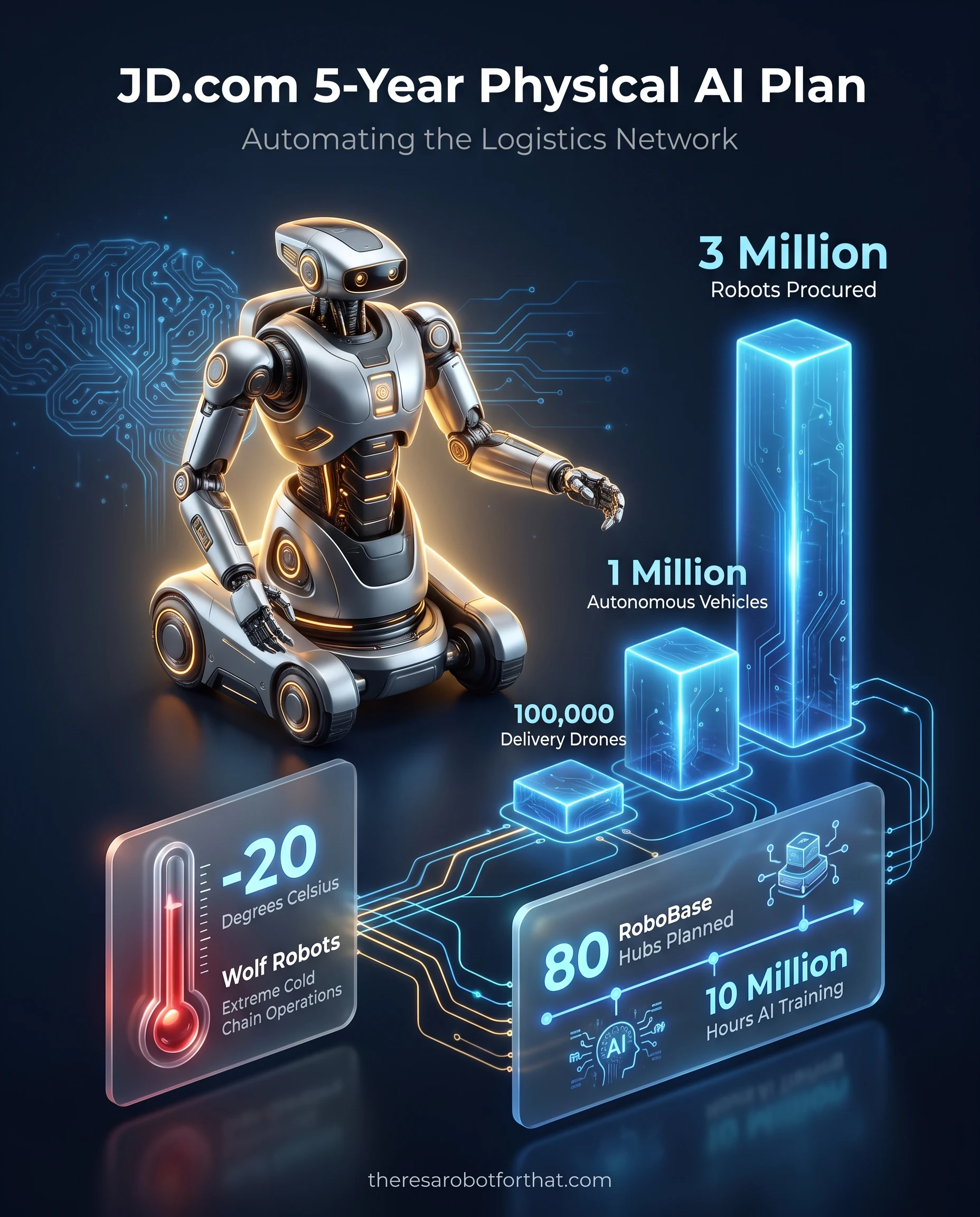
JD.com plans to procure more than 3 million robots over the next five years to automate its logistics network.
Welcome back to your Robot Briefing
The humanoid story this week moved from spectacle to spreadsheet: a procurement target measured in millions, an IPO reckoning, a chip acquisition, and a lab built to make factory robots boring and reliable.
The through-line is capital and discipline. China is pouring money into deployment while its regulators cool the froth, and North America is buying the silicon and building the test benches. Here is the week for an operator in under a minute.
The 60-Second Read
JD.com committed to buying more than 3 million robots in five years, the largest single robot-procurement target yet announced.
China's securities regulator is quietly raising the bar for humanoid IPOs after Unitree gave back nearly half its value.
Analog Devices is paying up to 1.55 billion US dollars for Alif Semiconductor to put AI chips inside physical machines.
Vention opened a Montreal lab whose only job is making factory robots reliable enough to trust on a production line.
News
JD.com Puts a Number on Physical AI: Three Million Robots
The five-year procurement target pairs the 3 million robots with 1 million autonomous vehicles and 100,000 delivery drones, aimed at automating warehousing, sorting, transport and last-mile delivery.
JD Logistics unveiled an industrial "Wolf" robot line for warehouse and sorting work, including units rated to operate in cold-chain conditions down to minus 20 degrees Celsius.
JD Cloud said it will build what it calls the world's largest embodied-AI data collection center, gathering more than 10 million hours of real-world human-activity video over the next two years to train the machines.
A property arm plans more than 80 "RoboBase" robotics hubs across China over five years to host suppliers, data collection and deployments.
Takeaway: The scale here is a demand signal more than a product. A single buyer ordering robots by the million reshapes the supply chain every other operator draws from, pulling forward actuator, sensor and battery capacity and setting a price floor for logistics automation. If you run a warehouse, the useful question is not whether to match JD's volume but whether your automation vendors are about to be capacity-constrained by it.
News
China's Regulators Cool the Humanoid IPO Frenzy
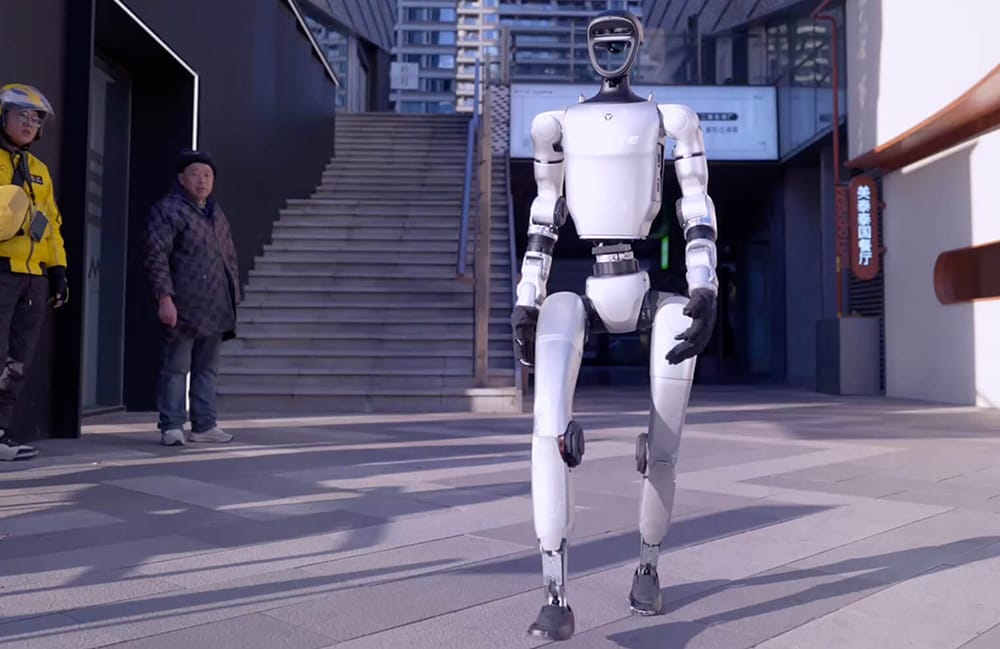
Image source: The Robot Report
Snapshot: Chinese regulators are tightening approvals for humanoid-robot IPOs after Unitree's wild debut, issuing informal guidance that asks would-be listers for real revenue and a credible path to profit.
Breakdown:
The China Securities Regulatory Commission has given banks informal "window guidance" requiring humanoid startups to show recurring revenue, a path to narrowing losses, or genuine technological innovation before a listing can proceed.
The trigger was Unitree, the first humanoid maker to list on the mainland: its shares surged as much as 629% on their August 19 debut, then slumped.
From a peak near 1,100 yuan the stock shed close to half its value, erasing about 200 billion yuan, roughly 30 billion US dollars, in market capitalization.
Unitree still lists its G1 humanoid from about 13,500 US dollars direct, yet its debut briefly valued the company near 66 billion US dollars, a mark analysts doubted for what one called an "infant level" industry.
Takeaway: A regulator slowing the IPO line is not bearish on robots, it is bearish on robot companies that cannot yet sell anything. For an operator, that filter is useful free diligence: the makers that clear a tougher listing bar tend to be the ones with real orders and service revenue, which are also the ones most likely to still be shipping and supporting hardware in three years. Treat a maker's revenue quality, not its demo reel, as the buying signal.
⏱️ The Compliance Clock
This week's news puts robots into warehouses, sorting lines and stores at a scale measured in millions, most of them sharing space with people. The standard that governs that contact is ISO/TS 15066, the collaborative-robot specification that sets concrete force and pressure limits for where a robot may touch a human body and how hard. Before a humanoid or mobile robot works beside your staff, ask the vendor which ISO/TS 15066 contact limits its safety system actually enforces, because a fenceless deployment lives or dies on that number.
Analog Devices Buys Its Way Into Physical AI Chips
Snapshot: Analog Devices agreed to acquire Alif Semiconductor in an all-cash deal worth up to 1.55 billion US dollars, adding AI-native edge processors built to run intelligence inside machines rather than in the cloud.
Breakdown:
The structure is 1.35 billion dollars upfront plus up to 200 million in contingent payments, all cash, with the deal expected to close before the end of 2026 pending antitrust clearance.
Alif, based in Pleasanton, California, designs low-power microcontrollers and "fusion processors" that combine sensing and AI on a single chip for battery-powered edge devices.
ADI framed the purchase around "physical intelligence," its term for AI that reasons from real-world signals like motion, sound, vibration and heat rather than text and images.
The deal is the latest in a run of chipmaker consolidation aimed at owning the silicon layer beneath robots and other physical-AI systems.
Takeaway: The humanoid headlines go to the robots, but the margin and the lock-in accumulate a layer down, in the chips that let a machine sense and act in real time. When a company like Analog Devices pays this much for edge-AI silicon, it is betting that the compute inside robots and sensors becomes as strategic as the datacenter GPU. Operators should note that the physical-AI supply chain is consolidating quickly, which shapes long-term component availability and pricing on the equipment they buy.
News
A Montreal Lab Built to Make Factory Robots Reliable
Snapshot: Vention opened a Physical AI Lab in Montreal with a narrow and unglamorous mandate: turn promising robot-manipulation research into systems reliable enough to run on a real production line.
Breakdown:
The lab will use data generated on customers' factory floors to post-train foundation models for robotic manipulation, validating them against the reliability, cost and variability that production actually demands.
It is led by Dr. Jimmy Li, with Cohere Chief AI Officer Dr. Joelle Pineau joining as an external technical advisor.
Physical AI is Vention's fastest-growing segment, with related revenue up about 400% over the past year, and the company says it is already working with a large automotive maker on unstructured final-assembly tasks.
The work builds on GRIIP, a modular pipeline Vention launched in February that handles scene digitization, object segmentation, pose estimation, grasp selection and collision-free motion planning.
Takeaway: Most humanoid coverage measures progress in new skills, but the number that decides a deployment is reliability, the share of attempts a robot completes without a human stepping in. A lab that exists specifically to close the gap between a demo and a dependable line is a sign the industry is maturing toward the boring metrics operations teams care about. If you are scoping a robotics pilot, ask vendors for task success rates under your real conditions, not their best-case footage.
▶ Operator's Playbook
Before you sign a robotics pilot this quarter, build a one-page reliability and safety sheet for each vendor. Require three numbers: the task success rate measured under your own line conditions, the mean time to repair with a spare-swap plan, and the ISO/TS 15066 contact limits the robot's safety system enforces where it works next to people. A vendor that can fill in all three is selling a deployable system. One that cannot is selling a demo.
Other Top Robot Stories
Algomatic Dynamics , a new Japanese startup, launched with $32.5 million from DMM.com to build a multi-fingered robotic hand and the motion-data pipeline to train it, targeting a platform by year-end.
CoreWeavelaunched Physical AI Field Engineering , embedding its specialists inside customer teams to turn proprietary sensor and telemetry data into production robotics and automotive AI models, work it says already spans more than 100 projects.
Antiochraised a $32 million Series A led by Greylock to scale cloud simulation that lets robotics teams run thousands of digital-twin tests before touching real hardware, with Amazon's Ring among its early users and Nvidia among its partners.
Hitachi Construction Machinerywill begin research on physical AI that learns an operator's excavator movements from lever inputs and camera footage, a government-backed project with Jizai and the Nara Institute of Science and Technology.
FANUC Americawill showcase physical AI at IMTS 2026 in Chicago, demonstrating how AI-guided industrial robots can lift productivity on the plant floor for its manufacturing customers.
Compliance toolkit
The EU Machinery Regulation applies from January 20, 2027.
The Robot Safety Documentation Toolkit gives your team all seven compliance documents, ready to fill in.
It is tempting to keep score of robotics by what a machine can newly do: a faster sprint, a cleverer hand, a bolder demo. This week rewarded a duller kind of progress. A regulator asking for revenue, a lab chasing reliability, a chipmaker buying the part you never see. The robots that end up in real workplaces will be the ones whose makers did that unglamorous work first.