
Linkerbot eyes $6B on robotic hand dominance
PLUS: Schaeffler's humanoid order projections, Intel's robotics VP hire, and Hexagon's AEON factory deployment
Welcome back to your Robot Briefing
Beijing's Linkerbot controls 80% of the global market for high-dexterity robotic hands and is now betting that dominance is worth $6 billion. The unicorn just closed a $3 billion round and is immediately hunting for more capital at double the valuation.
The aggressive move signals that investors are treating humanoid components as a near-term business, not a moonshot. If the hands are this valuable, what does that say about the timeline for full humanoid deployment—and who's positioned to win the integration race?
In today's Robot update:
Chinese robotics unicorn Linkerbot targets $6B valuation on robotic hand dominance
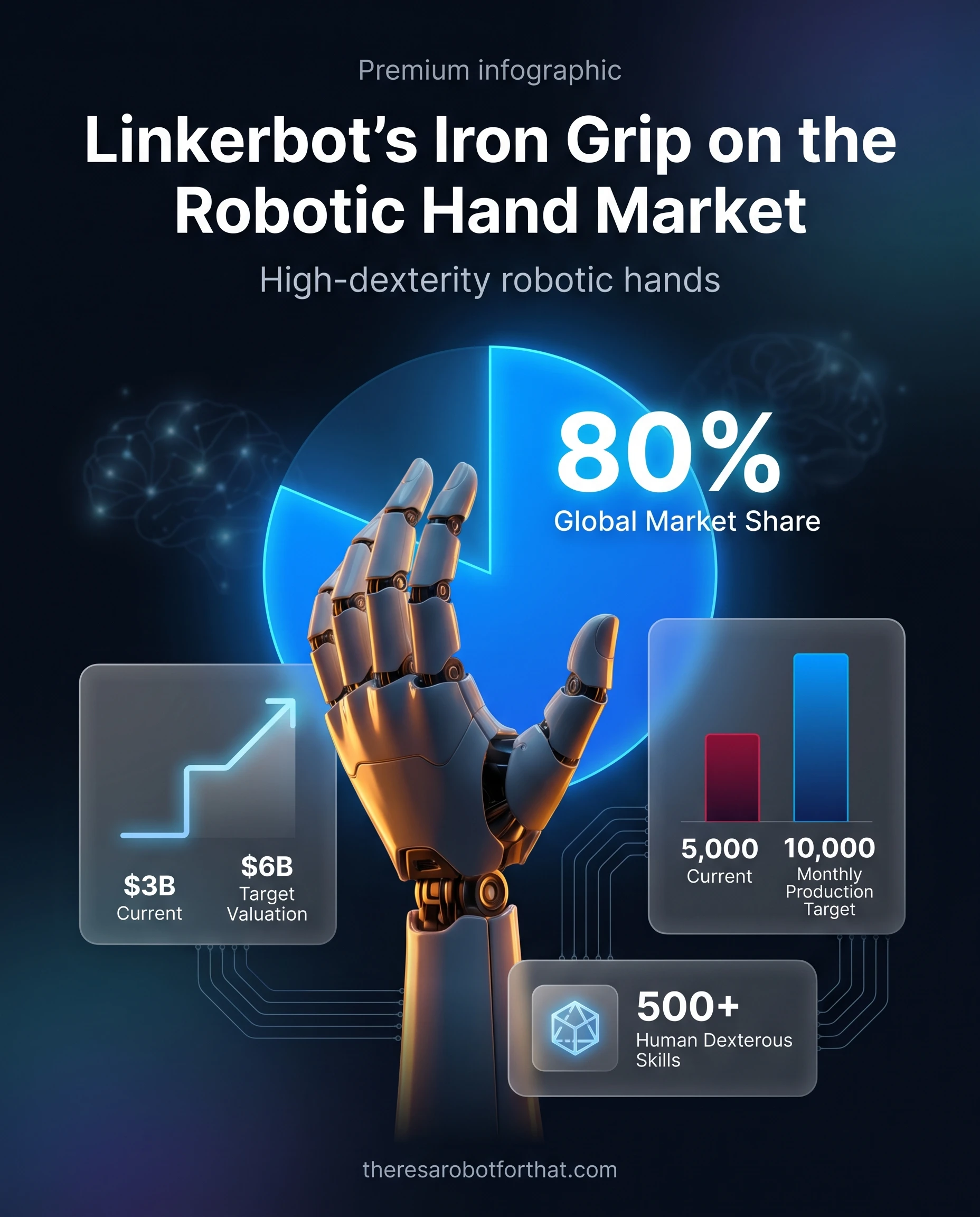
Image Source: There's A Robot For That
Snapshot: Beijing-based Linkerbot, which holds 80% of the global market for high-dexterity robotic hands, will seek a $6 billion valuation in its next funding round after closing a $3 billion Series B+ last week. This is a signal that investors see near-term demand for humanoid components as real, not speculative.
Breakdown:
Takeaway: When a component supplier commanding 80% market share doubles its valuation in months and scales production aggressively, it indicates downstream manufacturers are placing real orders. For operations leaders evaluating automation timelines, the supply chain is mobilizing now — which means deployment windows for humanoid systems are compressing faster than most roadmaps assume.
Schaeffler projects hundreds of millions in humanoid robotics orders by 2030
Snapshot: German industrial components maker Schaeffler expects to build an order book in the hundreds of millions of euros from humanoid robotics by 2030, as the company collaborates with 45 robotics players globally. This is a major Tier 1 industrial supplier publicly committing capital and customer pipelines to the sector.
Breakdown:
Takeaway: When a century-old industrial giant like Schaeffler bets on million-unit production by 2030 and signs contracts with unnamed major players, it signals the market is moving from prototypes to purchase orders. Operations executives should note that established suppliers are already building capacity, which means lead times for components will shorten and pricing will become more predictable as volumes scale.
Intel taps Qualcomm veteran to lead PC and physical AI robotics push
Snapshot: Intel appointed Qualcomm executive Alex Katouzian as EVP to lead its Client Computing and Physical AI Group, a new combined role merging the company's traditional PC business with emerging robotics, autonomous machines, and AI device systems. The organizational restructure signals Intel views physical AI as equally strategic to its core computing business.
Breakdown:
Takeaway: Intel reorganizing to place robotics and autonomous systems on equal footing with PCs shows the compute industry believes physical AI will be a major revenue driver, not a niche market. For operations leaders, this means the chip ecosystem is aligning around robotics workloads, which will accelerate performance improvements and drive down costs for industrial automation platforms over the next 18-24 months.
Hexagon deploys AEON humanoid in Austrian factory for real-world manufacturing
Snapshot: Hexagon Robotics and Fill Maschinenbau partnered to deploy the AEON humanoid robot across advanced production environments for machine tending, inspection, and operational support, following an earlier BMW Leipzig plant deployment. This moves AEON from pilot phase into multi-site customer validation.
Breakdown:
Takeaway: When a metrology and manufacturing software leader like Hexagon puts its humanoid into customer factories for real production tasks — not demos — it signals confidence that the technology can deliver ROI today. Operations executives should watch for performance data from these deployments in the next 6-12 months, as they'll provide the first credible benchmarks for humanoid productivity in environments similar to mid-sized manufacturers.
Other Top Robot Stories
Bebop delayed a Southwest Airlines flight from Oakland to San Diego by over an hour after security confiscated its lithium battery, which exceeded the airline's maximum allowable size for aircraft transport.
Hangzhou deployed 15 humanoid traffic police robots across Zhejiang province to manage golden week tourist congestion, with robots equipped with chest-mounted interactive navigation screens to direct travelers.
Intuitive raised its 2026 procedure guidance after Q1 revenue hit $2.77 billion, beating estimates by 6% on 16% growth in da Vinci surgical procedures to 847,000 cases and 39% growth in Ion bronchoscopy procedures to 43,000 cases.
🤖 Your robotics thought for today:
Schaeffler expects hundreds of millions in humanoid orders by 2030. Intel just reorganized to put robotics on equal footing with PCs. Linkerbot is doubling production capacity right now. The supply chain isn't preparing for humanoids — it's already fulfilling orders we haven't seen announced yet.
Which means someone's buying at scale.
Until Friday,
Uli


