Korea puts warehouse humanoids on a live line, Wandercraft lands 12 industrial customers, and OpenAI commits to building its own robot.
The Big Number
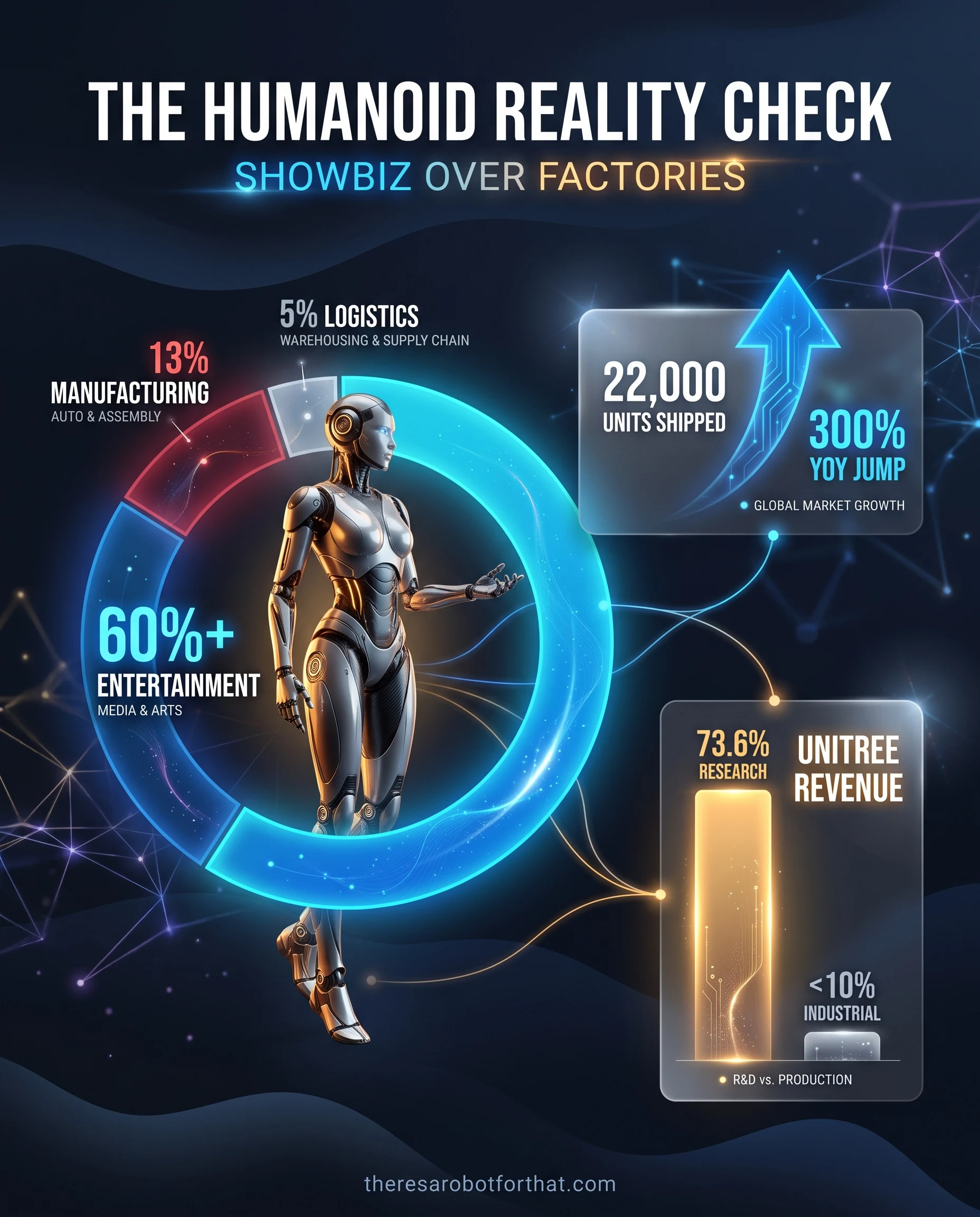
More than 60% of the humanoid robots shipped in the first half of 2026 went to entertainment, performance and research, not paid work.
Welcome back to your Robot Briefing
This week the humanoid industry threw its biggest party yet, and the numbers underneath it told a quieter story. A record run of robots walked a catwalk in Berlin while fresh shipment data showed most of them are still built to perform, not to work.
Look past the runway and the useful signals were elsewhere. A Korean logistics giant put humanoids on a live packing line, a French maker lined up a dozen industrial customers, and OpenAI made clear it wants to build the robot, not just the brain inside it.
The 60-Second Read
Humanoid shipments rose almost 300% in the first half of 2026, but Counterpoint says over 60% went to performance and research rather than paid work.
CJ Logistics became the first company in Korea to run humanoid robots on a live order-packing line instead of a pilot.
Wandercraft secured 12 blue-chip customers for its Calvin-40 industrial humanoid, with Renault planning to deploy 350.
Sam Altman said OpenAI will definitely build a humanoid robot, moving the company into hardware.
News
Humanoid Robots Filled IFA's Runway, Not the Factory Floor
Counterpoint Research counted more than 22,000 humanoid units shipped in the first half of 2026, up nearly 300% year over year, yet found over 60% went to entertainment, performance and data generation, with manufacturing at 13% and warehousing and logistics at just 5%.
The runway featured 11 robot makers, many of them Chinese, led by EngineAI's T800, a 173-centimeter humanoid with joint torque up to 450 newton meters, built to impress a live audience.
Unitree's own stock-exchange filing shows how young the business still is: research and education made up 73.6% of its humanoid revenue over the first nine months of 2025, with industrial use under 10%.
Xiaomi brought its CyberOne humanoid to IFA for the first time and mostly had it make gestures, even as the company says a fastening task in its EV-plant trial climbed from about 90% to 98% success over four months.
Takeaway: The mismatch between the show and the shipment data is the useful signal for operators. A robot that can backflip has proven balance and motor control, not that it can hold a task on your line for a full shift. When a vendor shows you a highlight reel, ask for the boring numbers instead: task success rate over hours, mean time between failures, and how many machines are doing paid work today rather than demos.
News
CJ Logistics Puts Humanoids on a Live Packing Line
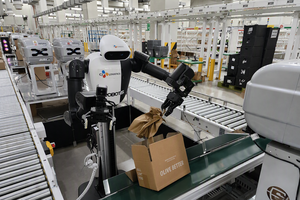
Image source: The Korea Herald
Snapshot: CJ Logistics put two dual-arm humanoid robots to work on a live packing line at its Olive Young fulfillment center in Yongin, filling real customer orders rather than running a trial.
Breakdown:
The robots insert cushioning paper into shipping boxes as orders move down the line, a fiddly step that has resisted reliable automation because it needs the machine to judge each box and place material with care.
CJ says it is the first company in Korea's logistics industry to run humanoids in a live operation, a step up from its 2025 proof-of-concept at the Gunpo fulfillment center.
The deployment leans on partners rather than one vendor: Robotis supplied the hardware, Aidin Robotics the robotic hand, and RealWorld AI a Robot Foundation Model trained on both real field data and simulation.
CJ plans to widen the robots' work from cushioning to picking, sorting, inspection and packaging, aiming eventually for one general-purpose machine that runs several steps in sequence.
Takeaway: This is the counterweight to the runway. A robot inserting packing paper is unglamorous, and that is the point, because the value is the operational data it generates under real order variability and real time pressure. For logistics leaders, the lesson is to start a humanoid on one narrow, genuinely hard task inside a live flow, then let the data earn the next task rather than buying a machine that promises all of them at once.
⏱️ The Compliance Clock
The robots that danced and backflipped at IFA proved they can move, not that they can stop safely. The standard that governs that difference is ISO 13849, which sets the performance levels a robot's safety-related control system has to meet so that a stop command or an emergency halt is reliable rather than best effort. Before a humanoid works near your people, ask the vendor which performance level its safety functions are rated to, because a convincing demo says nothing about the control system behind it.
News
Wandercraft Lines Up 12 Customers for Its Factory Humanoid
Snapshot: Wandercraft secured 12 blue-chip customers for Calvin-40, its industrial humanoid, spanning automotive, logistics, retail, healthcare and defense as it prepares to ramp production.
Breakdown:
Renault is the only named customer and the anchor, planning to deploy 350 Calvin-40 robots within 18 months, which moves the machine from pilot to fleet.
Calvin-40 is built for physically demanding, hard-to-staff jobs, handling boxes, parcels, tires, panels and carts, with picking and sorting the next capabilities on the roadmap.
Wandercraft, based in New York and Paris, comes at humanoids from an unusual angle, having spent more than a decade building self-balancing medical exoskeletons like its Atalante X rehabilitation system and Eve personal exoskeleton for people with severe mobility impairments.
CEO Matthieu Masselin frames the real test as whether a humanoid can deliver useful work safely and repeatedly at commercial scale, not whether it can perform an impressive one-off task.
Takeaway: Wandercraft's exoskeleton history is the interesting part for buyers. A company that already ships machines people strap to their bodies has had to clear real safety and reliability bars, which is exactly the discipline a factory humanoid needs and most startups lack. When you compare humanoid vendors, weigh where their engineering scar tissue comes from, because the ones who have shipped safety-critical hardware tend to understand what repeatable, certifiable operation actually costs.
News
OpenAI Says It Will Build the Robot, Not Just the Brain
Altman told TIME that everyone should eventually have a personal robot, and that owning the world's most capable AI model is no longer enough control on its own.
OpenAI has opened robotics roles spanning actuator design, control systems and data-collection operations, including a job running the facilities and rigs that gather real-world robot training data.
The logic is data: OpenAI shut its first robotics team in 2021 for lack of real-world interaction data and restarted the effort in 2024, and building its own robot is how it would generate that data at scale.
Hardware is the hard part, since actuators and dexterous hands account for more than half of a humanoid's bill of materials, and about 90% of the rare-earth magnets they depend on are made in China.
Takeaway: For operators the signal is not that an OpenAI robot is arriving soon, because it is not. It is that the companies with the most capital and the best models now treat the robot and its data as strategic, which will pull talent, money and supply toward humanoids for years. The practical read is to treat today's pilots as the start of a long curve, and to keep your own task data, because that data is the asset every one of these players is chasing.
▶ Operator's Playbook
Pick one repetitive, hard-to-staff task on your floor and write it up as a one-page spec before you talk to any humanoid vendor: the exact motion, the cycle time, the acceptable error rate, and the safety performance level the control system must hit under ISO 13849. Bring that page to every demo. It turns a dazzling runway pitch into a measurable question the vendor either can or cannot answer, and it becomes the baseline you grade a pilot against.
Other Top Robot Stories
A humanoid named Xiaogaibegan serving customers at a Hong Kong convenience store, speaking Mandarin, Cantonese and English as the city's first robot shopkeeper; its maker, Galbot, already runs around 200 uncrewed stores across mainland China.
Chery's robot unit AiMOGAcleared EU certification for its Mornine humanoid, which it calls the first to obtain dual EU approvals covering both hardware and software, shown live on the IFA floor.
Polish shopperswarmed to store robots in a UCE Research survey of 1,011 people, where 79.6% accepted robots for at least some store tasks, though only 16.8% trusted them to advise on products and 9.1% to handle complaints.
Agility Roboticsreleased a clip of its Digit humanoid dragging a couch across a room, a mundane whole-body task that is harder for a robot than the acrobatics that draw a crowd.
Pudu Roboticsmade its IFA debut , bringing its D7 semi-humanoid and a service-robot lineup it says has now passed 130,000 units deployed worldwide.
Free for subscribers
Deploying humanoids this year?
Our Facility Readiness Checklist walks your site before the robot arrives, 77+ items, one complete toolkit module.
It is easy to watch a robot do a backflip and feel like the future landed this week. The harder thing to sit with is the shipment data underneath the show, where most of these machines still exist to be watched, not to work. That gap is not a failure. It is the ordinary distance between a thing that can move and a thing you can depend on, and it closes one boring task at a time, on a packing line in Yongin, on a floor at Renault, far from any stage.