Operator-Free Excavators Start Digging Active US Job Sites
Ex-Meta vision AI for the factory floor, a skill one robot learns and three can run, $90M for human-robot research, and a $399 duck.
The Big Number
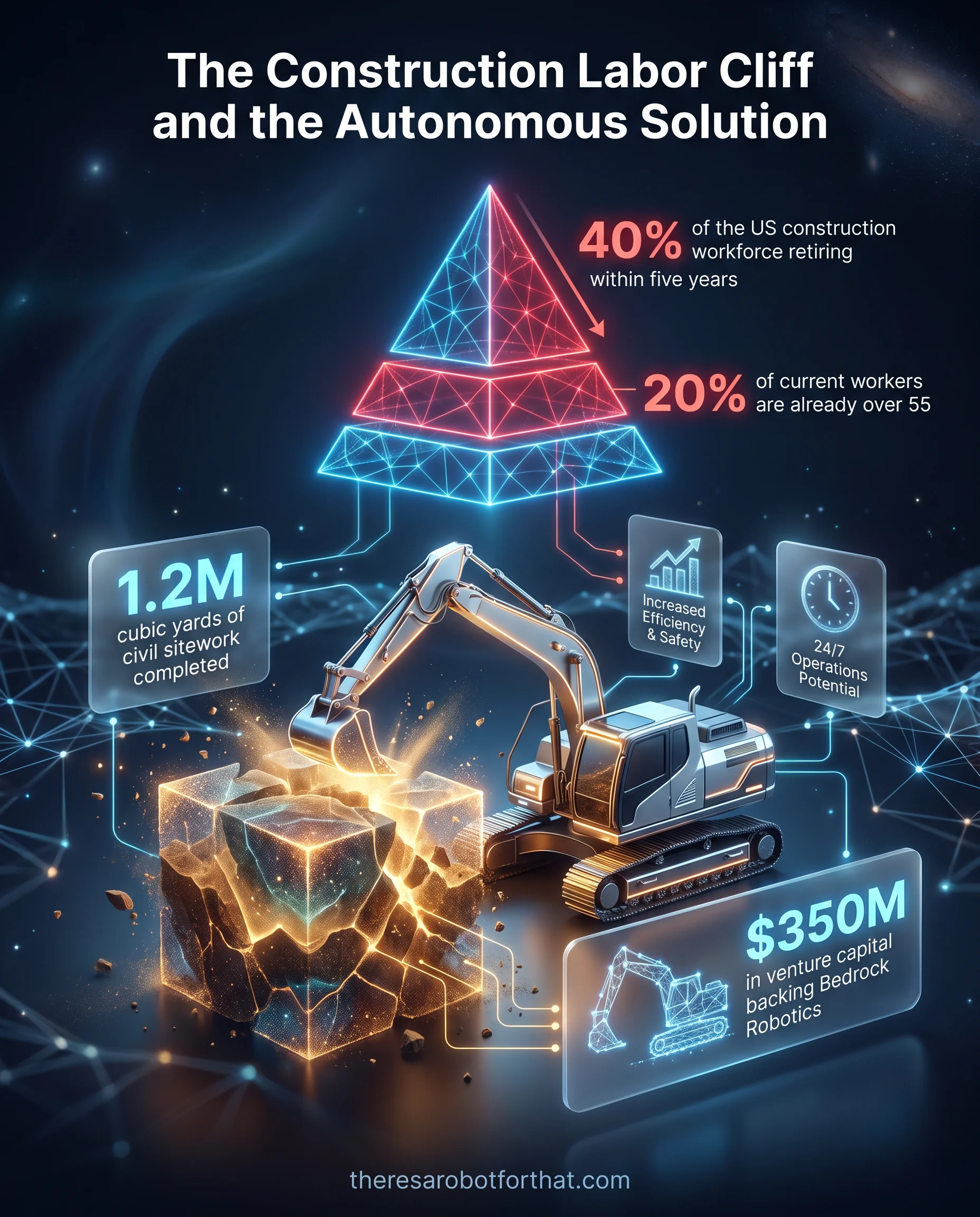
More than 40% of the US construction workforce is expected to retire within five years, the labor cliff that Bedrock Robotics is betting operator-free excavators can start to fill.
Welcome back to your Robot Briefing
This week the loudest robot stories were not about spectacle. They were about the unglamorous economics underneath deployment: who is left to do the work, and what it costs to teach a machine the next task.
An autonomous excavator is already moving dirt on live US sites, an open-weight vision model is aiming at the factory floor, and one motion learned once now runs across three different robot bodies. The through-line is cost per unit of capability, not the demo.
The 60-Second Read
Bedrock Robotics is running excavators with no operator in the cab on active Texas and Nevada job sites, backed by $350 million.
Perceptron, founded by two ex-Meta FAIR scientists, released Isaac 0.5, an open-weight vision model any plant can inspect and run on-premise.
The RAI Institute and Boston Dynamics built ZEST, which teaches a skill once and runs it with no retuning on Atlas, Unitree's G1 and Spot.
The NSF put $90 million into three research centers, one focused on how humans and robots safely adapt to each other.
News
Bedrock puts driver-free excavators on live US job sites
The Operator kit turns a standard excavator autonomous, and the current work is early earthwork: clearing, cut-and-fill, and the prep for foundations.
Named deployments include a water-treatment build with Sundt Construction in Nevada, multimillion-cubic-yard earthwork with Champion Site Prep in Texas, and 1.2 million cubic yards of civil sitework with Zachry Construction.
The company was founded in 2024 by former Waymo autonomy engineers, is led by CTO Kevin Peterson, and has raised $350 million in venture capital.
It is aimed at a labor gap: over 40% of the construction workforce is expected to retire within five years, and 20% of workers are already over 55.
Takeaway: For a site operator, the pitch is not a novelty humanoid, it is a familiar machine that can run a second shift without a scarce, aging operator pool. The number to watch is not the funding but the throughput and safety record coming off these Texas and Nevada jobs, because that field data is what actually moves a procurement decision.
News
Ex-Meta scientists bring open vision AI to the factory floor
Snapshot: Perceptron, founded by two former Meta FAIR researchers, released Isaac 0.5, an open-weight vision model built to let factory and warehouse robots perceive, reason and act.
Breakdown:
Founders Armen Aghajanyan and Akshat Shrivastava started the company in November 2024 after working on Meta's Fundamental AI Research team.
Isaac 0.5 is open-weight, so its parameters and training materials can be inspected by anyone, and it targets vision-guided robots navigating warehouses and factory floors.
The team frames it against two extremes: generalist foundation models that need dedicated cloud GPUs for every instance, and narrow models that handle either perception or control but not both.
It was trained on roughly a million hours of general video plus egocentric footage, part of petabyte-scale multimodal datasets.
Takeaway: Open weights are the operational hook. A plant can run and audit the model on its own hardware, without a metered cloud-GPU bill for every robot and without shipping factory-floor video to someone else's servers. For a team wary of vendor lock-in, an inspectable model is far easier to push past a security review than a black box.
⏱️ The Compliance Clock
As robots move out of cages and start working next to people, the standard that governs physical contact is ISO/TS 15066, the technical specification that sets concrete force and pressure limits for a cobot touching a human body. This week's NSF center on human-robot co-adaptation is research into exactly that boundary, and any operator putting a collaborative machine near staff should be able to show its contact forces stay inside those limits. Treat it as the measurable floor for a shared workspace, not a nice-to-have.
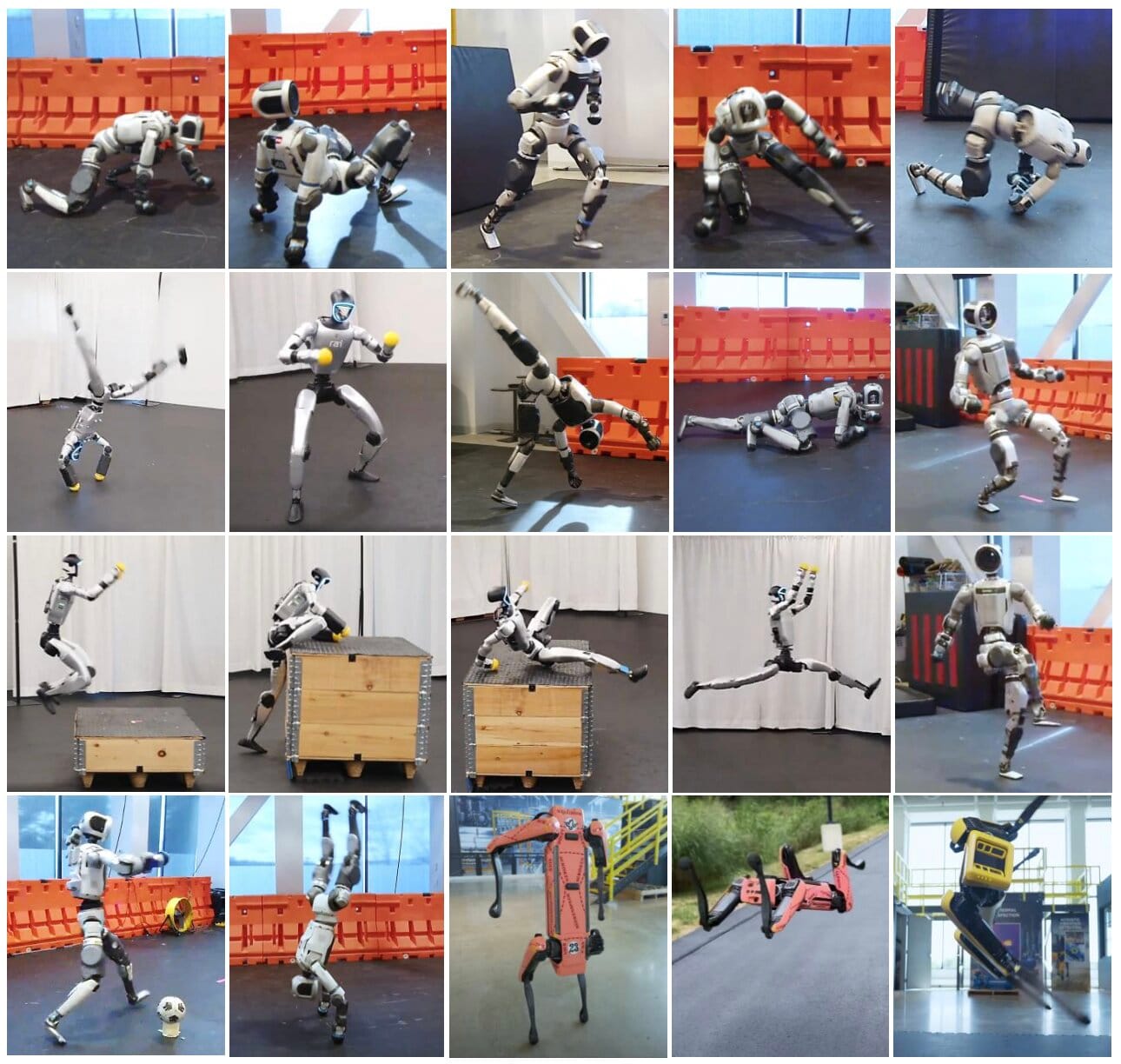
Snapshot: The RAI Institute and Boston Dynamics taught robots athletic skills with ZEST, a framework that learns a motion once and runs it with no per-robot retuning across different bodies.
Breakdown:
ZEST, short for Zero-shot Embodied Skill Transfer, learns from three input types: high-fidelity motion capture, ordinary single-camera video, and keyframe animation.
The same policies drove Boston Dynamics' Atlas through crawling, forward rolls, cartwheels and breakdancing, and transferred to Unitree's G1 humanoid.
It extended across body types to the Spot quadruped, which picked up a continuous backflip from animation alone.
The method skips contact labels, state estimators and heavy reward shaping, and was published in Science Robotics.
Takeaway: The cost that matters to a fleet owner is not the first skill, it is the tenth. If a behavior taught once transfers across mixed hardware without a bespoke training run per model, the per-robot cost of adding capability drops. That is the line between a viral demo and a fleet that keeps getting more useful after you have bought it.
News
The US backs research on robots that adapt to people
Snapshot: The National Science Foundation is funding three new research centers with $90 million, one of them dedicated to how humans and robots safely adapt to each other.
Breakdown:
Each center receives about $6 million a year for an initial five years, with the option to compete for up to five more.
The Center for Human and Robot Co-Adaptation, led by the University of Texas at Austin, studies service and assistive robots in homes, hospitals, workplaces and public spaces.
Its researchers pair robotics, AI and human factors so a robot can learn from a person and adapt physically and cognitively to different users.
The other two centers, at Michigan State and Northwestern, work on turbulence and genome engineering.
Takeaway: Public research money is a leading indicator of where deployment problems are surfacing. Co-adaptation, the messy work of a machine adjusting to an individual worker rather than a fixed cell, is exactly the wall operators hit when they move robots out of cages and next to people. Funding it now signals that shared human-robot workspaces, not lights-out cells, are where the next wave lands.
▶ Operator's Playbook
Before you pilot any robot that shares floor space with staff, ask the vendor for its measured force and pressure limits against ISO/TS 15066, in writing, for the specific tasks and contact points in your cell. A generic safety claim instead of task-level numbers is your gap. Then model the labor case the way Bedrock frames it: count how many of your operators are within five years of retirement, and price the shift you actually need to cover.
Other Top Robot Stories
Gatikraised $200 million in a Series D led by the Qatar Investment Authority and Koch Disruptive Technologies, funding driverless regional freight for customers including PepsiCo, Kroger and Tyson.
Carbon Roboticsswapped its crop-specific vision models for a single large plant model trained on 150 million labeled plants, with iMerit handling the annotation, so its LaserWeeder can adapt to a new field without retraining.
Nvidiaunveiled the Jetson Orin Nano 2, an entry-level edge computer that delivers 78 TOPS and doubles the inference of its predecessor in the same form factor, aimed at physical AI on robots and drones.
Hugging Faceput on sale Microduck, a $399 open-source robot that waddles, lifts up to 800 grams with its beak and rights itself after a fall, shipped as a reinforcement-learning platform with its full training stack on GitHub.
Compliance toolkit
The EU Machinery Regulation applies from January 20, 2027.
The Robot Safety Documentation Toolkit gives your team all seven compliance documents, ready to fill in.
The most repeated word in this issue was not intelligence, it was retirement. The excavator with no driver, the model any plant can inspect, the skill that copies itself across a fleet, each one is really a story about work that is getting harder to staff and cheaper to automate. The machines are catching up to a labor math that was already breaking.