Humanoids for the world's most dangerous jobs, a robot safety-testing layer, and $75M for robots that make medicine.
The Big Number
$1 billion is the valuation RobCo reached this week, making the Munich firm Europe's newest robotics unicorn.
Welcome back to your Robot Briefing
The money is moving again, and this week it moved toward the unglamorous middle of the market: the companies putting robots on real factory floors, not the ones promising a humanoid in every home.
Four funding stories, one government program, and a safety-testing startup tell the same story. Capital is flowing to whoever can make physical AI work in production, safely, and at a price a plant manager can forecast.
The 60-Second Read
RobCo doubled its valuation to $1 billion in nine months, Europe's newest robotics unicorn.
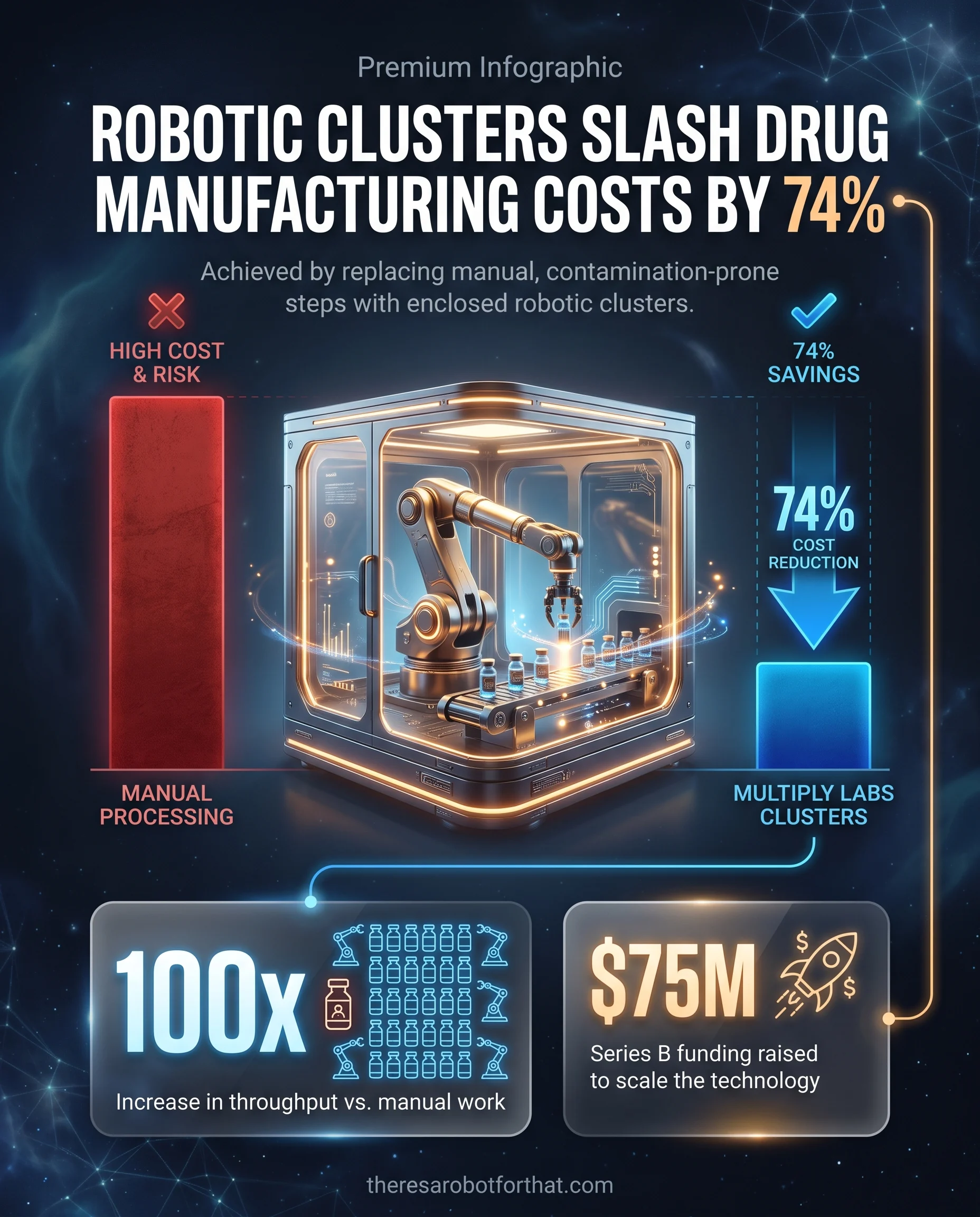
Multiply Labs raised $75 million for robotic clusters that it says cut drug cost per dose by 74%.
Doosan Robotics won about $70 million in Korean government-backed projects for cobots and nuclear-grade welding.
A Japanese nursing-home chain bought into humanoid maker Donut Robotics to put robots on the eldercare floor.
News
RobCo Becomes Europe's Newest Robotics Unicorn
Snapshot: Munich-based RobCo reached a $1 billion valuation this week, doubling its worth in nine months and becoming one of Europe's few robotics unicorns.
Breakdown:
The milestone came through a share sale that combined new investment with roughly $40 million in secondary stock, letting long-standing employees cash out part of their stake.
Existing backers Sequoia, Lightspeed and Lingotto returned, joined by new investors Cherry Ventures and the European Tech Collective.
The deal lands nine months after RobCo raised $100 million in January, the capital behind its push into the United States.
CEO Roman Hölzl has relocated to the US to focus on what the company calls its fastest-growing market.
Takeaway: The capital here is not chasing humanoids that fold laundry. It is chasing modular automation that mid-sized manufacturers can actually buy and run, which is the business RobCo built. For operations leaders, a European unicorn in shop-floor automation means more vendor choice and more pressure on incumbents to price and support factory robots competitively.
News
Multiply Labs Raises $75 Million to Put Robots in the Drug Factory
Image Source: There's A Robot For That
Snapshot: Multiply Labs raised a $75 million Series B to scale robotic clusters that automate the manual, contamination-prone steps of making advanced medicines.
Breakdown:
The San Francisco company says each cluster cuts cost per dose by 74% and delivers up to 100 times the throughput of manual work, inside an enclosed, GMP-compliant system.
The round was led by Patrick Soon-Shiong's NantWorks, bringing total funding past $100 million since the firm was founded in 2016.
New investors include AstraZeneca, which is also evaluating the systems for commercial-scale cell-therapy manufacturing, alongside Teradyne, Lingotto and Strange Ventures.
The clusters bolt onto a drugmaker's existing equipment and stay under the manufacturer's own control, rather than being sold as an outsourced service.
Takeaway: Biomanufacturing is the quiet bottleneck behind the AI drug-discovery boom, because designs pile up faster than plants can make them. Robots that drop into already-validated lines without a new facility are an easier yes than a greenfield build. Operators in regulated manufacturing should press on whether the cost-per-dose claim holds up under audit, because that number, not the robot, is what moves a capital decision.
⏱️ The Compliance Clock
105 days
until the EU Machinery Regulation becomes mandatory (Jan 20, 2027)
RobCo sells robotic automation into European factories, where machines placed on the market will fall under the EU Machinery Regulation, the rulebook that replaces the decades-old Machinery Directive. It tightens the documentation and digital-safety bar for robots and the cells they run in, and it is not optional once it applies. If you buy or integrate automation in the EU, confirm now which party owns the conformity assessment.
Doosan Wins $70 Million to Build Korea's Homegrown Factory Robots
Snapshot: Doosan Robotics was selected for two government-backed physical-AI projects worth a combined 98.9 billion won, about US$70 million, to build cobots and industrial humanoids that run on domestic AI chips.
Breakdown:
About 68.1 billion won, roughly US$48 million, is government funding, under programs run by Korea's Ministry of Trade, Industry and Energy.
The first project puts a domestic AI system-on-chip inside three cobot models at 5, 10 and 20 kilograms of payload plus a dual-arm industrial humanoid, so the machines perceive and decide on-device without the cloud.
The second automates high-complexity welding, targeting more than 95% similarity to a skilled welder's path within a 3-millimeter margin, demonstrated at a nuclear-equipment plant.
Doosan is targeting commercialization from 2031, with 72-hour continuous-operation trials at customer sites along the way.
Takeaway: This is industrial policy as much as product news. Korea is paying to keep the compute, the sensors and the software for its factory robots inside its own borders, which matters for any buyer worried about cloud latency or data security on the line. For operators in nuclear, defense or biotech, on-device robots that keep data local are the ones that clear a security review.
News
A Japanese Nursing-Home Chain Buys Into a Humanoid Maker
Image source: Donut Robotics
Snapshot: Charm Care, which runs more than 100 nursing homes in Japan, invested 300 million yen, about US$2 million, in humanoid startup Donut Robotics to move its cinnamon robot onto the eldercare floor.
Breakdown:
The two have trialed the cinnamon humanoid at a Charm Care home since July, and plan to expand it from patrol duty to answering resident nurse calls.
Donut's cinnamon 1 stands about 170 centimeters, walks on two legs, and uses vision-language-action AI to read its surroundings and spoken requests.
Charm Care, listed on the Tokyo Stock Exchange's Prime Market, is buying newly issued shares rather than taking a stake through a fund.
Founder Taisuke Ono started the company in 2014 to build a robot that could watch over his mother; eldercare is now a lead market alongside manufacturing and construction.
Takeaway: Japan's eldercare labor gap is the clearest near-term pull for humanoids anywhere, and a care operator writing the check, not just piloting, is the signal worth watching. When the buyer is also the deployment site, the feedback loop on what actually helps staff gets much shorter. For anyone selling service robots, the customer who co-develops is worth more than the one who only orders.
▶ Operator's Playbook
Before you sign for any robot cell this quarter, ask the vendor in writing which safety standards it is certified to, IEC 62443-4-2 for cybersecurity and ISO 10218 for mechanical safety, and who owns the conformity assessment once the EU Machinery Regulation applies. Model the cost per unit of output rather than the sticker price, and put the certificate and the name on the Declaration of Conformity in the purchase file. Two of this week's stories, Techman's SL2 certificate and SafeWorld's simulation layer, exist because buyers started asking exactly these questions.
Other Top Robot Stories
Minerva Humanoidsraised $10 million to build Roger, a VR-teleoperated humanoid that lets bomb-disposal and offshore-energy specialists handle the dangerous part from a safe distance, with General Catalyst leading the pre-seed round.
SafeWorldcame out of stealth with more than $12 million, led by Shine Capital and a16z Speedrun, to run AI-driven robots through thousands of simulated encounters with people, from blind factory corners to workers who trip and fall, before a machine ever ships.
Siemens and TD SYNNEXstruck a global distribution deal to push industrial automation, AI and cybersecurity through TD SYNNEX's IT channel as factory IT and operations technology converge.
Techman Robotearned the first IEC 62443-4-2 SL2 certificate for a built-in-vision AI cobot, an independent cybersecurity mark that matters as robots connect to plant networks under the EU Cyber Resilience Act.
Extend Roboticsraised £2.6 million to grow a pay-for-the-result model that lets UK and European manufacturers hire robots by the outcome instead of buying them by the unit.
The International Federation of Roboticscounted almost 250,000 professional service robots shipped worldwide in 2025, up 24%, led by 117,000 transport and logistics robots that move materials and deliveries.
Compliance tool
Where does your robot documentation stand?
The ISO 10218:2025 Gap Analysis Checklist finds every gap in 62 audit questions.
The flashiest robot clips this week were humanoids boxing in a cage. The money went somewhere quieter: welding seams, drug vials, and a nurse call at 3 a.m. Useful tends to look boring before it looks inevitable.