Robots Outran Usain Bolt. The Factory Test Is Harder.
A US distributor goes domestic, China's visa squeeze on India, and a benchmark built to keep robots honest.
The Big Number
At Beijing's World Humanoid Robot Games, a humanoid ran the 100-meter dash in 9.39 seconds, faster than any human has ever run it.
Welcome back to your Robot Briefing
This was the week humanoid robots ran faster than the fastest human alive, on live television, in front of the world. It was also the week the numbers underneath the spectacle told a quieter story.
Records fell in Beijing while a market report showed shipments tripling and a labor study warned that the machines are the easy part. Read together, they point at the same gap: robots are getting impressive faster than they are getting useful. Here is what actually matters for anyone who has to buy, deploy or budget for one.
The 60-Second Read
Two humanoids beat Usain Bolt's 100-meter record in Beijing, but the games' real tests were packaging, cables and factory tasks.
Humanoid shipments rose nearly 300% in the first half of 2026, yet most of those robots still perform and collect data rather than work.
Two robot-industry CEOs date the software breakthrough from the end of 2027 to two to three years out at the earliest, so plan for scripted tasks now.
The bottleneck at scale is the human crew that operates and maintains a fleet, not the robot's price tag.
News
Robots Beat Bolt in Beijing, Then Face the Real Test
Snapshot: China's humanoids outran the fastest humans alive at the five-day World Humanoid Robot Games in Beijing, then turned to the jobs that actually pay: packaging, warehouse picking and plugging in cables.
Breakdown:
Two robots beat Usain Bolt's 9.58-second 100-meter world record on opening day, the fastest clocking 9.39 seconds. In 2025 the quickest machine needed more than 20 seconds to cover the same distance.
The program runs 51 events, 30 sports and 21 scenario contests staged in simulated factories, restaurants, offices and disaster zones. More than 40% require the robot to operate fully autonomously, with no human at the controls, according to games tech partner Huawei.
A humanoid ran 400 meters in 39.7 seconds, under Wayde van Niekerk's 43.03-second human record, though braking was rough enough that organizers padded the track with a thick mat past the finish line.
The revealing tests are built around small imperfections: a cable at the wrong angle, a shifting package, a missed step, the moments that decide whether a robot can hold a real shift without a human stepping in.
Takeaway: Sprint times make the headlines, but the scenario events are the ones an operations leader should watch. A robot that runs fast on a clean track tells you nothing about whether it can position a connector, apply the right force and recover from its own mistakes for eight hours straight. Treat this week's records as a recruiting video, then ask the vendor for the boring numbers instead.
News
Humanoid Shipments Tripled, But Most Are Still Props
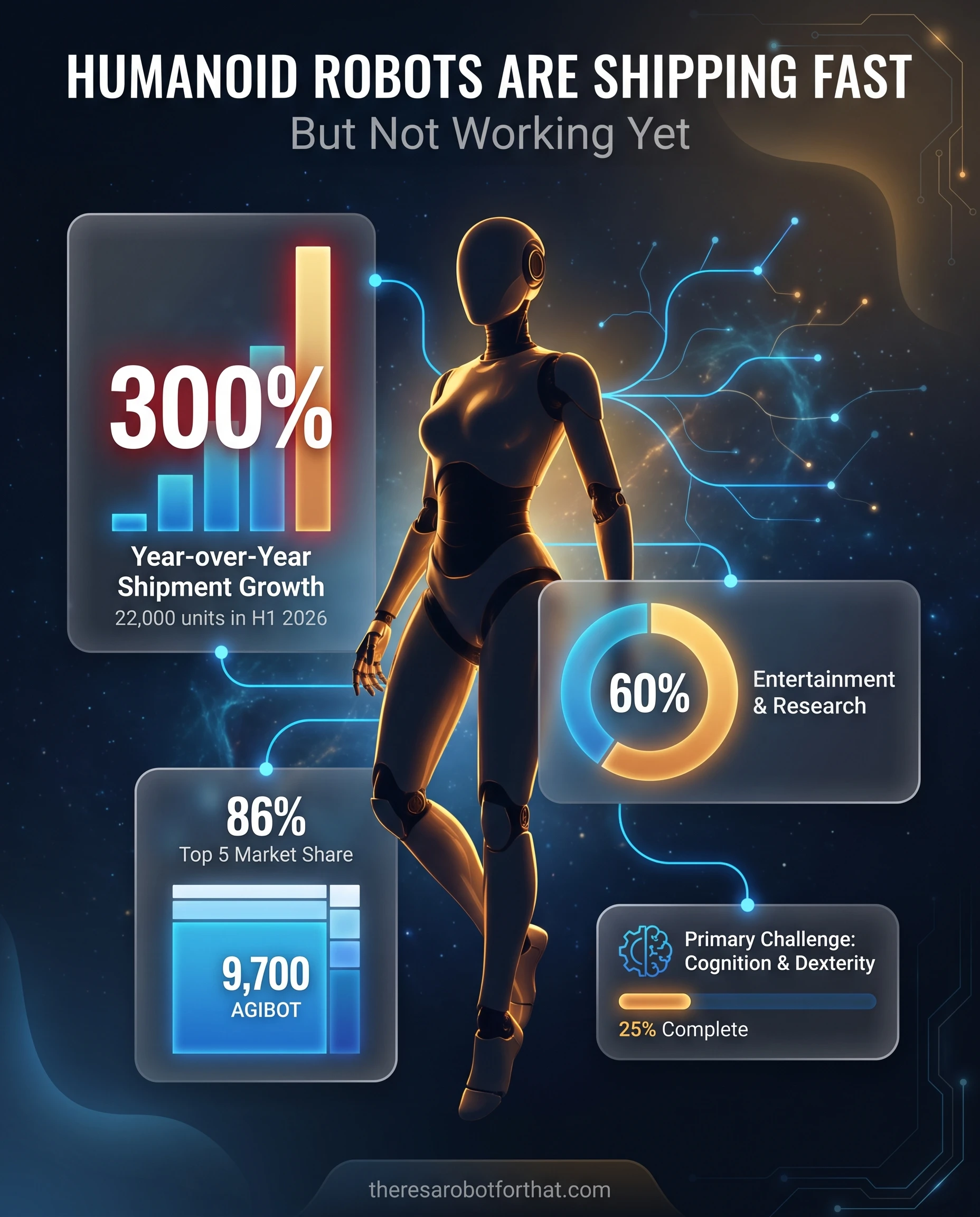
Image Source: There's A Robot For That
Snapshot: Makers shipped more than 22,000 humanoid robots worldwide in the first half of 2026, nearly 300% more than a year earlier, and yet most of them are not doing productive work.
Breakdown:
China's AGIBOT led the market with about 9,700 units. The top five makers, AGIBOT, Unitree, Galbot, UBTECH and Leju, together accounted for 86% of global shipments.
More than 60% of those robots went into entertainment, performance, research and data production, not manufacturing or logistics, according to Counterpoint Research.
Counterpoint expects global shipments to pass 50,000 units for full-year 2026, with the mix tilting toward service and industrial use as makers close the software loop.
Takeaway: Volume is not adoption. When a vendor cites a shipment figure, ask how many of those units are on a payroll doing a defined task versus dancing at a trade show or feeding a training set. The growth is real, but the productive share is the number that decides your business case, and today it is still the minority.
⏱️ The Compliance Clock
The robots sprinting and stacking boxes in Beijing are demonstrations, not certified machines. Before any humanoid works next to your people, it has to satisfy ISO 10218-1/-2:2025, the safety baseline for industrial robots that was rewritten to raise the bar on risk assessment and documentation. A vendor who can show you a race time but not a conformity file is selling a highlight reel, not a deployable machine.
Snapshot: ACE Robotics chairman Wang Xiaogang put a date on the breakthrough, predicting robot brains will reach their ChatGPT moment by the end of 2027.
Breakdown:
Wang credited world models and large-scale data capture, and said broad commercial rollout would still take another four to five years after that leap. ACE has raised more than $100 million and is preparing an IPO.
Unitree founder Wang Xingxing, speaking the week his company's shares surged 460% on debut, was more cautious: a major jump in robot software could arrive in two to three years at the earliest.
The distance between ACE's firm end-of-2027 call and Unitree's more guarded two-to-three-years-at-the-earliest is the difference between piloting now and waiting, and both men build hardware that is already shipping today.
Takeaway: For a C-suite planning cycle, the honest read is that the bodies are ready and the brains are not. You can deploy a humanoid today for a narrow, scripted task, but the general, learn-on-the-job capability that would justify a fleet is a forecast, not a product. Budget for the scripted use case you can prove this year, and revisit the general case when a vendor can demo it rather than describe it.
News
The Hidden Headcount Behind Every Robot Fleet
Snapshot: As deployments scale, the operators, technicians and data specialists who keep robots running are becoming the real bottleneck, not the machines themselves.
Breakdown:
Small pilots run on tight engineering teams, but that model breaks once a fleet spans dozens of sites, multiple shifts and messy real-world conditions, according to staffing firm HireArt. At that point robotics behaves less like a product launch and more like a distributed operations business.
New job categories are forming around the fleet: robot operators, field technicians, teleoperators, QA validators and data-capture specialists. Many firms are settling on a hybrid of stable W-2 staff plus surge capacity.
The metric that matters shifts from raw throughput to uptime, safety and repeatability, which gig-style, task-based labor struggles to deliver.
Takeaway: The sticker price of a humanoid is the smallest number in the business case. Model the people who install it, supervise it, maintain it and cover for it when it fails, because at scale that headcount, not the robot, sets your cost per task. A vendor who cannot describe the support crew a fleet needs has not run one at scale.
▶ Operator's Playbook
Before you take a single demo meeting off this week's headlines, write down two questions and do not let a vendor leave without answering both in writing. First, for your exact task, what share of the work runs fully autonomously versus teleoperated or scripted. Second, can they hand over a conformity file against ISO 10218-1/-2:2025 and a staffing plan for operating the fleet. If either answer comes back as a race time or a shipment total, you are looking at a highlight reel.
Other Top Robot Stories
A police-uniformed humanoiddirected traffic outside Shanghai's World Artificial Intelligence Conference, working an intersection alongside human officers as an embodied-AI showcase.
RoboStore , the main North American distributor of Unitree's humanoids, is building its own robots on Long Island after Washington's crackdown on foreign-made machines, standing up a 66,000-square-foot plant and a new company, Robo Inc., by early 2027. It has already sold more than 1,500 robots to buyers including Cisco, OpenAI, Nvidia and over 150 universities.
University of Hong Kong researchersreleased RoboDojo , the first Hong Kong-led benchmark that tests physical-AI systems the same way in simulation and on real robots, spanning 42 simulated tasks and 18 real-world ones.
Indian physical-AI startupsare losing access to Chinese suppliers as Beijing withholds visas from Indian executives, pushing young robotics firms to reroute parts and R&D through Hong Kong, Taiwan and Singapore.
Saga Robotics' Thorvaldwon agriculture robot of the year for autonomous UV-C crop protection now running across 2,500 acres of US vineyards and 30% of the UK's tabletop strawberry production, cutting reliance on chemical fungicides.
Free for subscribers
Deploying humanoids this year?
Our Facility Readiness Checklist walks your site before the robot arrives, 77+ items, one complete toolkit module.
The number everyone repeated this week was 9.39 seconds, a robot faster than the fastest human who ever lived. The number that will actually change a factory is smaller and quieter, the share of robots doing a real job instead of a demo, which is still the minority. Speed is easy to film. Usefulness is the part nobody claps for, and it is the part that pays.