Samsung bets its appliance factories can build cheaper humanoids
Humanoids arrive on US auto lines, a robot built to pick tomatoes, and a California county writes the rulebook.
The Big Number
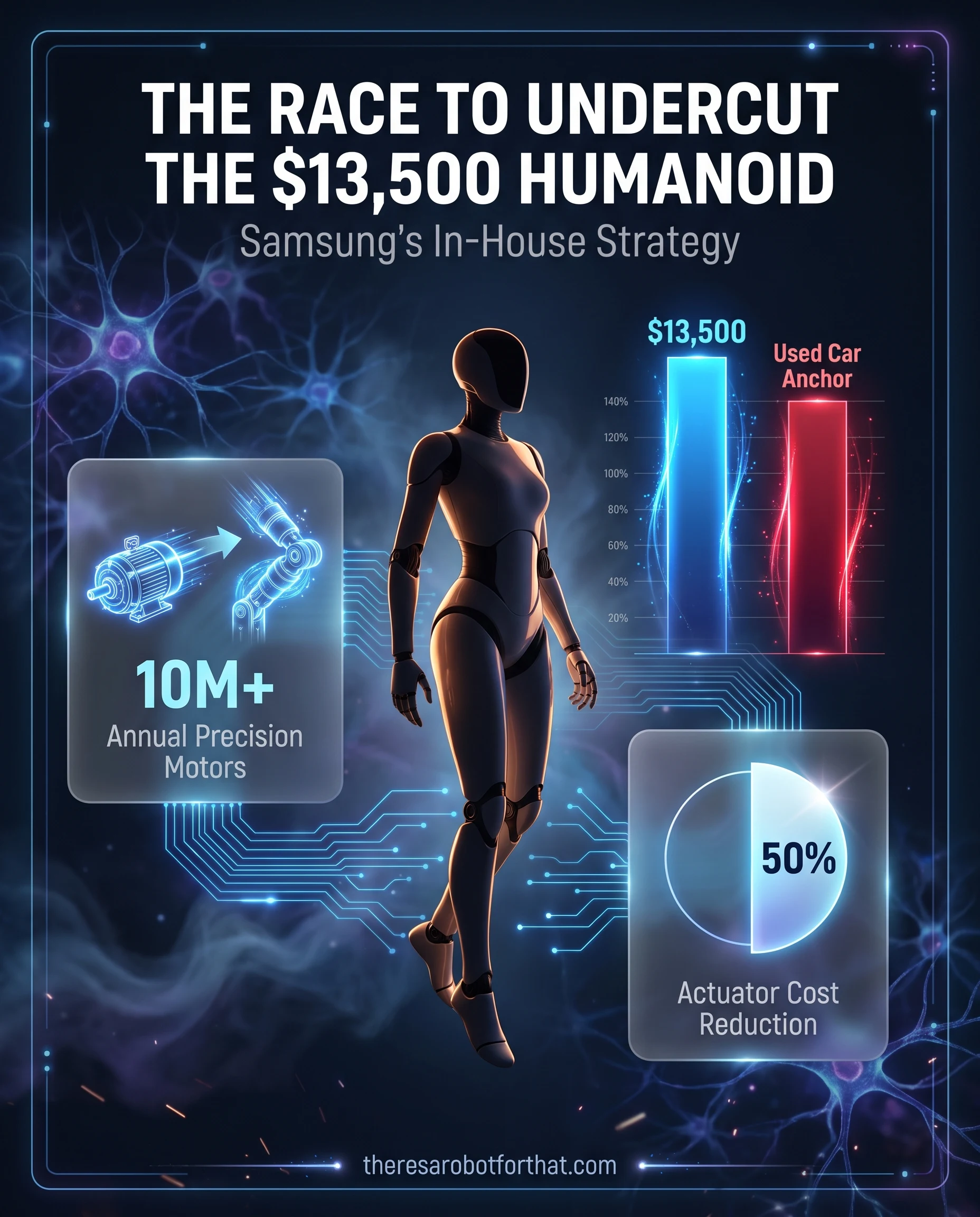
China's Unitree already sells a basic humanoid for about $13,500, roughly the price of a used car, and that is the cost bar Samsung's appliance factories are built to undercut.
Welcome back to your Robot Briefing
This week the humanoid story stopped being about who has the best demo and turned into who can build the machines cheaply, and who gets to write the rules once they show up at work.
A consumer-electronics giant leaned on its factories, the world's largest automakers leaned into an unproven bet, a farm-equipment maker aimed a humanoid at a greenhouse, and one California county decided it had seen enough to start regulating. Here is what earned an operator's attention.
The 60-Second Read
Samsung is building humanoids in-house, using actuators from its appliance motor lines to chase a structural cost advantage.
The world's biggest automakers are putting humanoids on US assembly lines, but the productivity case is still unproven.
Korea's Rainbow Robotics and Daedong built a humanoid to pick tomatoes, targeting AI greenhouses by 2028.
San Mateo County became one of the first US places to require permits, kill switches and fire rules for commercial humanoids.
News
Samsung builds its humanoids in-house to win on cost
Image Source: There's A Robot For That
Snapshot: Samsung has begun developing humanoid robots in-house, separate from its stake in Rainbow Robotics, using actuators adapted from the motor technology it already mass-produces for washing machines, air conditioners and refrigerators.
Breakdown:
The in-house effort sits under the Robotics eXperience (RX) division Samsung stood up under its CEO in July, and runs in parallel with its position as the largest shareholder in Rainbow Robotics rather than through it.
The cost logic is manufacturing, not software: adapting existing appliance-motor lines to make robot actuators is faster and cheaper than building dedicated actuator production from zero.
Samsung's plan is to prove the robots inside its own global network of plants first, which lets it drive unit costs down before selling to anyone else.
The company is also positioned to supply actuators and components to other robot makers, mirroring the parts business it already runs in phones and displays.
Takeaway: The threat to today's humanoid vendors is not a better demo, it is a balance sheet that already knows how to build tens of millions of precision motors a year. If a company like Samsung can halve the actuator bill, the economics of a factory pilot shift for everyone. Operations leaders sizing a deployment should ask vendors where their actuators are made and at what volume, because that number will drive price long after the launch video fades.
News
Humanoids arrive on US auto lines, and the payoff is unproven
Snapshot: BMW, Hyundai, Mercedes-Benz and Tesla are moving humanoids toward their assembly lines as a possible next stage of factory automation, betting that a machine which walks the existing floor can take on work that fixed robots cannot.
Breakdown:
Unlike traditional industrial arms bolted in place for one task, humanoids are meant to move through a plant built for people and adapt to changing conditions using onboard AI.
Supporters argue the machines can ease labor shortages and help US plants compete with lower-cost Chinese rivals by absorbing repetitive jobs.
The doubts are concrete: current humanoids move slower than people, still struggle with the sensitivity and flexibility of the human hand, and often lose on cost to simpler automation that does the same job.
China holds an edge through its dense supplier network and lower deployment costs, which is part of why the US has restricted imports of advanced Chinese robots.
Takeaway: For a plant leader, the trap is buying the form factor before the math. A humanoid earns its place only where a task genuinely needs a human shape and simpler automation has already failed. Before a pilot, write the success metric as cost per completed task against your cheapest existing option, and hold the robot to it. The automakers testing now are effectively paying to learn where that line sits.
⏱️ The Compliance Clock
As electronics giants and automakers push humanoids onto real production floors, the safety baseline that governs them is ISO 10218, the international standard for industrial robots, updated in its 2025 revision. The new edition folds collaborative operation into the core standard and raises the documentation bar for anyone placing a robot next to a worker. If you are scoping a humanoid for a line this year, treat the certificate against this standard as part of the purchase, not an afterthought.
A humanoid built to pick tomatoes heads into the greenhouse
Snapshot: Daedong and Rainbow Robotics have completed a first prototype of AGROID, an agricultural humanoid now in real-world testing on tasks such as tomato harvesting.
Breakdown:
The two split the work along their strengths: Daedong handles the autonomous lower platform, work-path planning and the agricultural AI that recognizes crops and decides when to harvest, while Rainbow Robotics contributes the harvesting arm, precision control and digital-twin integration.
The robot pairs Rainbow's humanoid upper body with Daedong's mobile drive base, a combination aimed squarely at the fiddly, high-variation manual work that fixed farm machinery cannot do.
Daedong is positioning AGROID as the core robot for a fourth-generation AI greenhouse under a national agricultural platform project in Jeollanam-do, with deployment targeted by 2028.
The companies plan joint certification and on-site demonstrations, and say commercialization follows only after they verify both performance and cost.
Takeaway: Agriculture is a useful tell for where humanoids actually fit. Harvesting is high-mix, unstructured and seasonal, the exact profile that defeats single-purpose automation, which is why a walking, grasping machine can pencil out here before it does on a tidy assembly line. For operators outside farming, the lesson is the same: the strongest early cases are messy tasks that resist a cheaper fixed robot.
News
San Mateo County votes to put humanoids on a permit
The measure, introduced by Supervisor Ray Mueller, directs the county to require permits for commercial humanoid use and to build a framework before the technology becomes widespread.
It calls for emergency kill switches, fire-safety measures and tracking of job displacement, with permit fees earmarked to fund specialized equipment for lithium-ion battery fires.
Mueller tied the fire concern to the rising number of battery blazes from e-bikes, laptops and cars, arguing first responders need to be ready for robot-related incidents.
Labor and AI-safety voices backed it, including the county's Central Labor Council and the group Pause AI, which pressed for worker protections and safeguards.
Takeaway: This is a local resolution, but the shape of it matters because other jurisdictions copy templates. The permit, the kill switch and the battery-fire plan are exactly the documents a compliance team will be asked to produce. If you operate public-facing robots in the US, start assembling that file now, because the questions San Mateo is asking will not stay in one county.
▶ Operator's Playbook
Before a humanoid goes anywhere near your floor, ask the integrator for two documents in writing: the Declaration of Conformity naming the safety standard the machine is certified against, such as ISO 10218, and the emergency-stop and kill-switch specification. If a vendor cannot hand those over on request, you have your answer on how deployment-ready the product really is.
Celonalaunched Orion , a converged wireless platform that unifies private 5G, Wi-Fi 7, public cellular and satellite so a robot fleet keeps one network identity as it moves, with a phased rollout starting in the fourth quarter of 2026.
Jabil's Bruce Richardcalled deployment a crawl, walk, run process, noting each humanoid packs 30 to 50 actuators, which is why structured factories and warehouses are the only practical starting points today.
FIRAbrought its Robotics Village to Penn State's Ag Progress Days, its first showcase in the eastern US, where Philadelphia's Burro rolled out a 40-horsepower autonomous platform that can tow 6,000 pounds.
Woodburn Nursery & Azaleasput an autonomous pruner to work doing the job of 30 people, saving the Oregon grower about $260,000 a year.
1Xopened orders for Neo, a 5-foot-6 home humanoid priced at $20,000 outright or $499 a month, though it still leans on a remote human operator for its hardest chores.
South Korean startupsare racing to build high-precision digital twins, virtual practice rooms that train robots and self-driving systems on the risky situations that are hard to stage in the real world.
Compliance toolkit
The EU Machinery Regulation applies from January 20, 2027.
The Robot Safety Documentation Toolkit gives your team all seven compliance documents, ready to fill in.
The humanoid race is quietly turning into a manufacturing race. The company that ships tens of millions of small motors a year may end up mattering more than the one with the sharpest demo, because a robot that cannot be built cheaply and serviced reliably never leaves the stage. This week the most telling numbers were not about intelligence at all. They were an actuator count, a used-car price, and a county worrying about who puts out the fire.