Samsung builds a robotics division to chase humanoids
Europe's newest robot unicorn, Singapore's care robots, and a humanoid named Sally reports for class.
The Big Number
Samsung Electronics shares jumped 6.76% in a single session, the market's verdict on the electronics giant formally standing up a humanoid robotics division.
Welcome back to your Robot Briefing
This week the humanoid story stopped being about dancing robots at a trade show and started being about balance sheets. A $300 billion electronics giant built a robotics division, a European startup became a unicorn before mass production, and a rural school district signed a contract for a robot teacher.
The through line for operators is that the money and the deployments are getting specific. Below are four signals worth a few minutes, plus the compliance clock that governs where any of these machines can actually work.
The 60-Second Read
Samsung created a CEO-led robotics division and tied factory money to humanoid manufacturing, the clearest sign yet that consumer-electronics giants are entering the race.
UK startup Humanoid raised $152 million at a $1.35 billion valuation, with Schaeffler and Bosch as both investors and factory customers.
Singapore, now super-aged, is scaling care humanoids like Dexie, where unit cost, not capability, is the adoption brake.
A New York school district bought a Realbotix humanoid for $57,590, one of the few humanoid prices with a public paper trail.
News
Samsung stands up a robotics division under the CEO
Snapshot: Samsung Electronics created a dedicated robotics division called RX, or Robotics eXperience, reporting straight to CEO TM Roh, a signal that the world's largest memory-chip maker now treats humanoid robots as a core growth engine rather than a side project.
Breakdown:
The RX office consolidates Samsung's scattered robotics work and is chartered to carry the technology from core research all the way to commercialization.
Roh said this month that Samsung will invest about 60 trillion won ($40.7 billion) in Korea's Yeongnam region, with 19 trillion won earmarked for Gumi to build physical AI infrastructure and humanoid manufacturing lines.
The unit plans research bases in the United States, China and Japan, extending a bet Samsung made in late 2024 when it became the largest shareholder in humanoid maker Rainbow Robotics.
Investors approved, as Samsung shares rose 6.76% on the news while the benchmark Kospi gained about 4%.
Takeaway: When a company Samsung's size puts a robotics unit under the CEO and attaches factory money to it, the message to operations leaders is that humanoids are moving from demo videos toward supplier roadmaps. Watch for Samsung and Rainbow Robotics to start appearing in the same procurement conversations as the Chinese and US humanoid vendors you already track.
News
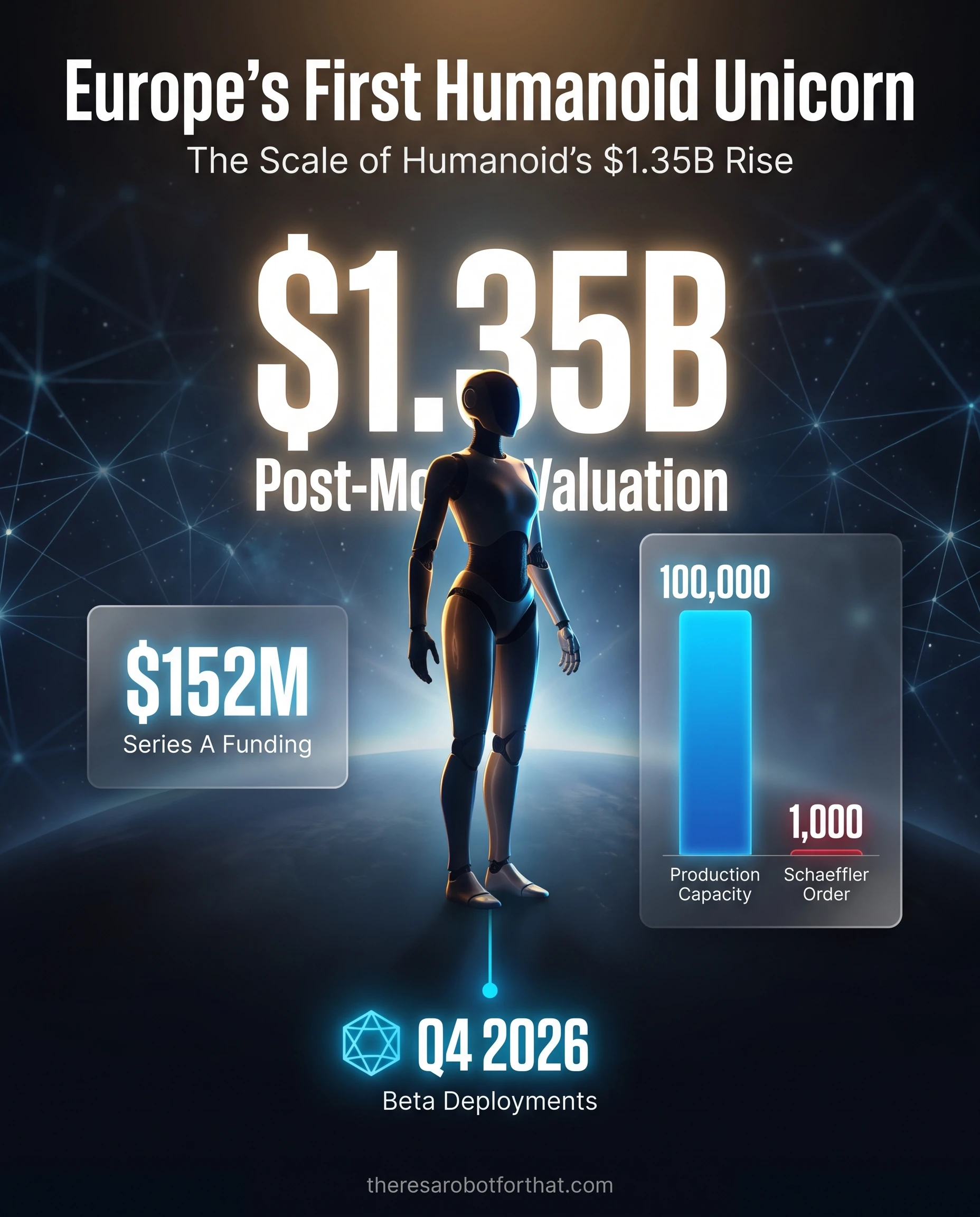
Europe's newest robot unicorn is a UK humanoid startup
Image Source: There's A Robot For That
Snapshot: UK-based startup Humanoid raised $152 million in a Series A round at a $1.35 billion post-money valuation, making it one of Europe's first humanoid unicorns and a sign that industrial buyers, not just venture funds, are lining up behind physical AI.
Breakdown:
The round was led by Prime Movers Lab, with participation from Schaeffler, Bosch, Fubon Financial Holding Venture Capital and Aglaé Ventures, taking Humanoid's total funding to $270 million.
The company said it will use the money to expand its KinetIQ software platform, start mass manufacturing of wheeled robots, and begin beta deployments at customer sites in the fourth quarter across manufacturing, logistics and retail.
Humanoid already has an agreement with auto-parts giant Schaeffler covering the planned deployment of thousands of robots at manufacturing facilities, and names SAP, Nvidia, Bosch and Siemens as partners.
Bosch will act as Humanoid's contract-manufacturing partner and provide hardware and supply-chain expertise.
Takeaway: The investor list is the real story, because Schaeffler and Bosch are not tourists in a factory, they are the buyers and the builders. A humanoid startup with industrial customers writing checks before mass production carries a different risk profile than one selling a vision, and it puts genuine European deployment volume on the 2027 horizon.
⏱️ The Compliance Clock
182 days
until the EU Machinery Regulation becomes mandatory (Jan 20, 2027)
This week's funding news puts European factory floors back in focus, and that means the EU Machinery Regulation. It replaces the decades-old Machinery Directive and sets the baseline every robot, humanoids included, must meet to be placed on the EU market, from risk assessment to the declaration of conformity. Humanoid's deal to put thousands of robots into Schaeffler plants only works if each unit clears that bar, so operators planning European deployments should be asking vendors about it now.
Singapore leans on humanoid robots as it turns super-aged
Snapshot: As Singapore crosses into super-aged status this year, its care sector is putting humanoid robots to work with seniors, from a robot named Dexie that leads physiotherapy and karaoke to sensor systems that watch for falls at home.
Breakdown:
More than one in five Singapore residents are expected to be 65 or older in 2026, and a shortage of care workers is pushing providers to automate routine engagement and monitoring.
Dexie, a humanoid deployed at the Lions Home for the Elders since 2023, guides daily exercises, bingo and singalongs for the home's 300 plus residents, and staff say some residents respond to it more readily than to human instructors.
Cost is the brake, as advanced humanoids like Dexie are priced at over 150,000 Singapore dollars per unit, about US$116,000, while smaller imported AI care devices sell for S$600 to S$8,000, roughly US$465 to US$6,200.
Operators stress the robots are meant to free carers for human contact rather than replace them, with privacy by design a recurring condition for adoption.
Takeaway: Singapore is a preview of the demand case that has nothing to do with factories. Aging economies with tight labor markets are a genuine market for service humanoids, and the gating factor is unit economics, not enthusiasm. Facilities that model cost per resident-hour instead of sticker price will be the first to make the math work.
News
A New York school district is putting a humanoid robot in class
Snapshot: The Salamanca City Central School District in rural western New York will place a humanoid robot in a classroom this fall, one of the first US districts to do so, deploying a Realbotix robot named Sally as a teaching assistant.
Breakdown:
Sally is a seated Realbotix M-Series humanoid with silicone skin and upper-body movement, paired with an avatar tutor students reach on their laptops, launching in the district's high school AI and robotics classes.
The district paid $57,590 for the robot and software package, per the board contract, a discount on the M-Series list price of $95,000 that Realbotix quotes on its own website.
It runs on a closed system with no internet connection, keeps student data on campus, and is trained to say "I don't know" rather than generate a fabricated answer, superintendent Mark Beehler said.
Educators' groups pushed back, arguing the money would be better spent on teachers, and the district says Sally will assist learning, not replace any staff.
Takeaway: Strip away the classroom framing and this is a reception-and-training deployment, the same near-term niche where humanoids are landing in workplaces. The useful detail for buyers is the pricing, because a real district signed a real contract at $57,590, one of the few humanoid transactions with a public paper trail, which makes it a rare honest benchmark in a market full of aspirational numbers.
▶ Operator's Playbook
Before you shortlist any humanoid vendor this quarter, ask them one question in writing: which safety standard does your robot's declaration of conformity cite, and can you show it? A vendor selling into EU sites should answer with the EU Machinery Regulation and ISO 10218, and one that cannot name the standard it certifies against is offering you a demo, not a deployable machine. Log the answers next to price in your comparison sheet, because the compliance paperwork, not the sticker, decides whether a robot can legally run on your floor.
A police-uniformed humanoidworked traffic outside Shanghai's World AI Conference, a live-street stunt that doubled as a showcase for China's embodied-AI ambitions.
More than 300 humanoid robots from 200-plus Chinese firmsfilled the same conference, with exhibitors stressing practical factory and service tasks over the usual dance routines.
China's robot makersconceded at WAIC that their machines still lack a good "brain", as SenseTime and AgiBot executives pointed to a shortage of real-world data to train the world models next-generation humanoids need.
The global humanoid marketis forecast to reach $40.5 billion by 2033, a 38.2% compound annual growth rate, with manufacturing the single biggest adopter.
Compliance tool
Where does your robot documentation stand?
The ISO 10218:2025 Gap Analysis Checklist finds every gap in 62 audit questions.
The most honest number in this issue did not come from a billion dollar startup. It came from a small school district that wrote $57,590 into a public contract for one seated robot trained to say I do not know when it does not know. In a field addicted to round, aspirational figures, a real receipt is a small act of clarity.