
SoftBank's robots now handle squishy wire harnesses
PLUS: LimX raises $200M pre-IPO, Booster unveils T2 humanoid platform, and DeepX connects YOLO to NPU
Welcome back to your Robot Briefing
SoftBank just cracked one of manufacturing's most stubborn automation barriers: teaching robots to handle floppy, unpredictable objects like wire harnesses. Using Nvidia's GPU cloud platform, they're training machines in simulation before sending them to the factory floor.
The real question isn't whether virtual training works. It's how fast this approach scales across industries still relying on human hands for "too complex" assembly work. If simulation can finally unlock deformable object handling, we're looking at a new wave of automatable tasks.
In today's Robot update:
SoftBank cracks robotics' squishy object problem with Nvidia-powered physical AI
Snapshot: SoftBank Corp demonstrated a GPU cloud platform that enables robots to handle deformable objects like wire harnesses, solving a manufacturing challenge that has kept robots from mastering complex assembly tasks. The system uses Nvidia's simulation tools to train robots in virtual environments before deploying them on factory floors.
Breakdown:
Takeaway: The cloud-based training model signals a shift in deployment economics: companies won't need expensive on-site experimentation to teach robots new tasks. SoftBank's focus on deformable objects targets the specific manipulation challenges that have kept automation out of complex assembly operations worth hundreds of billions in labor costs.
Chinese robot startup LimX Dynamics raises nearly $200M to improve autonomy
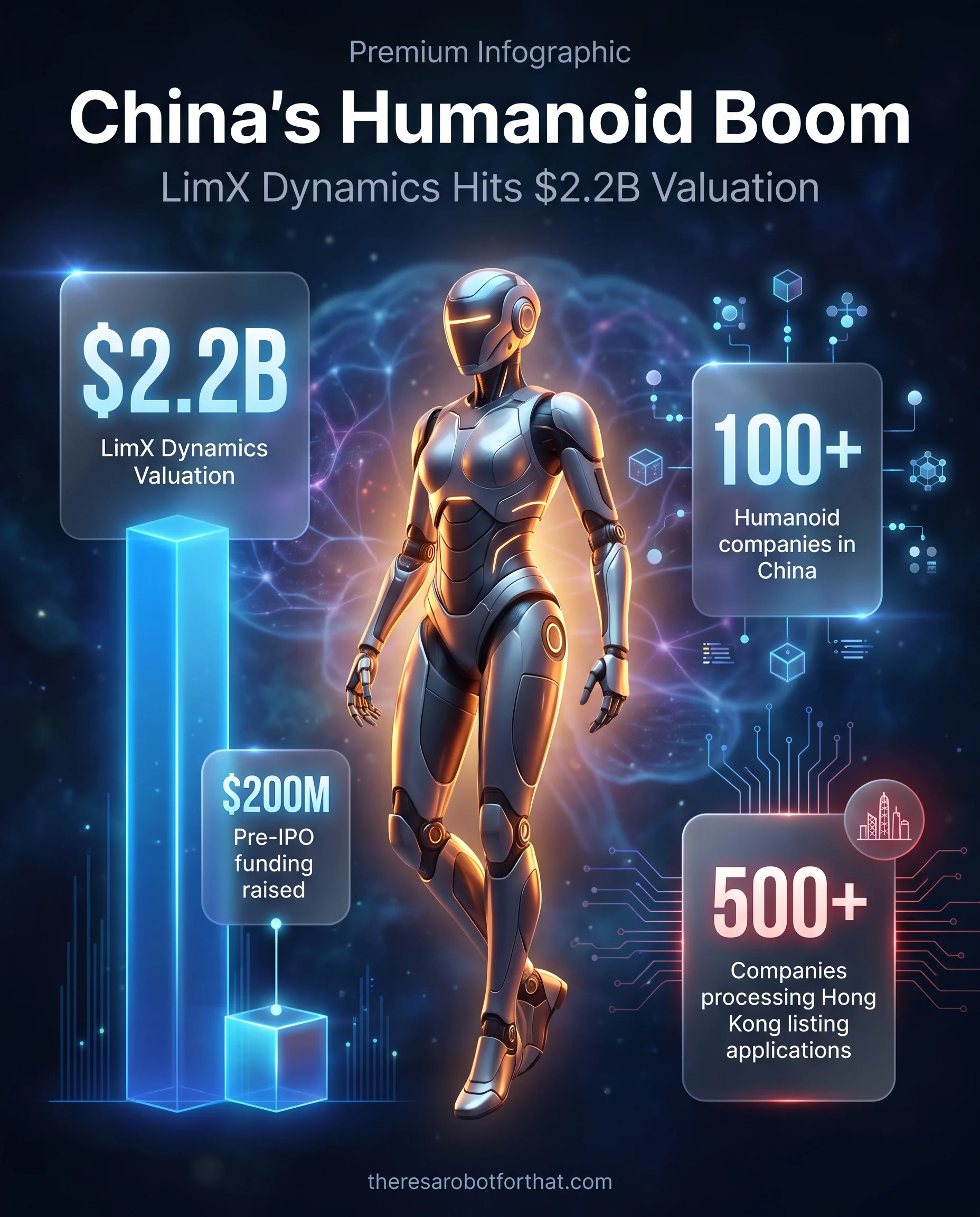
Image Source: There's A Robot For That
Snapshot: Chinese humanoid robotics startup LimX Dynamics secured $200 million at a $2.2 billion valuation in a pre-IPO round backed by European investors, as founder Will Zhang declares "listing is a must" amid a wave of Chinese humanoid companies preparing for public markets.
Breakdown:
Takeaway: The IPO rush creates a forcing function: Chinese humanoid startups must demonstrate commercial viability on compressed timelines or risk becoming the next WM Motor (an EV company that failed to list and collapsed). Public market pressure will separate working products from prototypes faster than private funding cycles ever could.
Booster Robotics unveils flagship T2 humanoid platform for embodied AI development
Snapshot: Santa Clara-based Booster Robotics launched Booster T2, a next-generation humanoid robot platform combining advanced bipedal locomotion, flagship-grade onboard computing, and whole-body coordination designed to move humanoid robots from "being able to move" to "being able to work." The platform targets developers building embodied intelligence applications for real-world deployment.
Breakdown:
Takeaway: Booster's emphasis on whole-body coordination and continuous operation reveals where the technical bottleneck sits: not in making robots walk, but in making them work while walking. The "flagship-grade onboard computing" signals that edge processing power, not cloud connectivity, is becoming the constraint for industrial deployment.
DeepX links YOLO, PaddlePaddle, and Raspberry Pi to NPU to accelerate physical AI deployment
Snapshot: Korean AI semiconductor company DeepX is building an open physical AI ecosystem by connecting popular AI frameworks (Ultralytics YOLO, PaddlePaddle) and Raspberry Pi hardware with its ultra-low-power NPU, creating a streamlined path from AI model development to industrial product mass production. The approach eliminates separate conversion and optimization steps between model training and deployment.
Breakdown:
Takeaway: DeepX is solving the "proof of concept to production" gap that kills most robotics projects, the expensive, time-consuming model conversion process that makes pilot success stories impossible to scale. By standardizing the path from $100 development boards to industrial deployment, they're removing a major friction point that has kept physical AI in the lab.
Other Top Robot Stories
Robot.com launched R-noid, a wheeled humanoid its maker says goes from first site visit to autonomous on-site work in as little as eight to twelve weeks with no facility remapping or GPS, running FieldAI navigation and a Physical Intelligence manipulation model as it targets warehouses, restaurants, and hotel housekeeping under a robots-as-a-service model.
Boston Dynamics became a wholly owned Hyundai subsidiary after Hyundai paid SoftBank $325 million for its remaining 9.65% stake, valuing the maker around $3.4 billion as its electric Atlas humanoid moves from a World Cup demo toward parts-sequencing work at Hyundai's Georgia plant, where the group plans to deploy more than 25,000 units.
ByteDance is exploring entry into autonomous driving with its world model team leading early preparations focused on unmanned logistics scenarios under its Volcengine cloud services brand, marking the TikTok parent's expansion from digital AI into physical AI applications.
Not sure where your robot documentation stands? The ISO 10218:2025 Gap Analysis Checklist ($49) finds every gap in 62 audit questions.
🤖 Your robotics thought for today:
SoftBank's wire harness breakthrough isn't the headline. It's the cloud training model that matters. If you can iterate robot behavior in simulation instead of on a $500K production line, you've just collapsed deployment timelines from quarters to weeks. LimX raising $200M at a $2.2B valuation pre-IPO tells you where the smart money thinks this is heading.
I'm watching how fast the simulation-to-deployment cycle compresses.
Until Friday,
Uli


