A $15M physical-AI data startup, GE Aerospace's $225M lab, and a robot that flinches when you get too close.
The Big Number
Tesla has set an eventual target of building 20,000 Optimus humanoid robots a week.
Welcome back to your Robot Briefing
This week the headline numbers grew, and the honest caveats grew louder with them. Tesla put a target of 20,000 Optimus robots a week on the table, then admitted it is stuck building the hands. Older industrial names in Korea are quietly turning the humanoid into a platform play rather than a single product.
Underneath the funding rounds and demo reels, one question keeps surfacing. Not what a robot can do once, but what it can do reliably, on your floor, next to your people. That is the thread through everything below.
The 60-Second Read
Tesla has scaled Optimus about tenfold to several hundred a week, but wants 20,000 and cannot yet build the hands at that rate.
HD Hyundai Robotics is engineering a humanoid out of its industrial-arm business, aiming to run every robot type on one factory platform.
Carbon Robotics opened its autonomous-tractor platform to any implement maker, starting with Great Plains.
Niantic, the Pokémon GO company, is now mapping factories in under an hour so robots know exactly where they stand.
News
Tesla Wants 20,000 Optimus Robots a Week, First It Has to Fix the Hands
Image Source: There's A Robot For That
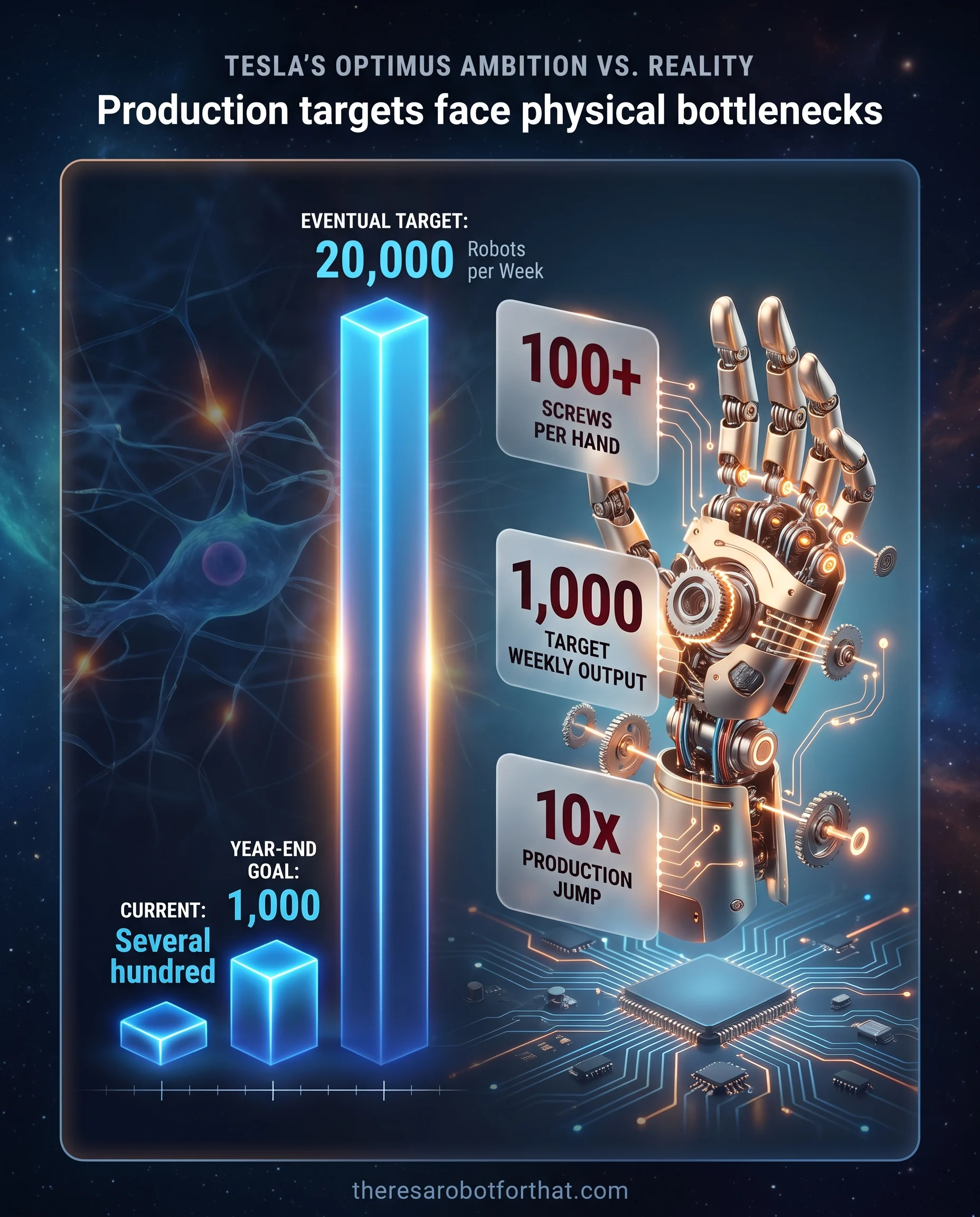
Snapshot: Tesla ramped up Optimus assembly roughly tenfold since spring, to several hundred units a week, and told managers it wants a continuous line that can build more than 1,000 robots weekly by year-end on the way to an eventual 20,000.
Breakdown:
Output rose from a few dozen units a week during small-batch testing in the second quarter to several hundred a week by August, about a tenfold jump, with managers targeting more than 1,000 a week by year-end.
The bottleneck is the hands. Each hand and forearm packs over 100 screws and small components that workers still assemble by hand, some touch sensors have shown reliability problems, and a replaceable sensing glove is planned for 2027.
The AI still struggles to generalize, taking several days to learn even a basic task and behaving unpredictably in situations it was not trained on, so units stay in tightly controlled, supervised areas.
Tesla plans to lease rather than sell early units, starting with warehouse and factory customers whose sites resemble its own, and to use those deployments to gather training data.
Takeaway: For an operator, the signal is not the 20,000 figure, it is the lease-first plan and the roped-off work cells. Tesla is saying plainly that these robots are not drop-in labor yet, they are supervised pilots that need a site shaped like a Tesla plant. Anyone evaluating a humanoid should ask how many hours of task-specific training a new job takes, and who owns the machine when a hand breaks.
News
HD Hyundai Is Building a Humanoid Out of Its Factory-Arm Business
Snapshot: HD Hyundai Robotics is developing a humanoid on top of the arm design, control and safety technology it built up mass-producing industrial robots and cobots, chief technology officer Ahn Sung-hwan said, with the first prototypes headed for the company's own controller assembly line.
Breakdown:
The humanoid is not a standalone project but part of a "Robot-Defined autonomous Factory," an open platform meant to run industrial robots, cobots, mobile robots and humanoids in one environment.
Ahn said hand technology for precision manipulation is the core focus, and the physical-AI skills gained, including task recognition, perception, force and tactile control and task planning, will be pushed back into existing industrial and collaborative lines.
The company plans a "data flywheel" that learns from skilled-worker task data, robot logs and simulation to specialize AI models for welding, painting and assembly.
Its new HDC high-payload cobots, launched in the second half of this year, are in supply talks with more than 30 potential customers, and HD Hyundai targets over 100 units annually by 2027 and more than half the domestic high-payload cobot market by 2030.
Takeaway: This is the industrial incumbent's answer to the humanoid startups. Rather than chase a general-purpose robot, HD Hyundai treats the humanoid as a research vehicle whose control and safety work flows back into the arms it already sells. For a factory buyer that hints at a future where one operating system runs the whole floor, and it raises the practical question of whether your next robot purchase locks you into a single vendor's platform.
⏱️ The Compliance Clock
This week's stories share a thread. Humanoids and cobots are moving onto floors where people already work, and even Tesla's own robots still sit in supervised, roped-off zones. ISO/TS 15066 is the technical specification that puts concrete force and pressure limits on where a collaborative robot may contact a human body, and it is what a safety officer will point to when a machine shares space with a worker. If you are planning a mixed human-and-robot line, treat the contact-force data as a spec you request from the vendor, not a detail you discover after installation.
News
Carbon Robotics Opens Its Tractor Autonomy to Any Implement Maker
Image source: Carbon Robotics
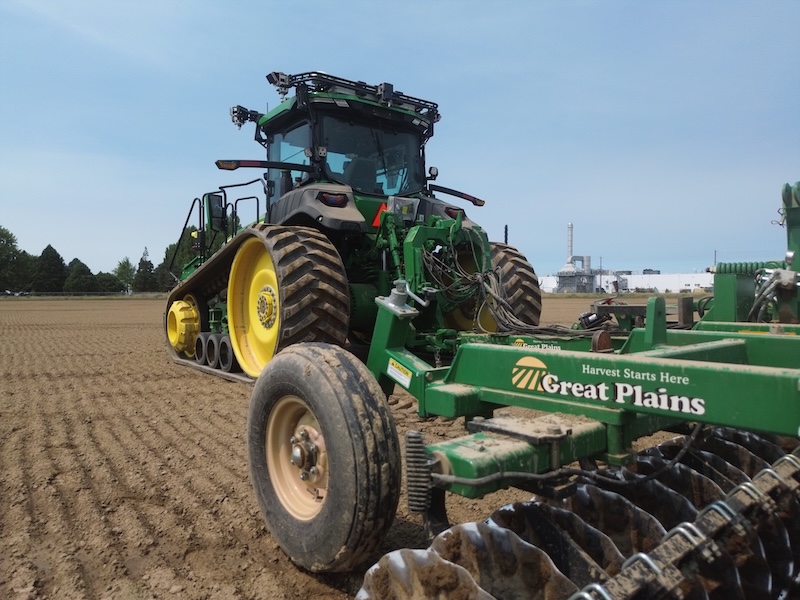
Snapshot: Carbon Robotics launched a Carbon Autonomy Ready program that lets any farm implement plug into its autonomous-tractor platform, with seeding and soil-equipment maker Great Plains Manufacturing signing on as the first partner.
Breakdown:
The program sets a technical specification so third-party implements can feed real-time data to a tractor running Carbon Autonomy and take automatic adjustments to depth, down pressure and leveling, the way a human operator would.
Great Plains brings its Implement Command system, and the pair will show a Great Plains HT1100 Terra-Max fitted with sensors and a Carbon implement kit at the 2026 Farm Progress Show.
Chief executive Paul Mikesell pitched the program as a way to extend working hours, ease a skilled-operator shortage and raise tractor utilization.
Carbon, known for its LaserWeeder, is building an implement-agnostic layer so farmers can mix equipment brands without giving up autonomy.
Takeaway: The interesting move is the open specification. Instead of selling one closed autonomous machine, Carbon is trying to become the autonomy layer that other equipment plugs into, the same platform play now showing up on factory floors. For operations leaders outside farming it is a preview of how autonomy spreads in heavy industry, not by replacing the fleet, but by retrofitting a common control layer onto the machines you already run.
News
The Pokémon GO Company Now Maps Factories So Robots Know Where They Are
Snapshot: Niantic Spatial, the firm spun out of Pokémon GO maker Niantic, is turning the mapping technology behind the game into "spatial AI" that gives robots centimeter-accurate maps of real factories and streets.
Breakdown:
The system captures a site with 360-degree cameras and rebuilds it as a 3D model. CEO Jo In-hee said scanning a factory takes 10 to 15 minutes and a usable model is ready within an hour.
Its Visual Positioning System matches what a robot's camera sees against that 3D map to fix the machine's location and heading to centimeter precision, where GPS in dense urban areas can be off by 10 to 40 meters.
Niantic has reconstructed real offices in 3D to train a humanoid partner's movement, and signed a memorandum of understanding with the Singapore Land Authority to build a nationwide VPS.
Jo, who joined in March after the company sold its gaming business, argued that about 80% of global GDP is generated in the physical world that language models have never learned.
Takeaway: Navigation is the unglamorous half of physical AI, and it is often the part that stalls a deployment. A robot that cannot reliably know where it stands inside your building is a robot that needs rails, floor tape or a human minder. If mapping a facility really drops to under an hour, the cost of commissioning a mobile robot on a new site falls with it, and that is exactly the line item that kills most pilots.
▶ Operator's Playbook
Before you shortlist any humanoid or cobot for a shared work cell this week, send the vendor two written requests. First, the robot's ISO/TS 15066 contact-force and pressure test data for every body region a worker could touch. Second, a plain statement of how much task-specific training a new job requires and how long the robot is out of service if a hand or sensor fails. Put both answers in the purchase file next to the price, because a robot that needs a roped-off zone or weeks of retraining carries a very different total cost than the demo suggests.
Other Top Robot Stories
O-ID , a Tokyo humanoid startup, raised $1.2 million in pre-seed funding to move a fully modular humanoid built for manufacturing and logistics into production.
Midcentury , a New York startup, emerged from stealth with $15 million to build training-data infrastructure for physical AI.
GE Aerospacecommitted $225 million to rebuild its Niskayuna, New York research center, with about $75 million earmarked for equipment supporting AI, robotics and advanced materials.
Lincoln Electricwill debut physical-AI welding automation at FABTECH in October, combining machine vision, welding intelligence and cobots as the company reports a broad surge in automation demand.
Robot.comran the first live handoff of its R-noid humanoid loading an R-kiwi delivery robot, sequencing the two machines together in a campus setting.
Agility Robotics' Digit 5learned to back off , stopping, stepping aside or dropping to a seated position when a worker moves into its space.
Free for subscribers
Deploying humanoids this year?
Our Facility Readiness Checklist walks your site before the robot arrives, 77+ items, one complete toolkit module.
The number everyone will quote this week is 20,000 robots a week. The number that actually matters is the one Tesla keeps quiet: how many days it takes Optimus to learn a single new task. A factory does not run on peak output, it runs on the dull reliability of a machine that already knows the job. Every serious robot story right now, the hands that still need a person to assemble them, the cobot that slows when you walk past, the map that takes an hour to build, is really a story about the gap between a demo and an ordinary Tuesday. The companies that win will be the ones that make Tuesday boring.