Boston Dynamics moves into Hyundai's plant, Cognex buys RealSense for $500M, Kawasaki builds an arm for warehouse humanoids, and Universal Robots ships Gen 7.
The Big Number
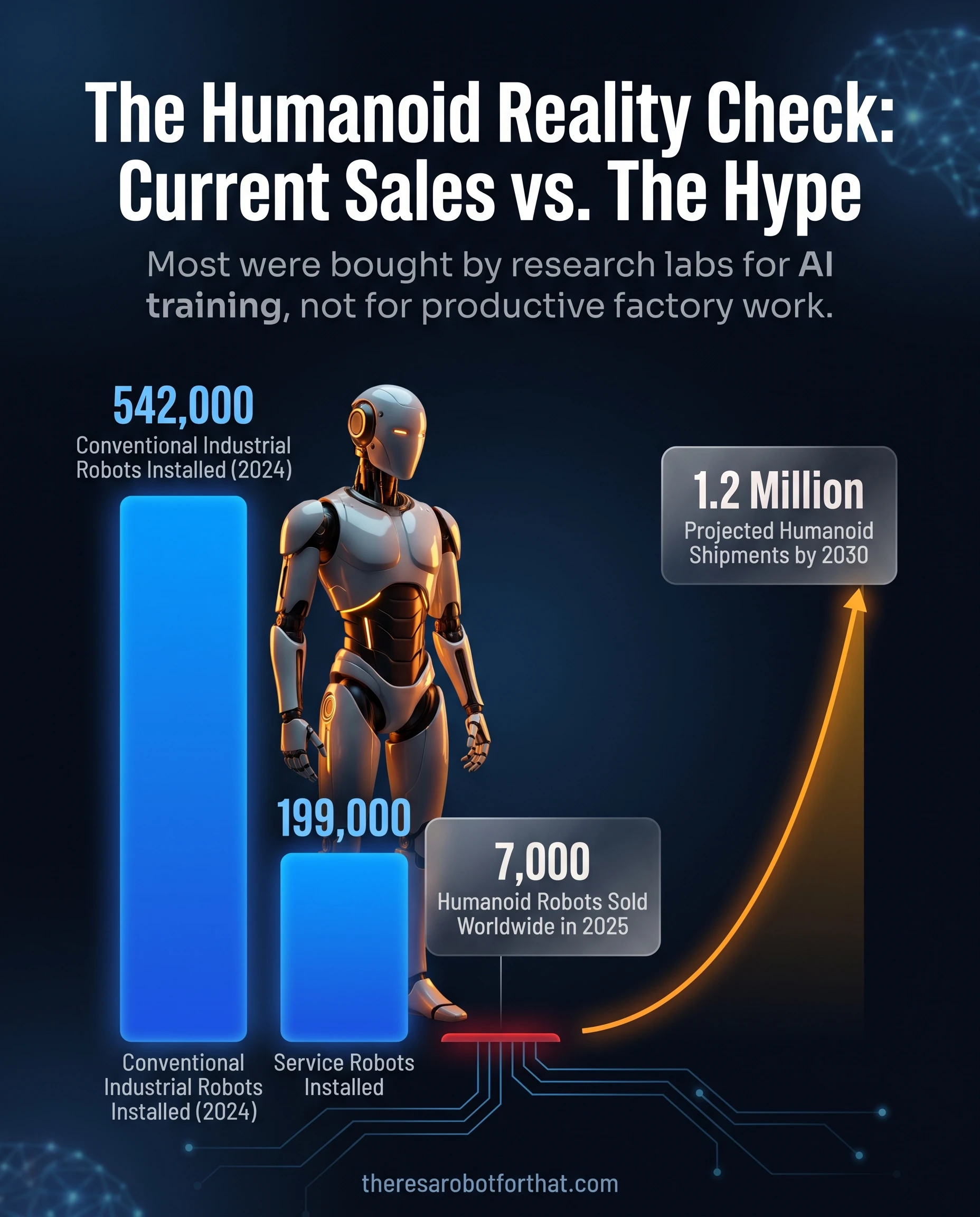
About 7,000 humanoid robots were sold worldwide in 2025, the first time an industry body has put a hard figure on the whole market.
Welcome back to your Robot Briefing
This week the industry got its first real scorecard, and the headline number is smaller than almost anyone expected. Within days of that count, two of the biggest names in robotics showed exactly how the install base is supposed to grow: inside a car factory, and through the supply chain that feeds it.
The theme running through all of it is the gap between forecast and floor. Billions are committed, roadmaps are public, and the robots are getting genuinely capable. What is still scarce is the boring part, robots doing the same job reliably, every shift, for money.
The 60-Second Read
The first industry-wide count puts 2025 humanoid sales at about 7,000, most bought by labs to generate AI training data rather than to work.
Boston Dynamics opened a training plant inside Hyundai's Georgia factory, the first step toward 25,000 Atlas robots on Hyundai and Kia lines.
Cognex is buying depth-camera maker RealSense for about $500 million to move machine vision into robot perception.
Kawasaki and Dexterity built a purpose-made eight-axis arm for warehouse humanoids that load and unload trailers.
News
Humanoids Drew Billions, But Only 7,000 Sold
Image Source: There's A Robot For That
Snapshot: The International Federation of Robotics counted about 7,000 humanoid robots sold worldwide in 2025 for industrial and professional service use, the first time the group has put a hard number on a market that has attracted billions of dollars in investment.
Breakdown:
The tally sits against roughly 542,000 conventional industrial robots installed in 2024 and an estimated 199,000 service robots, so humanoids remain a rounding error on the factory floor, IFR secretary general Susanne Bieller said.
Most 2025 buyers were research institutions and companies collecting data to improve AI models, not operators putting the machines to productive work.
Carmakers, the earliest adopters, are running pilots with "single-digit or sometimes double-digit numbers of robots" per plant, Bieller said.
Bank of America Global Research still projects 90,000 humanoid shipments in 2026 and 1.2 million by 2030, the gap between today's reality and the forecast that frames every other story this week.
Takeaway: The number to carry into a vendor meeting is 7,000, not the million-unit forecasts. Humanoids are real, shipping, and improving fast, but the install base is tiny and skewed toward data collection. Treat 2026 pilots as learning exercises with a clear exit, not production commitments, and press every vendor on what its robots are actually doing in the field today.
News
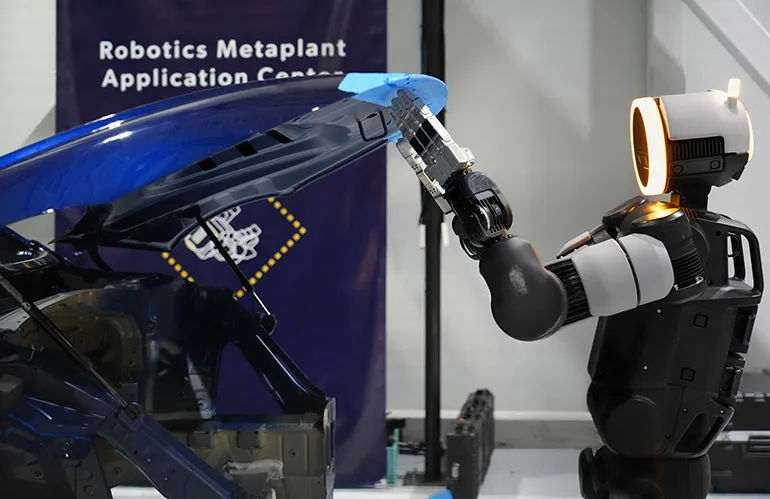
Boston Dynamics Moves Atlas Into Hyundai's Factory
Image source: Boston Dynamics
Snapshot: Boston Dynamics opened its Robotics Metaplant Application Center, a permanent training and data-collection site for Atlas humanoids built inside Hyundai's Metaplant America auto factory near Savannah, Georgia.
Breakdown:
The center, which the company calls a "robot behavior factory," feeds Atlas real parts, fixtures, and workcells so it learns automotive tasks like sequencing and staging components before assembly.
It anchors Hyundai's plan to deploy 25,000 Atlas units across Hyundai Motor and Kia plants over the next few years, with a US factory targeted to build up to 30,000 robots annually by 2028.
Boston Dynamics plans to expand the site roughly tenfold next year and move Atlas into component assembly by 2030.
Hyundai is separately in talks to test Atlas at its Nošovice plant in Czechia, which would make Europe the next proving ground after the US.
Takeaway: This is the clearest sign yet that humanoids are moving from demo reels to a named production schedule inside a real automaker. The pattern to watch is captive deployment, a manufacturer training robots on its own lines before selling the capability outward. If Atlas clears the Georgia plant, European and supplier sites are next, and the safety and integration questions travel with them.
⏱️ The Compliance Clock
119 days
until the EU Machinery Regulation becomes mandatory (Jan 20, 2027)
The EU Machinery Regulation (2023/1230) replaces the decades-old Machinery Directive and becomes mandatory for equipment placed on the EU market, humanoid robots included. It raises the bar on risk assessment, documentation, and how autonomous, AI-driven behavior must be accounted for in a machine's safety case. Any operator eyeing Hyundai's European Atlas trials, or a warehouse humanoid on an EU site, will need a conformity file ready well before the deadline the countdown above is tracking.
Snapshot: Machine-vision maker Cognex agreed to acquire RealSense, the depth-camera company spun out of Intel, for about $500 million in cash to push into 3D robotic perception.
Breakdown:
RealSense builds the depth-sensing cameras that let arms, mobile robots, quadrupeds, and humanoids perceive the space around them, what its team calls the "visual cortex of physical AI."
Cognex pegs the robotic perception market at about $600 million today and expects it to grow more than 25% a year to roughly $1.6 billion by 2030.
RealSense is on track for $80 million to $90 million in revenue in 2026, up more than 50% year over year, and the deal is expected to close in the fourth quarter.
Before closing, RealSense will spin its facial-authentication line into a separate company, keeping the sale focused on robot perception.
Takeaway: The money in humanoids is flowing to the picks and shovels as fast as to the robots. Perception is a bottleneck for every physical-AI system, and an established industrial vendor buying a depth-camera specialist signals that the supply chain is consolidating. For buyers, that points toward fewer, better-supported vision stacks, and less risk in betting on a startup sensor that might vanish.
News
Kawasaki Builds an Arm for Warehouse Humanoids
Snapshot: Kawasaki Robotics expanded its work with California's Dexterity to co-develop the RL030N, an eight-axis robot arm purpose-built for warehouse humanoids that load and unload trailers.
Breakdown:
Dexterity is scaling production of its "Mech" super-humanoid robots, which pair the new Kawasaki arm with its Foresight World Model software to handle unpredictable boxes and contact-heavy work.
Dexterity's warehouse requirements shaped the arm's reach, weight, and dexterity, and Kawasaki with parent Kawasaki Heavy Industries turned those specs into a production-ready platform.
The target is trailer loading and unloading, a physically punishing job where traditional fixed automation has struggled to scale.
The tie-up is one of several this month pairing an industrial arm maker with a physical-AI software firm, a growing division of labor between hardware and intelligence.
Takeaway: Warehouse loading is where humanoid-style robots have the clearest near-term business case, because the work is repetitive, injury-prone, and hard to staff. The signal here is specialization: rather than one vendor owning the whole stack, arm makers and AI software firms are splitting the job. Operators sizing up these systems should ask who owns the arm, who owns the model, and who answers the phone when a shift goes down.
▶ Operator's Playbook
If a humanoid pilot sits on your 2026 roadmap for a European site, ask the vendor for its EU Machinery Regulation conformity plan in writing, including which harmonized standards, such as ISO 10218-1 and -2:2025, its safety case will cite and who signs the Declaration of Conformity. Then model the full cost of the technical file, integration, and guarding, not just the robot, so the pilot budget reflects the paperwork the deployment actually requires.
Other Top Robot Stories
Universal Robotsunveiled Gen 7, its seventh-generation cobot platform, running ethernet, power, and safety straight to the tool flange to make AI-driven automation easier to deploy on a line.
Google's Intrinsicopen-sourced Intrinsic Core, the foundation of its industrial robotics platform, releasing it under a permissive Apache 2.0 license at ROSCon 2026.
Japanwill study using AI-equipped humanoid robots for defense tasks like base patrol and logistics, as its Self-Defense Forces struggle to recruit, while ruling out combat roles.
TacnIQ.airaised $1.5 million toward a $3 million pre-seed round to build tactile AI models that give machines a sense of touch.
LGexpanded an AI alliance with Microsoft spanning data-center infrastructure, enterprise software, and physical AI, after chairman Koo Kwang-mo met Satya Nadella in Redmond.
Echelon and Applied Intuitionpartnered to deploy physical AI at national scale across Saudi Arabia, targeting ports, mining, manufacturing, and trucking.
A wave of Chinese startupsdrew fresh capital , including Genisom AI's Series B and ForgeAI's angel round, as domestic backers keep funding embodied-AI brains and cross-embodiment skills.
Compliance tool
Where does your robot documentation stand?
The ISO 10218:2025 Gap Analysis Checklist finds every gap in 62 audit questions.
It is worth sitting with the number 7,000. A year of magazine covers, billion-dollar rounds, and stadium demos added up to fewer robots than a single car plant employs in people. That is not a verdict against humanoids. It is a reminder that the distance between a convincing demo and a shift that shows up every day is measured in years, and most of that work happens off camera.