The Navy's $900 Million Physical AI Shipbuilding Bet
A self-charging Atlas, a $6.5M raise for warehouse humanoids, and a county that wants to permit robots.
The Big Number
HII committed up to $900 million in shipbuilding work to two physical-AI robotics firms, its largest push yet to automate how U.S. warships get built.
Welcome back to your Robot Briefing
Physical AI stopped being a slide this week and started signing contracts. A shipbuilder put nine figures behind it, a humanoid learned to keep itself running, and a California county moved to regulate the machines before they arrive.
The through-line is a shift in the question being asked. It is no longer can the robot work, it is can the robot work a full shift, safely, next to people. Here is what an operator needs from the week.
The 60-Second Read
HII will route up to $900 million to two robotics firms to automate Navy shipbuilding, paid out only as they clear performance milestones.
Boston Dynamics' Atlas can now swap its own battery in under three minutes, built for multi-shift factory work.
Avatar Robotics raised $6.5 million to scale semi-humanoid warehouse robots that it says have already handled over 900,000 products.
Regulators are catching up: a San Mateo County supervisor wants a permitting process for humanoid robots in stores and restaurants.
News
HII routes up to $900 million to physical-AI robots for Navy shipbuilding
Snapshot: HII signed up to $900 million in long-term shipbuilding work to Path Robotics and GrayMatter Robotics, betting that autonomous manufacturing can hold Navy-grade quality across its yards.
Breakdown:
The seven-year, performance-based agreements pay out only after each firm proves its systems meet the quality, schedule and manufacturing standards Navy programs require.
Path Robotics stands to earn up to $600 million of the total, with GrayMatter Robotics taking the remainder.
The work targets autonomous welding, grinding, blasting, painting, assembly and inspection across carriers, submarines, destroyers and future frigates.
HII frames it as two stages: a Navy-grade development and qualification stage first, then a delivery stage that folds the robots into a live production line.
Takeaway: This is what physical AI looks like once it grows up. The money is gated behind milestones, not paid on a promise, which is the contracting model worth copying when you bring autonomy into a regulated, quality-critical line. Watch whether milestone-based deals become the default for industrial robotics procurement.
News
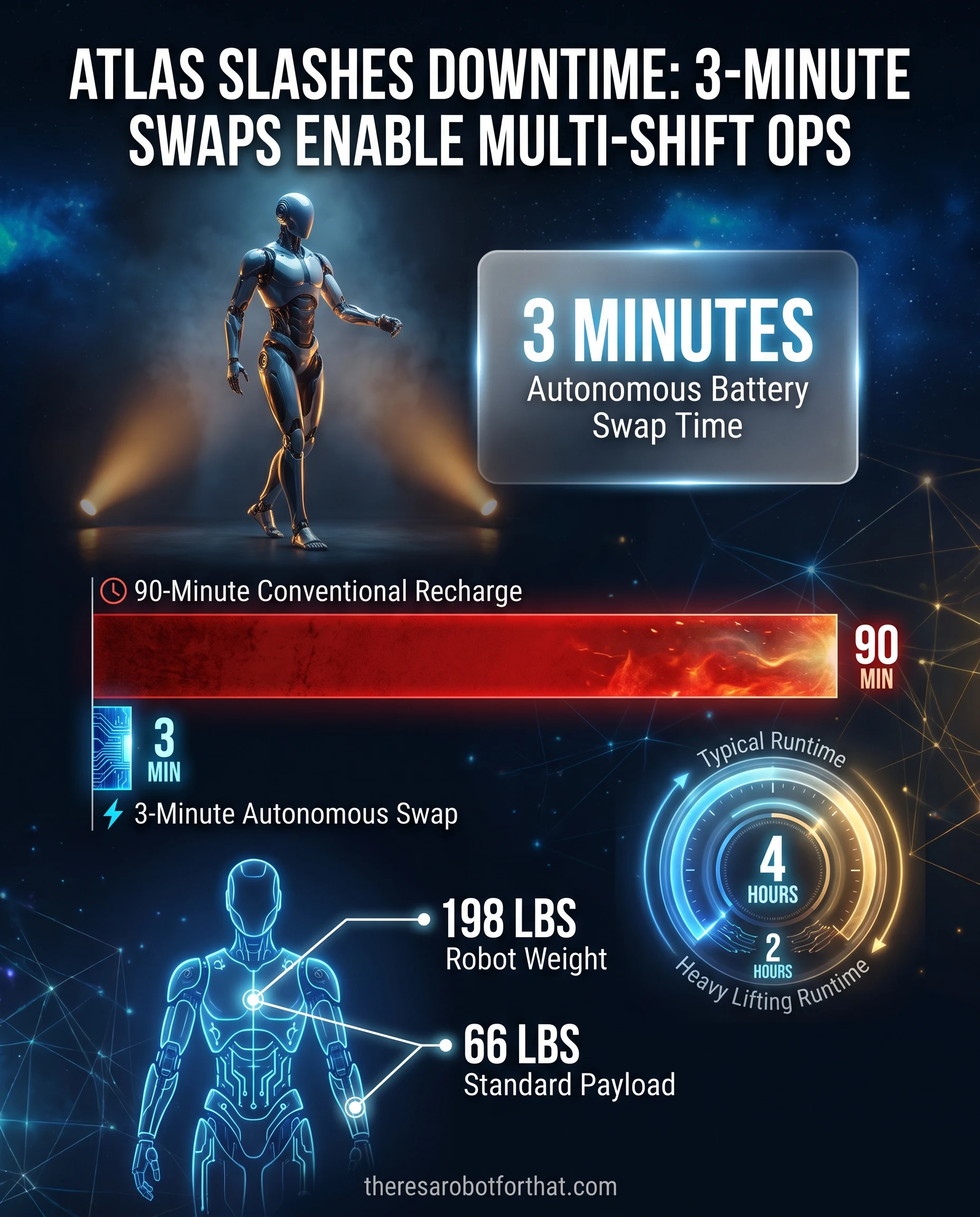
Atlas can now swap its own battery in under three minutes
Image Source: There's A Robot For That
Snapshot: Boston Dynamics' production Atlas can autonomously return to a station and swap its own battery in under three minutes, taking the human out of the most routine cause of robot downtime.
Breakdown:
The company's spec sheet lists roughly four hours of runtime in typical use and about two hours under heavy lifting, so an untended swap is what makes a multi-shift day possible.
A conventional recharge runs around 90 minutes, time a working robot would otherwise spend idle on the floor.
Atlas is built for industrial duty at about 6 foot 2 and 198 pounds, carrying loads near 66 pounds and briefly lifting up to 110.
The feature reframes Atlas from a demo machine into equipment measured on uptime, the number an operations manager actually budgets around.
Takeaway: Uptime is where humanoid economics are won or lost. A three-minute self-swap against a 90-minute recharge is the difference between one shift and three, so when you evaluate any humanoid, ask for its runtime and its swap or charge cycle before you ask about the party tricks.
⏱️ The Compliance Clock
As physical AI moves from demo to production line, the paperwork moves with it. ISO 10218-1/-2:2025 is the updated safety baseline for industrial robots and their integration, and it raises the documentation bar for anyone placing an automated cell into service. If HII's autonomous welders or an industrial humanoid land in your facility, this is the standard that defines what "safe enough to run" has to prove on paper.
Avatar Robotics raises $6.5 million to put semi-humanoids on the warehouse floor
Snapshot: Avatar Robotics raised $6.5 million in seed funding led by AlleyCorp to scale semi-humanoid mobile manipulators that it says have already handled more than 900,000 products inside live customer facilities.
Breakdown:
The San Francisco startup, founded in 2024 by two MIT graduates, runs its robots on remote human operators today while machine learning lifts autonomy with every task completed.
The mobile manipulators pick, pack and sort, and are already working with a global beauty retailer and a multi-billion-dollar warehouse operator.
The round follows a pre-seed led by defy.vc, with the new capital going toward larger fleets, more customer deployments and the autonomy software.
The pitch targets the same labor gap running under the rest of this issue: not enough people for repetitive logistics work.
Takeaway: The teleoperation-to-autonomy bridge is becoming the default go-to-market for physical AI, and it changes how you read a deployment number. Ask a vendor how much of a 900,000-products figure was autonomous versus remotely driven, because that ratio, not the headline count, tells you what you are actually buying.
News
DOBOT's LUMO pushes humanoids off the factory floor and into the home
Snapshot: DOBOT unveiled LUMO, a 1.3-meter humanoid it pitches as all-terrain, built to move between homes, malls and schools rather than a fixed industrial cell.
Breakdown:
DOBOT showed LUMO crossing grass, sand and cobblestones with a smooth gait, and demonstrating boxing, dancing and backflips.
It combines vision, voice and motion to perceive and respond without waiting on explicit commands, and is designed to keep learning from interactions.
The company has not released hardware specifications: no published weight, degrees of freedom, payload, battery life or price beyond the 1.3-meter height.
Separately, DOBOT teleoperated its Atom humanoid from 1,800 kilometers, about 1,118 miles, away to cook a steak, a nod to the remote-operation bridge many humanoid makers still lean on.
Takeaway: The consumer humanoid pitch keeps arriving ahead of the spec sheet. Without published payload, runtime and price, treat LUMO as a capability demo, not a product you can buy, and note the pattern: the demo travels first, the numbers follow later, if at all.
▶ Operator's Playbook
If you are scoping any robot that will lift alongside staff, add one line to the RFP this week: ask the vendor for measured force and pressure data against ISO/TS 15066, per contact point, not a blanket "collaborative" label. A robot whose maker cannot hand you that table has not been tested for the one scenario, human contact, that turns an ops decision into a safety liability.
Other Top Robot Stories
The UK governmentopened a £20 million round for farm robots that plant, tend and harvest crops, part of a £53 million push that brings this year's agricultural innovation funding to £123 million.
A San Mateo County supervisormoved to permit humanoid robots in restaurants and stores, proposing kill switches, on-site human supervision and ADA compliance before the machines can operate. The measure goes to the board on Tuesday.
Rodney Brooks, Jonathan Hurst and Ken Goldbergwill headline RoboBusiness 2026 in Santa Clara on October 20, opening the show's 20th anniversary with a look at the next two decades of the industry.
Chinaopened its first robot school, a training center where humanoid robots are put through tasks to "empower robots' brains" before they move into working roles.
Waymo co-CEO Dmitri Dolgovpushed back on Silicon Valley's "move fast and break things" reflex for physical AI, arguing there is no undo button once a machine starts moving in the real world.
Free for subscribers
Deploying humanoids this year?
Our Facility Readiness Checklist walks your site before the robot arrives, 77+ items, one complete toolkit module.
The most important number in a humanoid demo is rarely the one on stage. It is the one nobody mentions: how long it runs, what it costs, who fixes it at 2 a.m. The machines that reshape your operation will be the boring ones that keep showing up.