The US just redrew who can sell a robot on its soil
A club-of-two deployment index, 2,000 Chinese robots in UK warehouses, whole-body AI, and Beijing's threat of countermeasures.
The Big Number
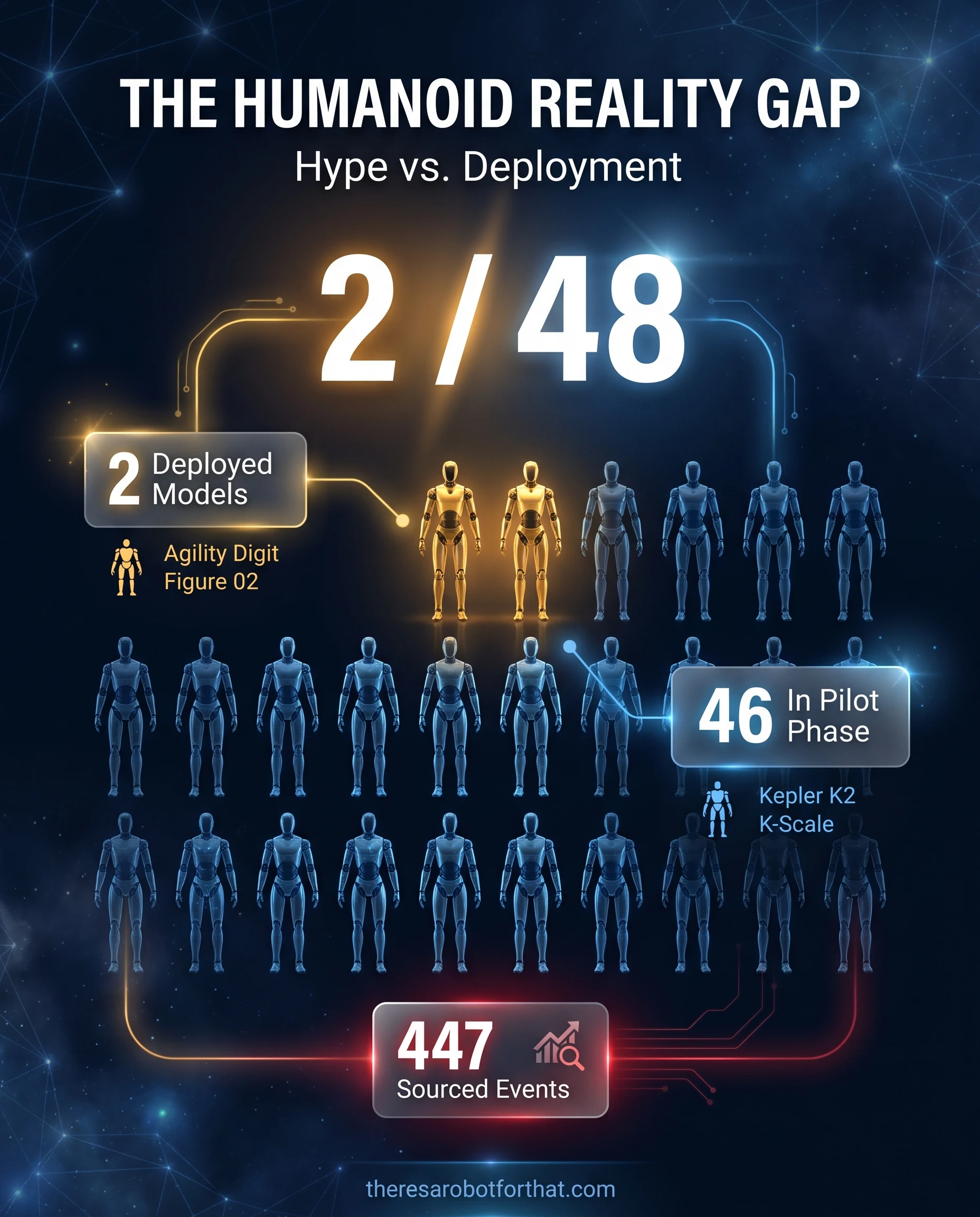
Just two of the 48 humanoid robots on our new Humanoid Reality Index have a deployment a paying customer will confirm; the other 46 are still demos or pilots.
Welcome back to your Robot Briefing
The loudest robot story of the week was not about what a machine can do. It was about who is allowed to sell one. A US agency added every foreign-produced advanced robot to a national-security list, and a day later Beijing threatened to hit back.
Underneath the politics, the real question for an operator is still the boring one: which of these machines actually works, and which model can legally ship to your site. This issue starts with the rule, then turns to the evidence, with our own deployment index landing the same week.
The 60-Second Read
The FCC added all foreign-produced advanced robots to its Covered List, blocking new authorizations while sparing models already approved.
Our new Humanoid Reality Index ranks 48 humanoids by evidence and puts only two in the Deployed tier.
More than 2,000 Chinese warehouse robots now run across 10 UK retail sites for Tesco, Asda and Next.
Google DeepMind's Gemini Robotics 2 brings whole-body control to humanoids, though lab success rates still swing widely.
News
Washington blocks new foreign robots from the US market
Snapshot: A White House-convened Executive Branch body directed the FCC to add all foreign-produced advanced robotic devices to a national-security roster, a step that blocks new device models from equipment authorization rather than stopping imports outright.
Breakdown:
The action arrived as Public Notice DA 26-786, released July 28, implementing two National Security Determinations the interagency body sent the day before; under the Secure Networks Act the FCC may only carry out such determinations, not start them.
It is not an import stop. Only new models are barred from FCC authorization, so already-authorized robots can still be imported, marketed and sold, existing owners can keep running theirs, and firmware updates continue under a separate waiver.
It is not legally a China measure. The FCC calls the action "country neutral" and says producer nationality is "not relevant," with coverage set by place of production under the Buy American test in 48 CFR 25.101.
The definition is wide: any ground robot over 4.4 pounds with an environmental sensor, at least 200 kbps of connectivity and navigation software, which pulls in warehouse AMR fleets. Stationary industrial arms, medical devices and drones are excluded, and Unitree's grants for the R1 on June 22 and the H2 and A2 quadruped on June 30 were issued weeks earlier and still stand.
Takeaway: For an operations leader the practical read is narrow. A model that already holds an FCC grant stays sellable and serviceable, so the machines caught by the Covered List are the ones not yet certified. That puts the risk in future orders and unproven vendors, not in the units already on your floor, and it makes an authorized-versus-pending audit of your robot pipeline the first thing worth doing this week.
News
Our new index finds only two humanoids are truly deployed
Image Source: There's A Robot For That
Snapshot: The Humanoid Reality Index went live on July 30 with 48 humanoid robots ranked by 447 dated, sourced events, and its first finding is blunt: only two machines have earned the Deployed tier.
Breakdown:
Tiers are computed in code from arms-length evidence, so a maker's own claim never lifts a robot up a rung.
Tier 1, Deployed, is a club of two: Agility's Digit and Figure 02, each with a customer confirmed outside the maker's own PR.
The index has grown from 20 robots at its July 16 baseline to 48 now, and it carries its first defunct maker, K-Scale Labs, whose K-Bot was America's first open-source humanoid.
Kepler's K2 sits at Tier 2 on a named pilot, the K2 introduced at an SAIC-GM automotive plant, and readers can submit robots, corrections or evidence, with every submission reviewed by hand and nothing published automatically.
Takeaway: For a manufacturing leader sizing a pilot, the signal is that shipped and deployed are different words. Forty-six of the 48 machines tracked have not yet cleared a customer-confirmed deployment, so a demo reel or a shipment total says little about whether a robot can hold down real work. Ask a vendor which arms-length customer will vouch for the machine on a dated record, and treat that answer, not the spec sheet, as the readiness test.
⏱️ The Compliance Clock
173 days
until the EU Machinery Regulation becomes mandatory (Jan 20, 2027)
The FCC has just changed who may place a robot on the US market, and the parallel gate on the other side of the Atlantic is the EU Machinery Regulation (2023/1230), which replaces the decades-old Machinery Directive and becomes mandatory for new machines, including many mobile and collaborative robots. It tightens the documentation a builder must hold before a unit can be sold in Europe. Any operator sourcing robots for an EU site should ask a vendor now whether its conformity file is being rebuilt to the new regulation rather than the old directive.
Chinese warehouse robots quietly take over UK retail
Image source: BBC
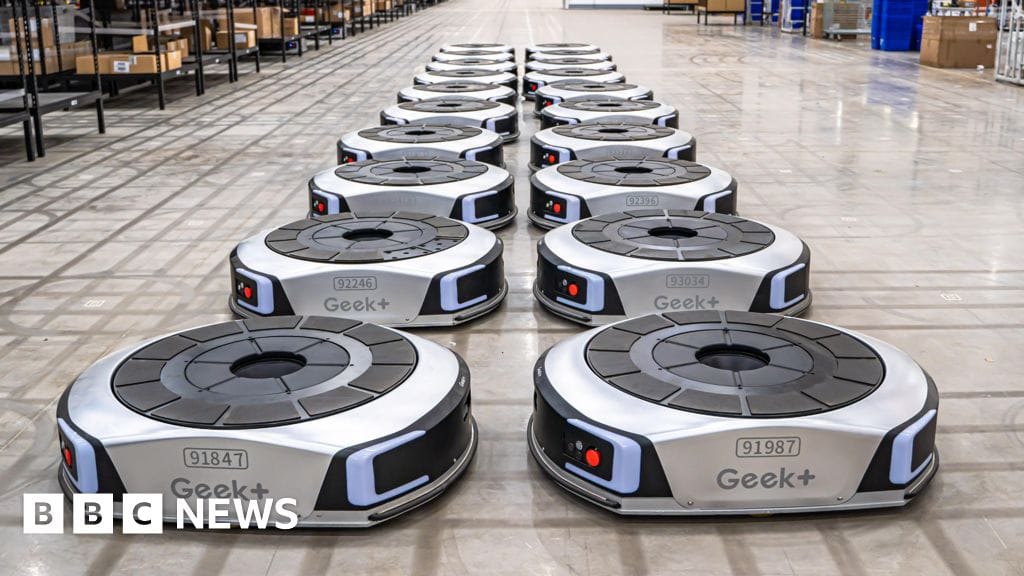
Snapshot: Chinese maker Geek+ now has more than 2,000 of its mobile robots running across 10 UK sites, with Tesco, Asda and Next among the retailers using the fleets to carry shelves to human pickers.
Breakdown:
The squat floor robots glide under a storage rack, lift the whole shelf and bring it to a waiting worker, which lets retailers raise picking speed, pack goods into tighter space and cut errors.
Unlike fixed conveyor automation, these autonomous mobile robots deploy with QR-code floor markers and safety fencing, needing no permanent infrastructure.
Britain is now Geek+'s biggest European market, served through its partner MotionTech, whose account director points to a UK labour shortage as the main driver of demand.
Geek+, which listed in Hong Kong in 2025, is the world's largest supplier of autonomous mobile robots and is now developing humanoids for picking and packing.
Takeaway: The lesson for operators is that the boring robot is the one paying its way. Wheeled movers already clear a return that today's humanoids cannot, which is why the near-term automation case still runs through fleets of simple AMRs rather than a single human-shaped machine. If you run a warehouse, the question is not whether to wait for a humanoid but whether a QR-code-and-fencing deployment can lift throughput on your existing floor within a quarter.
News
Google DeepMind teaches its robot model to use its whole body
Snapshot: Google DeepMind brought whole-body control to its robotics models with Gemini Robotics 2, extending the system from tabletop arm work to full humanoids that can walk, crouch and manipulate at the same time.
Breakdown:
The release is three models: a vision-language-action model, an embodied-reasoning model and an efficient on-device version, aimed at robots that adapt to a new body in a few hours instead of a longer retraining cycle.
It runs across several platforms named by the team, including Apptronik's Apollo 2 humanoid and a Franka dual-arm rig, and lets different robot types collaborate on one task.
Google reports whole-body manipulation success rates spanning roughly 46 to 76 percent across a task suite, with fine-finger jobs ranging from 32 percent on the hardest to 92 percent on the easiest.
The models handle task sequences lasting several minutes with better progress tracking, a step toward chores that take more than a single grab.
Takeaway: For operators the figure that matters is not the peak score but the spread. A model that lands anywhere from a third to nine-tenths of the time is promising in the lab and not yet a line worker, and the honest read is that general-purpose humanoid intelligence is improving fast while still short of a full shift. Track whether these success rates climb on tasks that resemble your own, because that curve, not the demo, will tell you when a general model is ready for a real slot.
▶ Operator's Playbook
Run one column down your robot procurement list this week. For every mobile robot model you own or plan to buy, record whether it already holds an FCC equipment authorization grant and where it was produced under the 48 CFR 25.101 domestic-content test. Models authorized before July 28 stay sellable and serviceable, while new, uncertified foreign models now carry approval risk. That single audit tells you which vendors can ship to a US site today and which are betting on a Conditional Approval that may not arrive.
Morgan Stanleyflagged a "PR problem" as the real barrier to China's humanoid boom, warning that framing robots as worker replacements could cost the industry its social license, even as the bank holds a 50,000-unit shipment forecast for 2026.
China's commerce ministrythreatened countermeasures over the US robot rule, calling it a move that "severely damages" trade relations and urging Washington to withdraw it, weeks before a planned Trump-Xi meeting.
Posco DXis robotizing Korea's steel mills , targeting second-half commercialization of self-operating cranes and ship unloaders and aiming to run 80 percent of one unloader's tasks unmanned.
Hellbenderdoubled its Pittsburgh campus to about 90,000 square feet, claiming the title of the only fully US-owned Tier 1 supplier of physical-AI hardware and pledging more than 500 local jobs.
NC AI and CMES Roboticssigned a physical-AI pact to pair a world model with factory-floor data, aiming squarely at the sim-to-real gap that stalls robots trained only in simulation.
Harper Adams Universityis testing humanoids as the "next stage" in farm automation, arguing a human-shaped machine can be reprogrammed to harvest, plant or prune rather than serving one fixed task.
Compliance toolkit
The EU Machinery Regulation applies from January 20, 2027.
The Robot Safety Documentation Toolkit gives your team all seven compliance documents, ready to fill in.
The biggest robot story of the week was not about what a machine can do. It was about who is allowed to sell one. That is a strange kind of progress, arguing over the paperwork for machines that, by our own count, have barely started working. Maybe that is the real signal. The robots have become important enough to regulate before they have become useful enough to trust.