
Unitree's $17,900 G1 humanoid tears down at MotorTrend
PLUS: Army uses C4 robots to breach enemy positions, NVIDIA gives factory humanoids car-grade safety, and why strawberry colors fool farm robots
Welcome back to your Robot Briefing
MotorTrend just published the first in-depth teardown of China's $17,900 Unitree G1 humanoid, revealing what's inside the machine that has automakers betting billions on factory automation. The sticker price is deceptive. The full software stack costs extra, pushing the real barrier to entry higher for companies testing the waters.
The question isn't whether humanoids will work on assembly lines, but whether the economics pencil out before competitors gain an edge. With Chinese manufacturers undercutting on price and Western automakers racing to catch up, the window for strategic advantage may be narrowing faster than expected.
In today's Robot update:
Inside the $17,900 robot that could change the auto industry
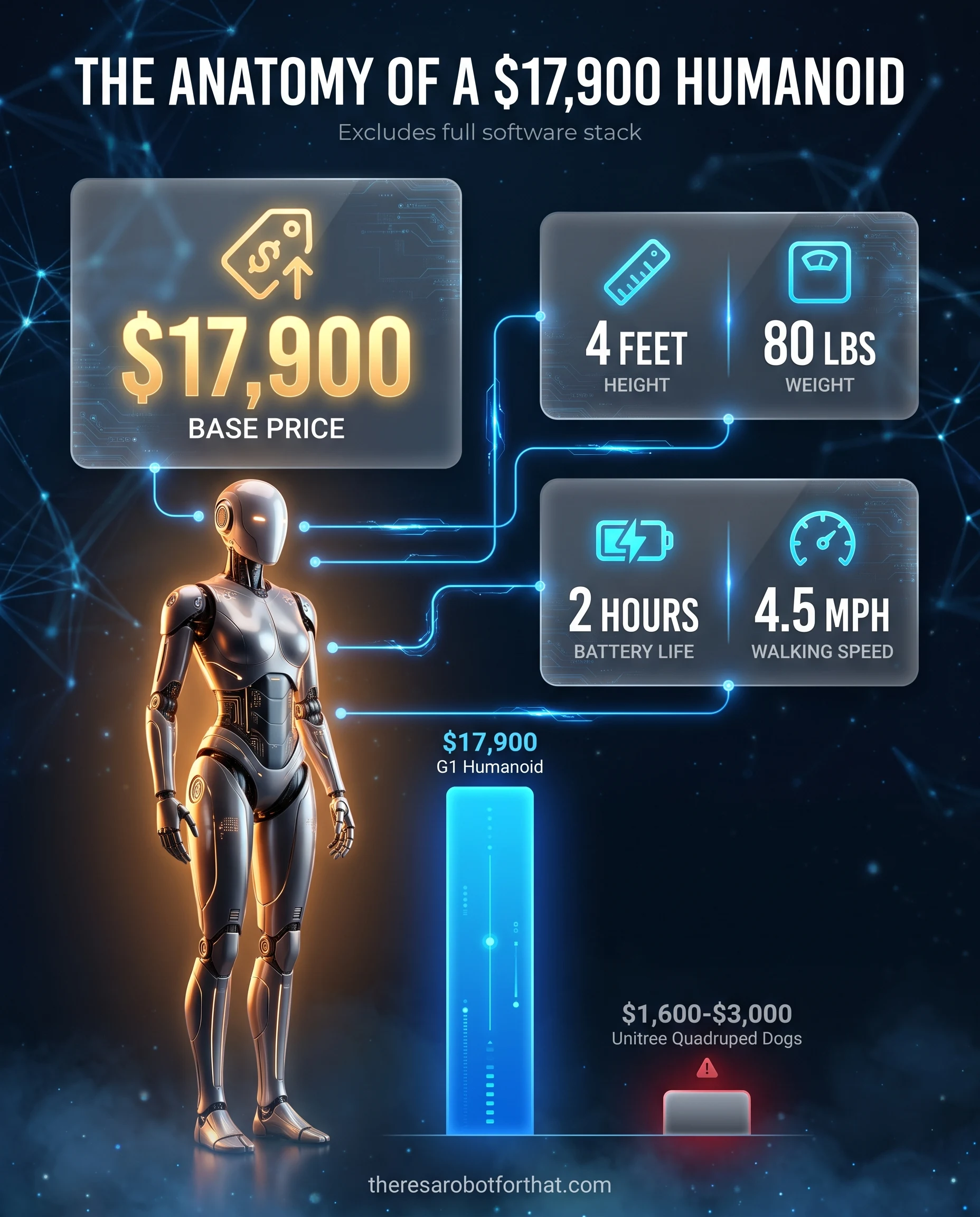
Image Source: There's A Robot For That
Snapshot: MotorTrend conducted the first detailed teardown of China's Unitree G1 humanoid robot, explaining why automakers are pouring billions into humanoid robotics for factory floors long before these machines reach homes. The $17,900 price tag doesn't include the full software development kit, making the real entry point higher for businesses exploring automation.
Breakdown:
Takeaway: The automotive industry's billion-dollar bets on humanoids signal these robots are transitioning from research projects to factory tools, with established robotics companies like Unitree creating a commercial supply chain. Operations leaders should watch automaker deployment results over the next 12-18 months as the clearest indicator of when humanoids become viable for non-automotive manufacturing environments.
US Army clears deadly breach with drones and C4-packed robots before soldiers enter
Snapshot: A US Army company commander at Fort Polk used 25 attack drones and explosive-laden ground robots to destroy fortified enemy positions and obstacles, completing a contested breach operation before riflemen arrived. The April exercise demonstrates how autonomous systems can handle the most dangerous tasks that would traditionally require dozens of soldiers.
Breakdown:
Takeaway: Military adoption of autonomous systems for dangerous, structured tasks provides the clearest real-world validation that robotics can replace humans in high-stakes operations today, not in three years. Industries with hazardous, repeatable work environments, such as mining, construction, and chemical processing, should study these military deployment patterns as proof points for board-level automation discussions.
Factory humanoids get car-grade safety as NVIDIA launches Halos
Snapshot: NVIDIA launched Halos for Robotics, which it calls the first full-stack safety system for humanoid robots and physical AI, adapting the safety architecture it originally built for self-driving cars. Agility Robotics is the first to build it into its Digit humanoid, which already works in warehouses for customers including Amazon, GXO, Schaeffler, and Toyota Motor Manufacturing Canada.
Breakdown:
Takeaway: Safety certification, not raw capability, is becoming the gate that decides when humanoids can work next to people on a production line. Operations leaders running humanoid pilots should treat a vendor's functional-safety architecture and third-party certification path as a primary procurement criterion, because that is what clears internal risk reviews and insurer requirements, not the polish of a demo reel.
Why strawberry colors could be fooling farm robots
Snapshot: University of East Anglia researchers found that much of the color variation agricultural robots see in strawberries comes from camera processing issues rather than actual ripeness differences, potentially causing automated systems to misjudge harvest timing. The research with agri-tech firm Antobot reveals that the "rich red color" indicating ripeness could be camera tricks rather than biological reality.
Breakdown:
Takeaway: Agricultural robotics exposes a broader automation truth: computer vision systems trained in controlled environments often fail when deployed in variable real-world conditions, requiring extensive calibration that delays ROI. Operations leaders evaluating vision-based automation should insist on pilot programs in actual operating conditions rather than vendor demonstrations, as perception accuracy remains the primary bottleneck for quality-dependent tasks.
Other Top Robot Stories
Innodata expanded its physical AI capabilities through new contracts supporting robotics datasets, agent evaluation and model optimization for autonomous machines, positioning the data services firm to benefit from the shift from text-based AI to embodied intelligence across enterprise and federal deployments.
Johns Hopkins deployed a humanoid robot named Sprite for mock sinus surgeries at its Baltimore campus, demonstrating AI-powered surgical assistance that could eventually expand patient access in regions facing surgeon shortages by providing stamina and precision unmatched by human assistants during hours-long procedures.
Unitree appeared in a viral marketing stunt in Chengdu, China, where a G1 humanoid robot was filmed begging for money to "recharge" its two-hour battery, drawing mixed reactions on social media as the latest attention-grabbing demonstration from China's booming humanoid robotics industry.
🤖 Your robotics thought for today:
The Army just blew up obstacles with C4-packed robots, NVIDIA gave factory humanoids car-grade safety certification, and MotorTrend tore down a $17,900 humanoid. But here's what matters: every deployment solved a different problem, whether danger, trust, or cost. The companies winning in robotics aren't building general-purpose machines. They're picking one hard problem and making the economics work.
I'm watching who goes narrow next.
Until Wednesday,
Uli


