
Universal Robots launches AI-powered PolyScope X platform
PLUS: Toyota Canada puts Agility's Digit humanoids on its assembly line, China deploys 10,000 humanoids, and Unitree's G1 summits 20,000-foot volcano

Welcome back to your Robot Briefing
Universal Robots just made physical AI something you can actually buy, not just watch in demos. The company's new PolyScope X platform turns its cobots into AI-powered systems with vision and learning capabilities, available now through its installer network.
The shift from programmable arms to thinking machines raises a critical question: can factory-floor AI deliver ROI fast enough to justify the infrastructure overhaul, or are we still a generation away from plug-and-play intelligence?
In today's Robot update:
Universal Robots ships production-ready physical AI platform
Snapshot: Teradyne Robotics unveiled PolyScope X, a software platform that turns Universal Robots from motion-control tools into AI-ready automation systems with imitation learning, multi-threaded logic control, and factory-deployable vision models. The company claims these physical AI applications are purchasable today through its integrator network.
Breakdown:
Takeaway: Universal Robots is signaling that physical AI has moved from research labs to purchase orders, this isn't a pilot program timeline, it's a "buy it through our channel partners now" message aimed at manufacturers evaluating 2026 automation budgets. The shift from selling robot arms to selling trainable AI platforms represents a fundamental change in how companies will justify and deploy collaborative automation.
Toyota Canada puts Agility's Digit humanoids on the assembly line
Snapshot: Toyota Motor Manufacturing Canada signed an agreement with Agility Robotics to deploy its Digit humanoid robot across its Ontario vehicle assembly plants, moving from a successful one-year pilot with three units to a wider rollout. The robots load and unload totes from an automated tugger, with seven more humanoids set to join the operation.
Breakdown:
Takeaway: This is one of the clearest signs that humanoid robots are crossing from demonstration into routine automotive production, the highest-volume and most cost-sensitive manufacturing there is. Operations leaders weighing humanoids should watch whether Toyota expands past its initial fleet, the real test of whether the economics hold at scale.
China launches plan to deploy 10,000 humanoid robots by year-end
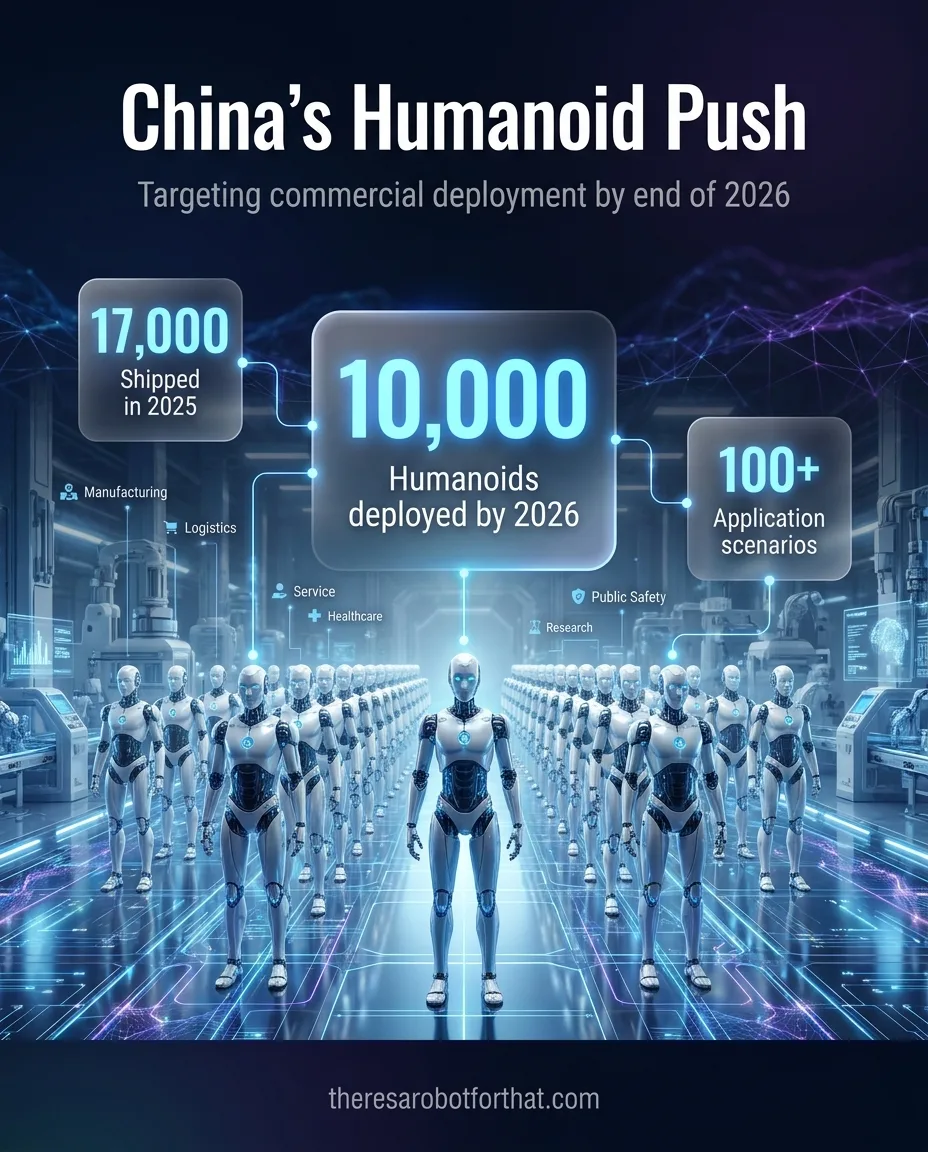
Image Source: There's A Robot For That
Snapshot: China's Ministry of Industry and the State-owned Assets Commission launched a nationwide action plan on June 9 to deploy roughly 10,000 humanoid robots across more than 100 scenarios by the end of 2026, one of the world's most aggressive physical AI commercialization timelines. China shipped about 17,000 humanoid robots in 2025 from more than 140 domestic manufacturers.
Breakdown:
Takeaway: China is treating humanoid deployment as a data collection exercise first and a productivity tool second, the six-month timeline prioritizes accumulating real-world training data over perfect performance. Companies competing in markets where Chinese manufacturers operate should expect rapid iteration cycles and falling unit economics as this installed base generates operational learnings at scale.
Humanoid robot summits 20,000-foot volcano, targets Everest next
Snapshot: A modified Unitree G1 humanoid named Pemba became the first robot of its kind to reach the 20,341-foot summit of Ecuador's Chimborazo volcano, autonomously navigating 16 hours of terrain under 30-degree inclines as preparation for an attempted Mount Everest climb. The robot wore specialized booties and a warming jacket to handle extreme cold and snow.
Breakdown:
Takeaway: This moves humanoid capabilities from controlled factory floors to genuinely unpredictable outdoor environments, terrain variability, weather exposure, and extended operational duration are all deployment barriers for industrial use cases. The demonstration suggests current-generation hardware can handle far more environmental stress than most operations leaders assume, potentially accelerating outdoor applications in mining, infrastructure inspection, and remote site monitoring.
Other Top Robot Stories
Needham initiated coverage of Ceva with a Buy rating and $55 price target, calling the IoT chip designer a "potential play on Physical AI" as autonomous cars, drones and robots require specialized semiconductors beyond compute and memory to interact with the physical world.
AgiBot warned that China's humanoid robotics industry is already showing signs of "involution", particularly in semi-humanoid and entertainment robots, as a state mandate to deploy 10,000 robots by year-end fuels concerns of the same self-destructive price wars plaguing the country's electric vehicle market.
Carbon deployed AI-powered laser weeding robots across California's Salinas Valley, enabling farmers to cut pesticide use by 70% and save $250 per acre, while rival TRIC Robotics patrols fields overnight with UV light to target pests as labor shortages and herbicide-resistant weeds push growers toward automation.
Sony defeated seven professionally ranked table tennis players with its Ace robot between February and April 2026, including former world No. 5 Miu Hirano, marking what the company calls the first demonstration of an autonomous system beating professional athletes under official competition rules.
🤖 Your robotics thought for today:
Universal Robots says you can buy physical AI today through their channel partners. China plans to deploy 10,000 humanoid robots in six months to collect training data. One company is selling intelligence, the other is farming it at scale, and only one of those strategies requires the tech to actually work on day one.
I'm watching which approach ships ROI first.
Until Friday,
Uli


