
Walden Robotics raises $300M for wheeled humanoids
PLUS: BYD's 3-per-home robot vision, Xpeng targets 1,000 humanoids monthly, and Nvidia's new Thor platforms for mass-market bots
Welcome back to your Robot Briefing
A secretive MIT/Toyota spinout just landed $300 million to build AI-powered factory robots that blend humanoid torsos with wheeled bases, one of the largest robotics deals Boston has ever seen. Walden Robotics emerged this year from Toyota Research Institute with machines designed to navigate real manufacturing floors autonomously.
The hybrid design raises a critical question: will partially humanoid robots prove more practical for factories than full bipedal models, or is this just a stepping stone to something more versatile?
In today's Robot update:
Walden Robotics raises $300M for partially humanoid factory robots
Snapshot: $300 million just moved into a secretive MIT/Toyota spinout building AI-powered factory robots that look half-human, half-wheeled platform, one of Boston's largest robotics deals ever. Walden Robotics spun out this year from Toyota Research Institute with technology focused on machines that can operate in real-world manufacturing without direct human control.
Breakdown:
Takeaway: The timing signal matters here: Toyota isn't funding research, it's already running these machines on a factory floor. If you're evaluating automation vendors in the next 18 months, ask whether their robots are operating in paying customer facilities or still collecting pilot program feedback.
BYD operates 200 humanoids, targets three robots per home
Snapshot: Everyone talks about deploying humanoids. BYD already puts them to work across its own factories, aiming to become its own biggest robot customer, and now the Chinese EV giant is building an open platform for factories, dealerships, and eventually consumer homes, with executives floating a vision of three robots per household.
Breakdown:
Takeaway: BYD is solving the "who's actually deploying at scale" question that separates hype from operational reality. The three-per-home vision may be years away, but the factory deployment is happening now. What cost and performance data is BYD learning that Western competitors aren't?
Xpeng targets 1,000 humanoid robots monthly for 2027 showroom rollout
Snapshot: If you run retail operations, this changes your competitive timeline. Xpeng plans to scale its Iron humanoid to over 1,000 units per month by the end of 2026, deploying them as sales assistants across China stores in Q1 2027 before expanding globally.
Breakdown:
Takeaway: Showroom deployment in six months puts tangible pressure on labor models for customer-facing roles. The signal isn't whether humanoids can theoretically work retail. It's whether Xpeng's China rollout demonstrates acceptable customer interaction quality and unit economics that make global expansion viable.
Nvidia launches Jetson Thor T3000 and T2000 for mass-market robotics
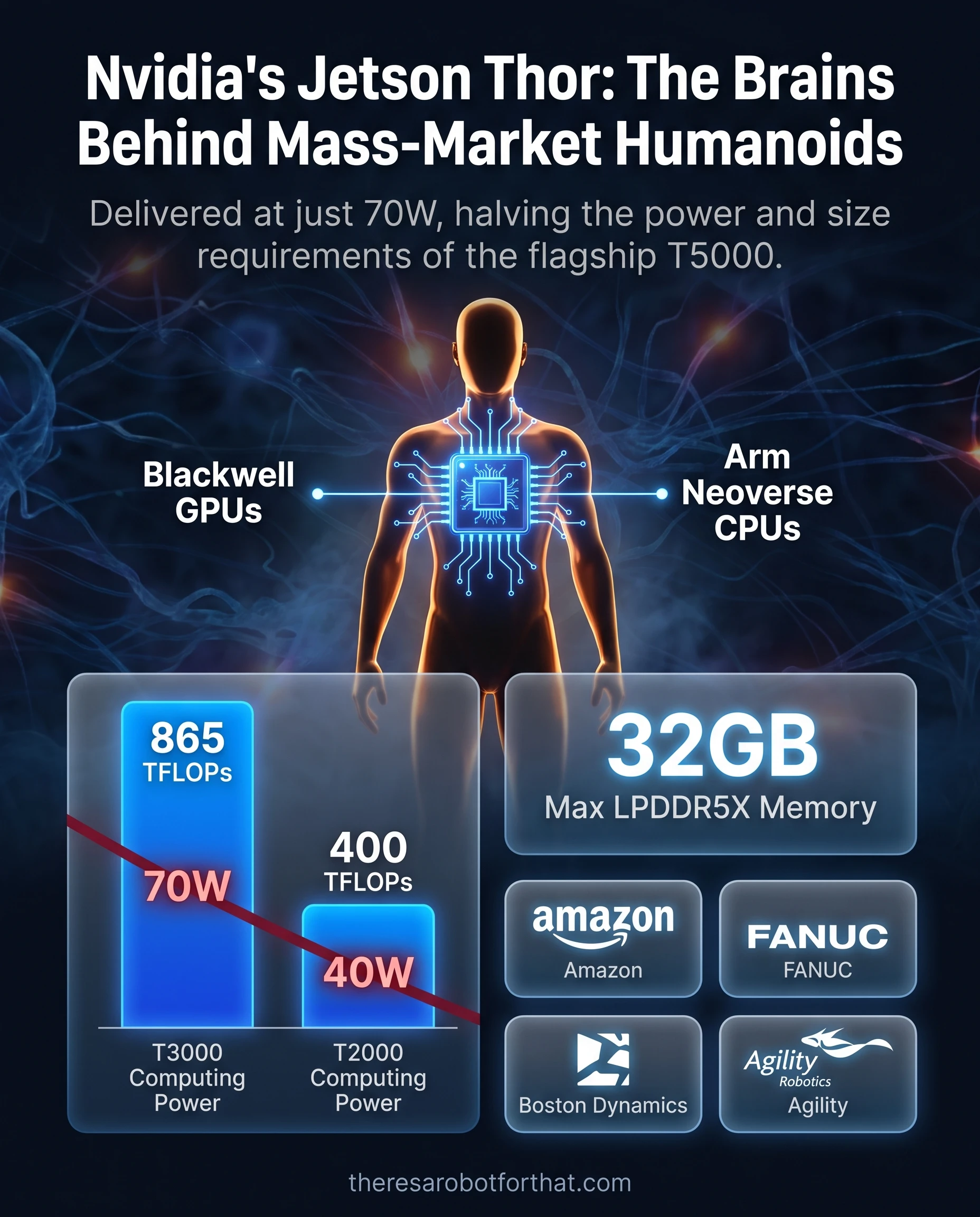
Image Source: There's A Robot For That
Snapshot: Nvidia just laid the computing foundation for mainstream humanoid economics. The new Jetson Thor platforms, T3000 delivering 865 TFLOPs at 70W and T2000 offering 400 TFLOPs at 40W, are already powering robots from Boston Dynamics, Agility Robotics, FANUC, and Amazon Robotics.
Breakdown:
Takeaway: Nvidia is commoditizing the brain of humanoid robots the same way it did for data centers, making performance accessible enough that competition shifts from "can we build it" to "can we deploy it profitably." When FANUC and Amazon share a common compute platform, integration timelines and vendor risk both compress significantly.
Other Top Robot Stories
Agility outlined six policy recommendations to strengthen U.S. humanoid manufacturing, urging policymakers to close the gap on internationally sourced components after McKinsey data showed China controls 90% of permanent magnet capacity critical for robot motors, a supply chain vulnerability that threatens domestic production resilience.
Hyundai faces the car industry's first factory stoppage over humanoid robots after tens of thousands of Korean auto workers launched a partial strike in Ulsan, withholding four hours of labor per day and demanding pre-emptive agreements before Boston Dynamics' Atlas robot can step onto production lines, a dispute estimated to affect 5,000 vehicles and cost over 200 billion won in lost sales.
Nanovel won a €2.5 million European Innovation Council grant to accelerate development of autonomous citrus-harvesting robots using AI and computer vision, with eligibility for up to €4.3 million in additional equity investment as the Israeli AgTech startup prepares large-scale field trials in Spain and Italy ahead of a planned 2028 commercial launch.
GIST established the PAIR-HCI Center inside MIT's Computer Science and Artificial Intelligence Laboratory through a Ministry of Science and ICT-backed overseas cooperation hub, pooling research capabilities from Korea and the U.S. to develop human-centered physical AI interaction technology that people can trust and use through 2030.
The EU Machinery Regulation applies from January 20, 2027. The Robot Safety Documentation Toolkit gives your team all seven compliance documents ready to fill in.
🤖 Your robotics thought for today:
BYD runs 200 humanoids in production right now. Xpeng is building a factory to hit 1,000 units monthly. Meanwhile, Boston just celebrated a $300M round for robots that aren't even fully humanoid. The deployment gap between pilot programs and operational scale keeps widening — and it's not widening in favor of Western startups.
I'm watching whether Walden's hybrid approach proves I'm wrong about full humanoids.
Enjoy your weekend,
Uli


